 Globe Quest
 Human Quest · LearningSign in
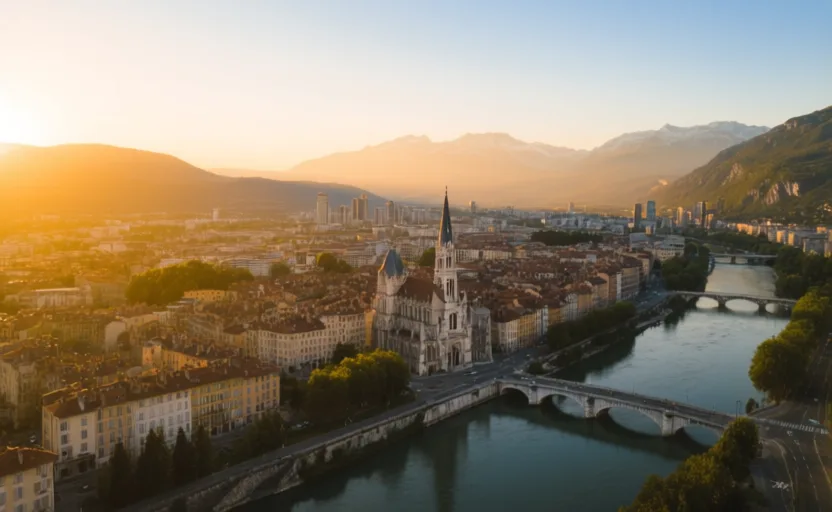 Grenoble · AI city illustration · Artistic impression
City · Europe
Grenoble
Saved in this browser — no account needed. Sign in later and it comes with you.
Where it is
Mountains close in on Grenoble from three sides: the Chartreuse to the north, the Vercors to the south and west, the Belledonne range to the east. The city itself is almost perfectly flat, because it is built on the alluvial plain where the Drac runs into the Isère, at about 214 metres. Only a few dozen houses climb the slopes of the Bastille hill. The setting gives the climate a continental streak: winter nights are colder than anywhere else in lowland France, with a record low of -27.1 °C, and rainfall is heavy for France, although the number of rainy days is moderate.
The land and water around it
The Isère and Drac confluenceriver
The city sits on the plain where the Drac meets the Isère, which is why it is flat and why bridges mattered from the start: the first Roman village stood by one across the Isère.
The ring of rangesmountains
The Chartreuse, Vercors and Belledonne enclose the city. Around twenty ski resorts of all sizes lie within reach, the nearest about fifteen minutes away by car.
The Bastille hillmountains
The only slope on which the city has built houses, an outlier of the Chartreuse above the plain.
Its history, in short
The first mention, from 43 BC, is of Cularo, a village of the Allobroges, a Gallic tribe, beside a bridge over the Isère. In 381 the emperor Gratian made it a city, and it was renamed Gratianopolis, which wore down over the centuries to Grenoble. Bishops held political power over it from the late 4th century. In the 11th century the Counts of Albon chose it as the capital of their scattered lands and, once they took the title of Dauphin, it became the capital of the Dauphiné. As a border city close to Savoy, then part of the Holy Roman Empire, it became a garrison and parliament town. Its economy grew in waves: gloves in the 18th century, hydroelectric power from the late 19th, and after 1945 a postwar boom that included the 1968 Winter Olympics. The Grenoble model of research and industry dates from 1955, when Louis Néel founded the nuclear studies centre, and today one in five inhabitants works in research, technology or innovation.
Timeline
Dates are shown on a timeline rather than as changing shapes on the map. The globe draws modern boundaries only, and tinting a modern outline to stand for a historical one would state something we cannot source.
Classical world
43 BC
Cularo
The first references to the site describe a village of the Allobroges near a bridge over the Isère.
Well attestedWikipedia286
A wall around the town
As the late Roman Empire grows less secure, the small town is given a strong defensive wall.
Well attestedWikipedia381
Gratianopolis
The emperor Gratian, pleased by his welcome, makes the village a Roman city. The name “city of Gratian” gradually becomes Grenoble.
Well attestedWikipedia
Post-classical world
11th century
Capital of the Dauphiné
The Counts of Albon make Grenoble the capital of their patchwork of territories. They share authority over the city with the bishop.
Approximate dateWikipedia
Early modern & oceanic
7 June 1788
The Day of the Tiles
Townspeople attack the troops of Louis XVI to stop the expulsion of the city's notables, which would have endangered its prosperity.
Well attestedWikipedia
Industrial & imperial
1815
Napoleon returns from Elba
On his way back from Elba, Napoleon passes near Grenoble at Laffrey, where he meets a Royalist regiment of Louis XVIII's army.
Well attestedWikipedia1925
The hydropower exhibition
An International Exhibition of Hydropower and Tourism draws more than a million visitors, showing how far electricity from mountain rivers had reshaped the city's economy.
Well attestedWikipedia
Contemporary
1968
The Winter Olympics
Grenoble hosts the X Olympic Winter Games, which brings an airport, motorways, a new town hall and a new station, and helps develop ski resorts such as Chamrousse.
Well attestedWikipedia
Places that carry meaning
The Bouchayer-Viallet siteIndustrial; converted since the late 20th century
A former factory that stands for the city's industrial past, now mixing housing, sport, a music venue, an arts centre and technology firms.
The De Bonne eco-district2009
Former barracks redeveloped as sustainable housing and named in 2009 the best eco-neighbourhood in France, and the city later held the title of European Green Capital in 2022.
Languages here
Places are usually multilingual. This lists what is actually spoken, not one language per border.
FrenchRomance family
The official language and the daily language of the city.
French is the language of schools, administration and the local research economy.
EnglishGermanic family
A working language for part of the research and industrial community.
Employers such as HP and Caterpillar have drawn American and British workers, so the region is home to the largest English-speaking community in France outside Paris, with its own church and an international school.
ItalianRomance family
The language of an earlier wave of industrial workers.
During the First World War, hydroelectric and electrochemical factories drew many Italian workers, who settled especially in the Saint-Laurent neighbourhood.
Learn the language here
- 1Understand which languages are spoken hereGrenoble is multilingual. Start with which languages are used, by whom, and for what — the phrase list only covers one of them.Written by Globe Quest
- 2Learn 12 phrasesCurated everyday phrases for Grenoble, with audio and a written form.Written by Globe Quest
- 3Say them out loudSpeaking practice with pronunciation feedback, one phrase at a time.Globe Quest material, your own additions
- 4Come back to themSpaced review, so what you learned this week is still there next month.Written by Globe Quest
Check yourself
Where does the name Grenoble come from?
From Gratianopolis, the Roman name honouring the emperor Gratian
In 381 Cularo took the name Gratianopolis, meaning “city of Gratian”, and regular sound changes turned it into Graignovol and then Grenoble.
Why is Grenoble so flat despite the surrounding mountains?
It is built on the alluvial plain where the Drac meets the Isère
Almost the whole city stands on the river plain at about 214 metres, with only a few houses on the slopes of the Bastille hill.
Worth arguing about
- A city enclosed by mountains has repeatedly been a place for industry, hydropower and research. Does that geography make innovation more likely?
- Grenoble claims to be the capital of the Alps but is a flat city. What does a mountain capital owe to the mountains it cannot see in the street plan?
Sources
- Wikipedia · GrenobleWikipedia · encyclopedia · checked 2026-11-24
- Wikipedia · FranceWikipedia · encyclopedia · checked 2026-11-24
Reviewed by Globe Quest editorial on 2026-11-24. Drafted with AI assistance and checked against the sources above before publication.