 Globe Quest
 Human Quest · LearningSign in
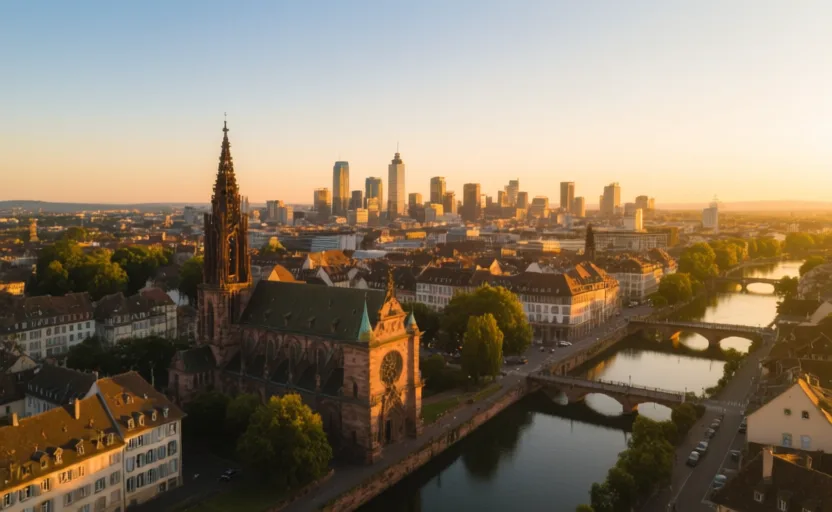 Strasbourg · AI city illustration · Artistic impression
City · Europe
Strasbourg
Saved in this browser — no account needed. Sign in later and it comes with you.
Where it is
Strasbourg is France's frontier on the Rhine: the river forms the eastern edge of the modern city, and on the far bank stands the German town of Kehl. The old core is a different watercourse altogether, the Ill, which runs parallel to the Rhine about 4 kilometres to the west and wraps the Grande Île. The plain between the two rivers is the Upper Rhine Plain, with the Vosges about 20 kilometres to the west and the Black Forest 25 to the east. That corridor carries river traffic, roads and railways north and south. Shelter from the wind makes the air stagnant, and the climate is moving from oceanic towards humid subtropical.
The land and water around it
The Rhineriver
The river forms the border with Germany and is the reason for the port of Strasbourg, the second largest on the Rhine after Duisburg and the second largest river port in France. Its bridge was used repeatedly by imperial armies, and that is one of the reasons Louis XIV wanted the city.
The Ill and the Grande Îleriver
The river Ill splits around an island that forms the historic centre. Several artificial waterways now connect it with the Rhine inside the city.
The Upper Rhine Plainplain
A fertile lowland between the Vosges and the Black Forest, inhabited since the Middle Palaeolithic, with towns bound together by the north–south valley route.
Its history, in short
The Romans founded a camp here, Argentoratum, first recorded in 12 BC, an origin the city marked with a 2,000-year anniversary in 1988. From 362 to 1262 the bishops governed it, until the citizens rose against them and made Strasbourg a free imperial city of the Holy Roman Empire. It became a printing centre, a centre of the Reformation and the seat of a university from 1538,. Louis XIV's army took it in 1681 without a fight, but its language stayed overwhelmingly German; observers of the day estimated that only one inhabitant in a hundred spoke French. After the Franco-Prussian War it was German from 1871 to 1918, French again until the German annexation of 1940, and French since its liberation in 1944. Since 1949 it has been the seat of European institutions, among them the Council of Europe and the European Parliament, and it is a symbol of Franco-German reconciliation.
Timeline
Dates are shown on a timeline rather than as changing shapes on the map. The globe draws modern boundaries only, and tinting a modern outline to stand for a historical one would state something we cannot source.
Classical world
12 BC
Argentoratum
A Roman camp is first mentioned. Its Gaulish name combined the words for silver and for a fortified enclosure.
Well attestedWikipedia
Post-classical world
Early modern & oceanic
1538
The university
The university is established, in a city that was also one of the first centres of printing and a key place of the Protestant Reformation.
Well attestedWikipedia30 September 1681
Annexed by Louis XIV
French forces surround the city and march in unopposed. The annexation is recognised in the Treaty of Ryswick in 1697, and Strasbourg and Alsace are spared the religious intolerance applied elsewhere in France.
Well attestedWikipedia
Industrial & imperial
1871–1918
Part of the German Empire
After the Franco-Prussian War the city becomes part of the Imperial Territory of Alsace–Lorraine. The Neustadt, built in this period, was added to the UNESCO site in 2017.
1940–1944
German annexation
Captured in June 1940, it is annexed into the Gau Baden-Elsaß. The 2nd French Armoured Division under General Leclerc liberates it in November 1944.
Well attestedWikipedia
Contemporary
1949
A European seat
The Council of Europe and the International Commission on Civil Status establish themselves here. The European Parliament and others follow.
Well attestedWikipedia
Places that carry meaning
Grande Île and NeustadtRoman to early 20th century
The old island centre was classified by UNESCO in 1988 and the German-built Neustadt was added in 2017. Together they form an urban ensemble shaped by both French and Germanic influence, centred on the cathedral.
Strasbourg CathedralGothic
A Gothic masterpiece that blends Romanesque art of the east with the Gothic of the kingdom of France, and whose spire drew on Prague. After 1681 it was taken from the Lutherans and returned to the Catholics.
The ChristkindelsmärikSince 1570
A Christmas market held from late November through December that dates from 1570, an example of the Germanic side of the city's culture.
Languages here
Places are usually multilingual. This lists what is actually spoken, not one language per border.
FrenchRomance family
The official language and today's language of daily life.
French became the official language in a slow process after 1681, and especially after the Revolution demanded that Alsatians give up German for French.
AlsatianGermanic family
The traditional German dialect of the region.
The city's name in Lower Alsatian is Strossburi. Alsatian is among the regional languages of France.
GermanGermanic family
The historic written language and the language across the border.
The German Lutheran university lasted until the French Revolution, and its students included Goethe and Herder. The Strasbourg-Ortenau Eurodistrict now spans the Rhine into Germany.
Learn the language here
- 1Understand which languages are spoken hereStrasbourg is multilingual. Start with which languages are used, by whom, and for what — the phrase list only covers one of them.Written by Globe Quest
- 2Learn 11 phrasesCurated everyday phrases for Strasbourg, with audio and a written form.Written by Globe Quest
- 3Say them out loudSpeaking practice with pronunciation feedback, one phrase at a time.Globe Quest material, your own additions
- 4Come back to themSpaced review, so what you learned this week is still there next month.Written by Globe Quest
Check yourself
Which river wraps around Strasbourg's historic island?
The Ill
The Rhine runs on the eastern edge of the modern city, but the historic centre lies on the Grande Île in the Ill, about 4 kilometres to the west.
What language did most people in Strasbourg speak when Louis XIV annexed it?
German
Contemporary observers reckoned that only about 1 per cent of the population spoke French. The university stayed German-speaking until the Revolution.
Worth arguing about
- Strasbourg changed nationality four times between 1870 and 1945. What does it mean to belong to a city whose language and flag were rewritten within a lifetime?
- The city hosts European institutions yet is not a national capital. Does a seat for a continent need a place with a divided past?
Sources
- Wikipedia · StrasbourgWikipedia · encyclopedia · checked 2026-11-24
- Wikipedia · History of StrasbourgWikipedia · encyclopedia · checked 2026-11-24
- UNESCO · Strasbourg, Grande-Île and NeustadtUNESCO World Heritage Centre · intergovernmental · checked 2026-11-24
- Wikipedia · FranceWikipedia · encyclopedia · checked 2026-11-24
Reviewed by Globe Quest editorial on 2026-11-24. Drafted with AI assistance and checked against the sources above before publication.