 Globe Quest
 Human Quest · LearningSign in
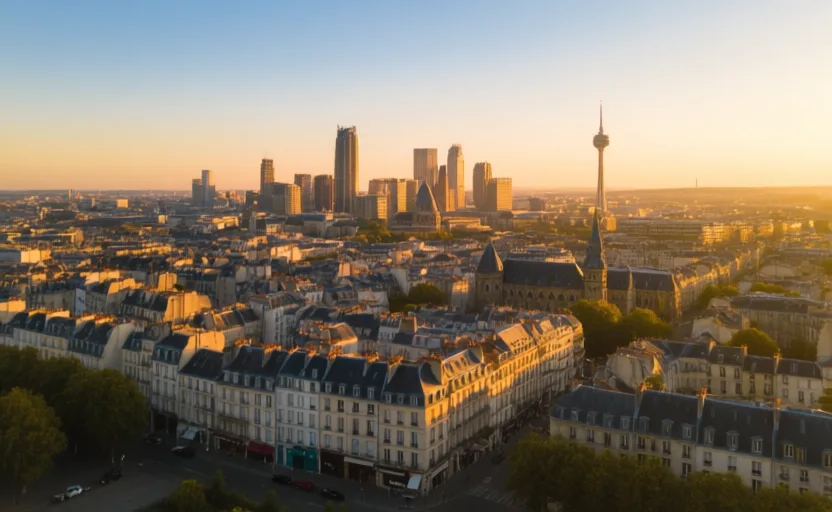 Lille · AI city illustration · Artistic impression
City · Europe
Lille
Saved in this browser — no account needed. Sign in later and it comes with you.
Where it is
Lille lies on the flat plain of French Flanders, on the little River Deûle, close to the Belgian frontier. Its name began as a description: the Old French form meant “the island”, and the Dutch name Rijsel preserves the same idea, a dry spot among low, wet ground. The municipal territory is small, 35 square kilometres, but around it spreads a conurbation with Roubaix, Tourcoing and Villeneuve-d'Ascq and, across the border, Mouscron, Kortrijk and Tournai. The climate is temperate and oceanic, with rain through the year and winters that can dip below freezing.
The land and water around it
The Deûle and the Flanders plainplain
A low river crossing in a flat landscape gave the early settlement its “island” name. The flat terrain also left the region open to invading armies, one reason that Lille was a garrison town ringed by a citadel.
The cross-border conurbationplain
Lille forms one built-up area with Mouscron, Kortrijk, Tournai and Menin in Belgium. In 2008 they formed a cross-border body with Lille, the Eurometropolis, which was the first of its kind in Europe and has more than 2.1 million inhabitants.
Its history, in short
Archaeology shows people here by about 2000 BC, but Lille enters documents in the 11th century, when Baldwin V of Flanders gave a charter to its collegiate church in 1066. A cloth fair made it known from the 12th century. For six hundred years afterwards the town changed hands: the Burgundian state, the Holy Roman Empire and the Spanish Netherlands each held it, and it was repeatedly besieged. Louis XIV took it in 1667 and Vauban enlarged its fortifications, which then confined the textile boom of the 19th century until Napoleon III annexed neighbouring communes in 1858. Mills made it a great industrial capital, but with sharp inequality: in 1828 more than 3,600 people lived in cellars. Occupation in 1914 and 1940 and the decline of coal and textiles after the 1960s followed. Reinvention began in the 1980s: the VAL automated metro in 1983, the Euralille business district from 1988, and high-speed trains to Paris and, from 1994, the Eurostar. The metropolis it leads now ranks second to Paris for corporate headquarters.
Timeline
Dates are shown on a timeline rather than as changing shapes on the map. The globe draws modern boundaries only, and tinting a modern outline to stand for a historical one would state something we cannot source.
Post-classical world
1066
Baldwin V's charter
Baldwin V, count of Flanders, grants a charter to the new collegiate church of Saint-Pierre, the first firm point in the city's documented history.
Well attestedWikipedia12th century
The cloth fair
The fame of Lille's cloth fair begins to grow, and in 1144 the parish of Saint-Sauveur is formed.
Approximate dateWikipedia
Early modern & oceanic
1555–1668
Spanish Habsburg rule
After the Low Countries pass to Philip II of Spain, Lille stays under Spanish Habsburg rule until 1668, in a period of textile boom, religious conflict and plague.
Well attestedWikipedia1667
Louis XIV's conquest
The city is attached to the kingdom of France and enlarged by Vauban. Its ramparts later become a constraint on growth.
1792
The Austrian siege
Austrian artillery destroys many houses and the main church, but the city does not surrender and the army leaves after eight days. A column raised in 1842 on the main square, dedicated to the Goddess, commemorates the resistance.
Well attestedWikipedia
Industrial & imperial
1858
Annexation of neighbouring communes
An imperial decree adds Fives, Wazemmes, Moulins and Esquermes to Lille so that the city can extend its walls and house its textile workforce.
Well attestedWikipedia1914–1918
German occupation
After a ten-day siege and shelling that destroys 882 apartment and office blocks, Lille is occupied from 13 October 1914. It is liberated on 17 October 1918.
Well attestedWikipedia
Contemporary
1994
Eurostar and Euralille
The Eurostar and the TGV make Lille reachable from the major cities of Europe, and the new Euralille business district, begun in 1988, reshapes the centre.
Well attestedWikipedia
Places that carry meaning
Old Lille17th century
The old centre with red brick town houses, paved pedestrian streets and the Grand'Place at its heart.
The belfry of the Hôtel de VilleListed 2005
One of 23 belfries across northern France placed on the World Heritage List in July 2005 for their architecture and what they say about the rise of municipal power in Europe.
The citadelFrom the 17th century
The fortress that marks Lille as a garrison town, built after the French conquest and enlarged by Vauban.
Languages here
Places are usually multilingual. This lists what is actually spoken, not one language per border.
FrenchRomance family
The official language and the daily language of the city.
French is the language of administration and schooling across the metropolis, which crosses into Belgium at several points.
Dutch (Flemish)Germanic family
The historic language of Flanders, and a regional language in France.
In the 8th century people in this area spoke Old Low Franconian, and the Dutch name Rijsel is still used. Flemish, a Dutch dialect, is among the regional languages of France, though Lille belongs to Romance Flanders, outside the area where Flemish dialects are spoken.
Learn the language here
- 1Understand which languages are spoken hereLille is multilingual. Start with which languages are used, by whom, and for what — the phrase list only covers one of them.Written by Globe Quest
- 2Learn 11 phrasesCurated everyday phrases for Lille, with audio and a written form.Written by Globe Quest
- 3Say them out loudSpeaking practice with pronunciation feedback, one phrase at a time.Globe Quest material, your own additions
- 4Come back to themSpaced review, so what you learned this week is still there next month.Written by Globe Quest
Check yourself
What does the name of Lille originally refer to?
An island
The Old French form meant “the island”, descended from Latin insula, and the Dutch name Rijsel comes from the same idea, a small island rising from low ground.
Why did Napoleon III annex neighbouring communes to Lille in 1858?
To relieve a town too cramped within its ramparts for a large textile industry
Vauban's two-century-old fortifications boxed the city in. The annexation of Fives, Wazemmes, Moulins and Esquermes let it extend its walls and house its mills.
Worth arguing about
- Lille has been Burgundian, Spanish, Austrian-besieged and French within a few centuries. What does a border city keep from each?
- A metropolitan area that crosses a national frontier now has formal cooperation with its Belgian neighbours. Does it make the border matter less?
Sources
- Wikipedia · LilleWikipedia · encyclopedia · checked 2026-11-24
- Wikipedia · History of LilleWikipedia · encyclopedia · checked 2026-11-24
- Wikipedia · FranceWikipedia · encyclopedia · checked 2026-11-24
Reviewed by Globe Quest editorial on 2026-11-24. Drafted with AI assistance and checked against the sources above before publication.