 Globe Quest
 Human Quest · LearningSign in
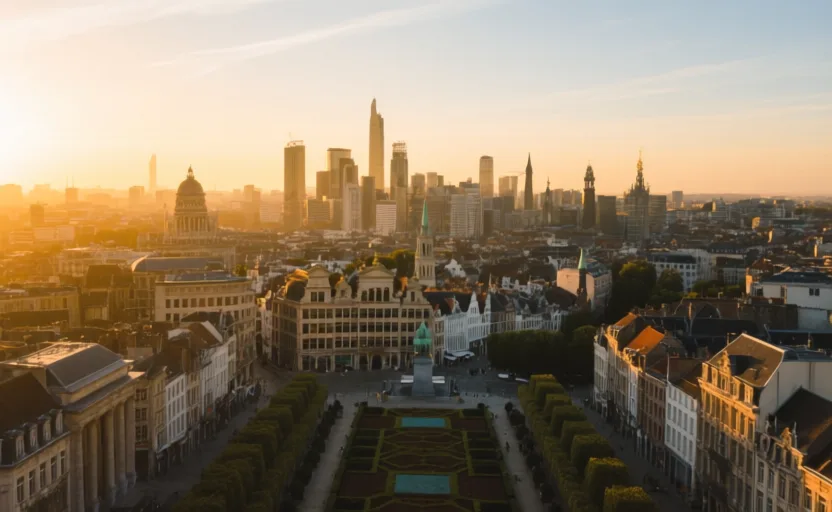 Brussels · AI city illustration · Artistic impression
City · Europe
Brussels
Saved in this browser — no account needed. Sign in later and it comes with you.
Where it is
The old town grew in a marshy valley of the Senne, a small river that is now almost entirely covered over, with princely quarters on the slopes above it. The ground rises from the central boulevards, about 15 metres above sea level, to the Sonian Forest on the south-eastern edge, where the region’s highest point reaches 127.5 metres. The Brabantian plateau around it is open and gently folded, and the climate is oceanic: roughly 135 rainy days a year and little snow. The Brussels-Capital Region covers 162 square kilometres but forms a bilingual island inside Flanders, with Wallonia less than 4 kilometres to the south.
The land and water around it
The Senne valleyvalley
The river cuts the region from east to west and was the reason for the original settlement: a landing place for grain and goods. Marshes and floods pushed the upper town onto the slopes, where the Coudenberg and the Sablon stood safe from high water, and the marshes were later drained for expansion. The river is now almost entirely culverted.
The Sonian Forestforest
A large wood on the south-eastern side of the region that holds the highest ground, and has been settled at its edges since Neolithic farmers cleared land there.
Its history, in short
Legend has the city begin with a chapel on an island in the Senne around 580; the traditional founding date is 979, when relics of Saint Gudula were moved there. Recent research points instead to a farming community that grew fast from the 8th century and, by about 1015, a river port on the Senne. The counts of Leuven took the area around the year 1000, and the city prospered as a textile and trade town on the route between Bruges, Ghent and Cologne, with a first wall in the early 13th century and a second between 1356 and 1383. Burgundian and Habsburg rulers made it a princely capital. Louis XIV’s artillery wrecked the centre in 1695, and the guild houses of the Grand-Place were rebuilt within a few years. The 1830 revolution began here, and the city became the capital of a new kingdom. In the 20th century it hosted three world’s fairs and after the Second World War became the home of international institutions, while its language shifted from Dutch to French.
Timeline
Dates are shown on a timeline rather than as changing shapes on the map. The globe draws modern boundaries only, and tinting a modern outline to stand for a historical one would state something we cannot source.
Post-classical world
c. 580
Saint Gaugericus’ chapel
According to local legend, the settlement begins when Saint Gaugericus builds a chapel on an island in the Senne.
Local legend; the earliest history of the city is unclear, and the first recorded reference to the place, as Brosella, dates from 695
979
The traditional founding
Charles, Duke of Lower Lorraine, moves the relics of Saint Gudula to Saint Gaugericus’ chapel. Current research treats the story of a castrum built by Charles as resting on later and less reliable sources.
The traditional narrative of the founding, against modern research that sees gradual growth from an 8th-century farming community
c. 1000
The counts of Leuven
Lambert I, Count of Leuven, gains the county of Brussels by marriage. In 1183 his successors become Dukes of Brabant, within the Holy Roman Empire rather than as vassals of the French king.
Approximate dateWikipedia1356–1383
The second walls
A second ring of walls is built to let the town expand beyond the first, put up in the early 13th century. The Halle Gate is one of the few remains.
Well attestedWikipedia
Early modern & oceanic
1695
Bombardment by Louis XIV’s army
French artillery destroys the heart of the medieval city in three days. The guilds and magistrates rebuild the Grand-Place in a short campaign that kept its earlier look, instead of adopting a new style.
Well attestedUNESCO World Heritage Centre
Industrial & imperial
1830
The revolution begins
A night at the opera, a staging of Auber’s La Muette de Portici in the Royal Theatre of La Monnaie, sparks the Belgian Revolution. The city becomes the capital of the new nation.
Well attestedWikipedia1893–1895
Horta’s town houses
Victor Horta designs Hotel Tassel (1893), Hotel Solvay (1894) and Hotel van Eetvelde (1895), with open plans and visible steel and glass, which are early monuments of Art Nouveau.
Well attestedUNESCO World Heritage Centre
Contemporary
18 June 1989
Brussels-Capital Region
After a constitutional reform in 1988, Brussels becomes one of the three regions of Belgium, officially bilingual in French and Dutch.
Well attestedWikipedia
Places that carry meaning
Grand-Place / Grote MarktRebuilt after 1695
A cobbled market square framed by the early 15th-century Gothic city hall, the King’s House and a row of Baroque guild houses. UNESCO inscribes it as an unusually coherent restoration after the 1695 bombardment.
Major Town Houses of Victor Horta1893–1895
Four houses in Brussels listed together as the highest expression of early Art Nouveau: the Hotel Tassel, Hotel Solvay, Hotel van Eetvelde and Horta’s own house and workshop.
Cathedral of St Michael and St GudulaFrom 1225
A Brabantine Gothic church that replaced an older Romanesque one and still marks the central skyline. Charles V was crowned King of Spain there.
The Palace of Justice19th century
Designed by Joseph Poelaert in an eclectic style, the building is reputed to be the largest constructed in the 19th century.
Languages here
Places are usually multilingual. This lists what is actually spoken, not one language per border.
FrenchRomance family
The majority language and lingua franca of the city.
French overtook Dutch from the late 19th century as the language of the courts, army, education and the press, and so of social advancement. Assimilation of the local Flemish population and immigration from France and Wallonia amplified the shift.
DutchGermanic family
The historic language of the city, now co-official.
In earlier centuries people here spoke Dutch, in a Brabantian dialect whose Brusselian form is also known as Marollian. The region has been officially bilingual since 1989.
English and migrant languagesGermanic family
Widely spoken by expatriates, officials and newer migrants.
Brussels is described as increasingly multilingual, with English widely spoken alongside the languages of migrants from Southern and Eastern Europe and Africa.
Learn the language here
- 1Understand which languages are spoken hereBrussels is multilingual. Start with which languages are used, by whom, and for what — the phrase list only covers one of them.Written by Globe Quest
- 2Learn 11 phrasesCurated everyday phrases for Brussels, with audio and a written form.Written by Globe Quest
- 3Say them out loudSpeaking practice with pronunciation feedback, one phrase at a time.Globe Quest material, your own additions
- 4Come back to themSpaced review, so what you learned this week is still there next month.Written by Globe Quest
Check yourself
Why does the Grand-Place look so uniform despite being medieval in origin?
It was rebuilt within a few years after French artillery destroyed it in 1695
Louis XIV’s army destroyed the medieval centre in three days. The guilds and magistrates restored it quickly, in a coherent Baroque and Gothic ensemble, instead of rebuilding in a new style.
How has the main language of Brussels changed?
From Dutch to French from the late 19th century
Dutch could not compete with French as the language of administration and social mobility, so the Brabantian-speaking population shifted to French.
Worth arguing about
- A city can be a national capital, a regional capital for two language communities and the seat of European institutions at once. Whose city is it?
- The city rebuilt the Grand-Place in 1695 to look like what was lost, yet its founding date, 979, may be a later story. How much does an origin story matter to a city?
What we have not established
These are open questions, listed rather than filled in. We would rather show a gap than a plausible guess.
When and how was Brussels really founded?
The traditional date of 979 rests on later, less reliable sources, while archaeology points to gradual growth from the 8th century and a first reliable mention around 1015–1020. The two accounts have not been reconciled.
Sources
- Wikipedia · BrusselsWikipedia · encyclopedia · checked 2026-11-24
- Wikipedia · History of BrusselsWikipedia · encyclopedia · checked 2026-11-24
- UNESCO · La Grand-Place, BrusselsUNESCO World Heritage Centre · intergovernmental · checked 2026-11-24
- UNESCO · Major Town Houses of the Architect Victor Horta (Brussels)UNESCO World Heritage Centre · intergovernmental · checked 2026-11-24
Reviewed by Globe Quest editorial on 2026-11-24. Drafted with AI assistance and checked against the sources above before publication.