 Globe Quest
 Human Quest · LearningSign in
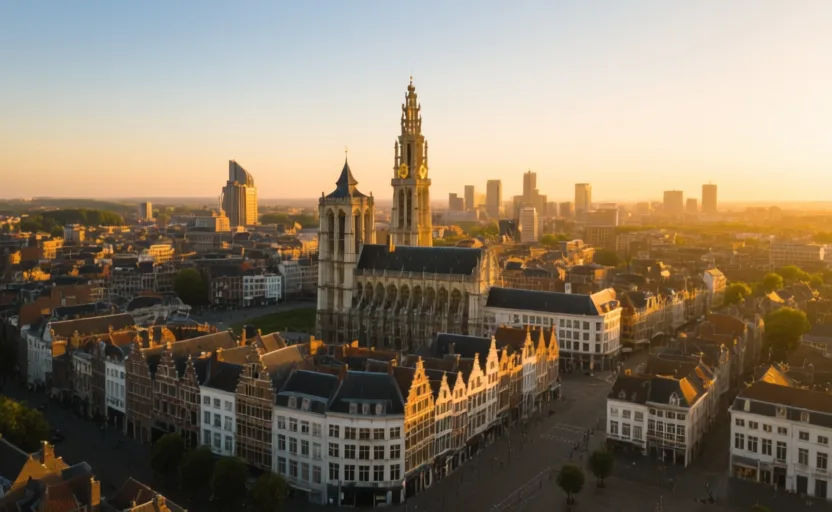 Antwerp · AI city illustration · Artistic impression
City · Europe
Antwerp
Also known as Antwerpen, Anvers
Saved in this browser — no account needed. Sign in later and it comes with you.
Where it is
A port city far from the open sea, Antwerp lies on the right bank of the Scheldt, where the river widens into the Westerschelde estuary on its way to the North Sea. It is about 40 kilometres north of Brussels and 15 kilometres from the Dutch border, on low ground with a mild, oceanic climate that swings only between about 4 and 19 degrees on average through the year. The municipality is large, 208 square kilometres, because it swallowed the villages around it and then the port docks to the north. Its whole existence depends on the river being navigable.
The land and water around it
The Scheldt and its estuaryestuary
The river runs through the city and, via the Westerschelde estuary, links it to the North Sea. Control of the river decided Antwerp’s fortunes: when it was closed to navigation in 1648 the port’s trade was destroyed, and it was reopened only in 1863.
The silted Zwinharbour
Bruges lost its sea access as the Zwin channel silted up, and Antwerp inherited the trade, along with the foreign trading houses that moved there at the end of the 15th century.
Its history, in short
A small Frankish river settlement, Antwerp became a border margraviate of the Holy Roman Empire in 980, facing the county of Flanders across the Scheldt. Its great age began around 1500, when the silting of the Zwin and the decline of Bruges moved the foreign merchant houses here. Portuguese ships brought Asian spices, English cloth came in, and a purpose-built exchange opened in 1531. The population doubled in seven decades. Religious war ended it: Spanish soldiers sacked the city in 1576, and after a long siege in 1585 its Protestant merchants were given two years to leave, most for the northern Netherlands, where Amsterdam took over as the trading centre. The 1648 peace closed the Scheldt to shipping and the city sank until the river reopened in 1863, falling below 40,000 people by 1800 before Napoleon had new docks built. Since then Antwerp has regained its place as a major European port, and also as a centre of diamond cutting and trading, with communities from many countries behind it.
Timeline
Dates are shown on a timeline rather than as changing shapes on the map. The globe draws modern boundaries only, and tinting a modern outline to stand for a historical one would state something we cannot source.
Post-classical world
980
A margraviate on the Scheldt
Emperor Otto II makes Antwerp a margraviate, a border province facing Flanders; by the close of the 10th century the river formed the edge of the Holy Roman Empire.
Well attestedWikipedia
Early modern & oceanic
1504
A Portuguese shipping base
The Portuguese make Antwerp one of their main bases, bringing in Asian spices and trading them for textiles and metal goods, as the old Mediterranean routes lose importance.
Well attestedWikipedia1531
The Stock Exchange opens
Built for merchants of all nations, it is described as the world’s first purpose-built commodity exchange. It was rebuilt in 1872.
Well attestedWikipedia4 November 1576
The Spanish Fury
Unpaid Spanish soldiers sack the city; the figure given for citizens killed is 8,000.
Approximate dateWikipedia1585
Capture by Parma
After a long siege Alessandro Farnese takes the city, which had been the capital of the Dutch Revolt. Protestant citizens are given two years to leave, and most move north.
Well attestedWikipedia1648–1863
The Scheldt closed
The peace recognising the Dutch Republic stipulates that the Scheldt be closed to navigation. The restriction was eased under French rule from 1795 to 1814 and under the United Netherlands, but only ended in 1863.
Well attestedWikipedia
Industrial & imperial
1920
Summer Olympics
The city hosts the Games, a few years after the First World War, during which Antwerp fell to the German army after an 11-day siege.
Well attestedWikipedia1944–1945
Liberation and V-weapons
British forces liberate the city on 4 September 1944. The Germans then fire rockets and V-weapons at it in an attempt to destroy the port, which the Allies were using; the damage to the city is severe but the port survives.
Well attestedWikipedia
Places that carry meaning
Plantin-Moretus House-Workshops-Museum1576–1867 as a printing house
The only surviving Renaissance and Baroque printing workshop and publishing house in the world, with its presses, type foundry, library and the business archives of the Officina Plantiniana. UNESCO inscribed it for its role in the history of printing and Antwerp’s humanist culture.
Het SteenBuilt 1200–1225, Carolingian origins
The city’s oldest building, a surviving gateway of a castle of the Dukes of Brabant on the Scheldt. The rest of the castle was demolished in the 19th century.
The diamond districtModern
The city is a world centre of the diamond trade. Jain and Armenian traders are prominent in it, and Belgian Indian Jains are said to control two-thirds of the rough-diamond trade.
Languages here
Places are usually multilingual. This lists what is actually spoken, not one language per border.
DutchGermanic family
The official and everyday language of the city, in its Flemish form.
Antwerp lies in Flanders, where Dutch is the language of government, education and the courts. Dutch-speakers make up about 60 per cent of Belgium’s population.
Languages of migrant and trading communities
Spoken in Jewish, Jain, Armenian, Turkish and many other communities.
The city counts about 180 nationalities, and in 2019 more than half of residents had a parent who was not a Belgian citizen at birth. The Haredi Jewish community numbers about 15,000, and the Jain and Armenian communities are linked to the diamond trade.
Learn the language here
- 1Understand which languages are spoken hereAntwerp is multilingual. Start with which languages are used, by whom, and for what — the phrase list only covers one of them.Written by Globe Quest
- 2Learn 11 phrasesCurated everyday phrases for Antwerp, with audio and a written form.Written by Globe Quest
- 3Say them out loudSpeaking practice with pronunciation feedback, one phrase at a time.Globe Quest material, your own additions
- 4Come back to themSpaced review, so what you learned this week is still there next month.Written by Globe Quest
Check yourself
Why did Antwerp’s trade collapse after 1648?
The Scheldt was closed to shipping by treaty
The peace that recognised the Dutch Republic closed the river to navigation until 1863, so the port lost its access to the sea. The silting of the Zwin was what had earlier ruined Bruges and helped Antwerp.
What was notable about Antwerp’s exchange of 1531?
It was the world’s first purpose-built commodity exchange
Merchants of all nations traded there. The city’s rise in the 16th century rested on spices, cloth and finance.
Worth arguing about
- Antwerp’s fortune turned on a river controlled by someone else. What does a port gain and lose from depending on a neighbour’s decisions?
- Protestant merchants who left in 1585 helped build the Dutch Golden Age. When a city expels its traders, who benefits?
Sources
- Wikipedia · AntwerpWikipedia · encyclopedia · checked 2026-11-24
- Wikipedia · BelgiumWikipedia · encyclopedia · checked 2026-11-24
- UNESCO · Plantin-Moretus House-Workshops-Museum ComplexUNESCO World Heritage Centre · intergovernmental · checked 2026-11-24
Reviewed by Globe Quest editorial on 2026-11-24. Drafted with AI assistance and checked against the sources above before publication.