 Globe Quest
 Human Quest · LearningSign in
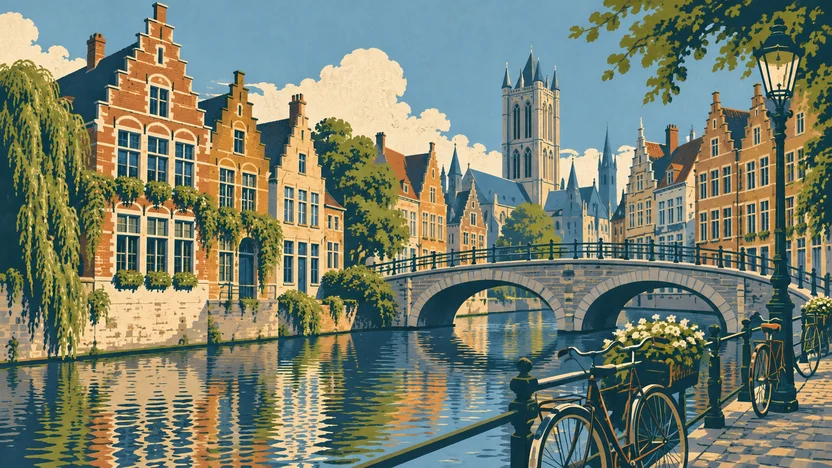 Ghent · AI city illustration · Artistic impression
City · Europe
Ghent
Saved in this browser — no account needed. Sign in later and it comes with you.
Where it is
The name is usually traced to a Celtic word for a confluence, and the site fits: the Leie runs into the Scheldt here, in a low plain where water-meadows were regularly flooded. That wet grass was good for sheep, and sheep made the city. Today a canal runs north from the docks to the Western Scheldt near Terneuzen in the Netherlands, so ships still reach what is now Belgium’s third-largest port. The climate is the usual north-west European marine one, with mild differences between highs and lows and rain all year.
The land and water around it
Confluence of the Scheldt and the Leieriver
Two rivers meeting on a flat plain gave the settlement its name, its early trade and its water-meadows. The Leie flows into the Scheldt at the heart of the old town.
The meersenmarsh
Seasonally flooded water-meadows around the rivers were ideal for grazing sheep. The wool they produced, along with imports from England and Scotland, supplied the cloth industry that made medieval Ghent.
The Ghent–Terneuzen Canalestuary
A canal runs from the docks to Terneuzen, in the Netherlands, and gives Ghent a connection to the sea, and carries the third-largest port in Belgium. An earlier new connection to the sea was built in 1824–27, and after 1830 the city went more than a decade without its sea access, which brought the local economy down.
Its history, in short
Two abbeys founded by Saint Amand around 650, and a trading settlement, were the cores from which Ghent grew. Under the counts of Flanders it prospered from the 11th century as a small city-state, and by the 13th century it was second only to Paris among the cities north of the Alps, living on woollen cloth woven from imported English and Scottish wool. Its weavers made it politically restive. Defeat by Duke Philip the Good at Gavere in 1453 and Charles V’s punishment of the city after the 1539 revolt, when its nobles were made to parade with nooses, broke its independence, and the Eighty Years’ War ended its role as an international centre. That decline left an unusually well-preserved medieval core. Textiles revived in the early 19th century with the first mechanical loom on the European continent, and the city became Belgium’s premier industrial centre until the 1880s. A treaty signed here on Christmas Eve 1814 ended the War of 1812 between Britain and the United States.
Timeline
Dates are shown on a timeline rather than as changing shapes on the map. The globe draws modern boundaries only, and tinting a modern outline to stand for a historical one would state something we cannot source.
Post-classical world
c. 650
Saint Amand’s abbeys
Two abbeys, St Peter’s and St Bavo’s, are founded. Around 800 Einhard, Charlemagne’s biographer, is made abbot of both. Vikings plunder the city in 851 and 879.
Approximate dateWikipedia13th century
The great cloth city
Ghent becomes Europe’s leading woollen cloth centre and the largest city north of the Alps except Paris, bigger than Cologne. By mid-century the industry employs 4,000 weavers and 1,200 fullers.
Approximate dateWikipedia
Early modern & oceanic
1453
Defeat at Gavere
After a rebellion against high taxes, Ghent is badly beaten by Philip the Good, Duke of Burgundy. Political weight in the Low Countries begins to shift from Flanders towards Brabant.
Well attestedWikipedia1539
Revolt and the “noose-bearers”
Charles V, who was born in Ghent, punishes the city after its revolt. Its nobles are made to walk before him barefoot with a noose round their necks, hence the nickname Stroppendragers. St Bavo’s Abbey is demolished for a fortress.
Well attestedWikipedia
Industrial & imperial
1800
The first mechanical loom on the continent
Lieven Bauwens smuggles plans of English machinery out of England and installs the first mechanically driven loom anywhere on the mainland of Europe, restarting the textile trade.
Well attestedWikipedia24 December 1814
The Treaty of Ghent
A treaty negotiated in the city ends the war of 1812 that had pitted Britain against the United States.
Well attestedWikipedia1816
A university
Ghent founds its own university under the United Kingdom of the Netherlands. The first Belgian trade union also originated in the city after 1830.
Well attestedWikipedia1913
World exhibition
The city hosts a world exhibition, and builds its Sint-Pieters railway station, finished in 1912, to receive visitors.
Well attestedWikipedia
Places that carry meaning
St Bavo’s CathedralMedieval
Home of the Ghent Altarpiece, the cathedral’s tower is one of several that make the medieval skyline, alongside the belfry and St Nicholas’ Church.
Graslei and the old harbourMedieval
The old harbour quay is lined with some of the finest of the city’s medieval architecture. The centre is now closed to cars.
GravensteenMedieval
A castle, one of the highlights of the well-preserved medieval centre.
Languages here
Places are usually multilingual. This lists what is actually spoken, not one language per border.
DutchGermanic family
The language of the city and of Flanders.
The Franks who arrived from the late 4th century replaced earlier Celtic and Latin speech with Old Dutch. Dutch is the language of government and education in Flanders today.
Languages of immigrant communities
Spoken in neighbourhoods with many residents of foreign origin.
In 2020 more than a third of residents had roots outside Belgium and 15.3 per cent held a non-Belgian nationality. Turkish restaurants are concentrated around Sleepstraat, and several districts are majority-minority.
Learn the language here
- 1Understand which languages are spoken hereGhent is multilingual. Start with which languages are used, by whom, and for what — the phrase list only covers one of them.Written by Globe Quest
- 2Learn 12 phrasesCurated everyday phrases for Ghent, with audio and a written form.Written by Globe Quest
- 3Say them out loudSpeaking practice with pronunciation feedback, one phrase at a time.Globe Quest material, your own additions
- 4Come back to themSpaced review, so what you learned this week is still there next month.Written by Globe Quest
Check yourself
Why was the area around Ghent so well suited to its medieval industry?
Seasonally flooded water-meadows fed sheep whose wool made cloth
Water-meadows beside the Leie and Scheldt were good grazing, and wool, local and imported, made Ghent the leading cloth city of Europe in the 13th century.
What was agreed in Ghent on Christmas Eve 1814?
The treaty that ended the American-British war of 1812
The Treaty of Ghent, negotiated in the city and adopted on Christmas Eve, brought to a close the American-British war of 1812, the North American phase of the Napoleonic Wars.
Worth arguing about
- Ghent’s decline after the 16th century is why its medieval centre survives. Is preservation a prize or a consolation?
- Citizens of Ghent have been called noose-bearers since 1539. When does a nickname born of humiliation become a point of pride?
What we have not established
These are open questions, listed rather than filled in. We would rather show a gap than a plausible guess.
How big was medieval Ghent?
One account gives about 50,000 people in 1300, another up to 65,000 within the walls in the 13th century; the difference lies in dates and what area is counted.
Sources
- Wikipedia · GhentWikipedia · encyclopedia · checked 2026-11-24
- Wikipedia · BelgiumWikipedia · encyclopedia · checked 2026-11-24
Reviewed by Globe Quest editorial on 2026-11-24. Drafted with AI assistance and checked against the sources above before publication.