 Globe Quest
 Human Quest · LearningSign in
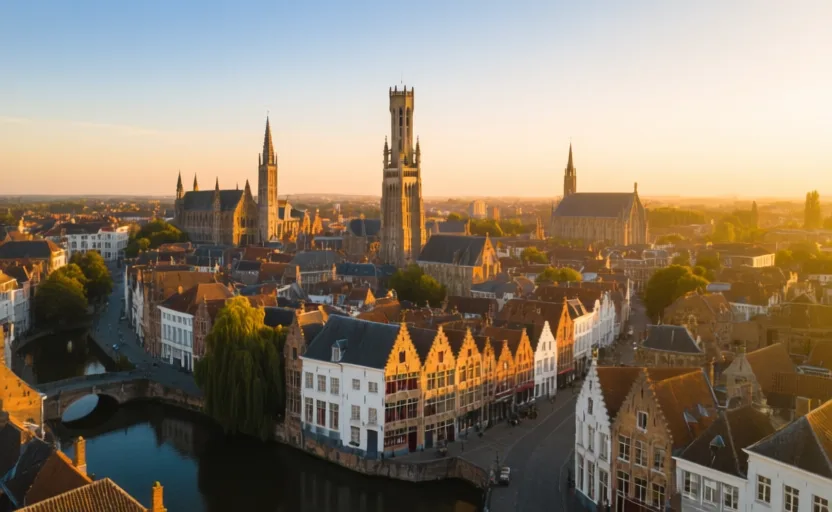 Bruges · AI city illustration · Artistic impression
City · Europe
Bruges
Also known as Brugge
Saved in this browser — no account needed. Sign in later and it comes with you.
Where it is
Bruges stands on a flat, low coastal plain in the north-west of Belgium. The medieval core is an oval of some 430 hectares ringed by the line of its former 12th-century walls and threaded with canals. The sea is not at the door now, but for centuries it nearly was: a tidal arm called the Zwin ran inland towards the city, and the whole fortune of Bruges rose and fell with that channel. The climate is oceanic, and the municipality stretches to the coast at Zeebrugge, which gives the city a modern port as well as a medieval one.
The land and water around it
The Zwin inletestuary
A tidal arm of the sea that brought ships to the city. Silting began to cut off the direct access around 1050, a storm in 1134 reopened it, and from about 1500 the channel filled for good. Damme, at the end of the inlet, served as the outer harbour.
The canal networklagoon
The medieval street pattern and the canals once used for goods have largely survived. They gave Bruges its comparison with Venice and Amsterdam as a canal-based northern city.
The Flemish coastal plainplain
Very low country in the north-west of Belgium, stretching to the sea at Zeebrugge, where a port was built in 1907 and enlarged in the 1970s and early 1980s.
Its history, in short
A fortified settlement on the coast, Bruges grew in the Viking age, when it filled the gap left by trading harbours that the raids had ruined. It became capital of the county of Flanders in 1089 and received a city charter in 1128. A storm in 1134 cut the Zwin and restored the sea access that silting had taken away, and from the 12th to the 15th centuries Bruges was a commercial metropolis: the northern Hanseatic traders met southern routes here, wool and cloth came in from England and Scotland, and its merchants adopted shared-risk partnerships, bills of exchange and letters of credit. In the 15th century it was the cradle of the Flemish Primitives, with Jan van Eyck and Hans Memling at work in the city. From about 1500 the Zwin silted up for good, foreign trading houses moved to Antwerp, and Bruges shrank into poverty. It mostly missed the industrial revolution, which preserved the medieval fabric, and in the 19th century visitors from Britain and France began arriving. Restoration after 1965 and the opening of Zeebrugge in 1907, later enlarged, put it back on the map.
Timeline
Dates are shown on a timeline rather than as changing shapes on the map. The globe draws modern boundaries only, and tinting a modern outline to stand for a historical one would state something we cannot source.
Post-classical world
c. 865
A fort of the margrave of Flanders
Baldwin I of Flanders reinforces the old Roman fortifications against Viking raids. Bruges is first named in an inventory compiled between 851 and 864.
1089
Capital of Flanders
Bruges becomes the seat of the county, and receives its city charter on 27 July 1128, with new walls and canals.
Well attestedWikipedia1134
A storm opens the Zwin
The storm creates a natural channel that reconnects the city to the North Sea after decades of silting.
18 May 1302
Bruges Matins
A massacre in the city, in the Flemish uprising against French rule. The French and Flemish fought at the Battle of the Golden Spurs at Kortrijk soon afterwards, and the Flemish won.
Well attestedWikipedia1430
Order of the Golden Fleece
The Burgundian chivalric order is founded in Bruges, when it was at its height as a court and trading city. Van Eyck was active in the city by 1425 and Memling around 1465.
Well attestedWikipedia
Early modern & oceanic
1505–1545
Merchants move to Antwerp
The Fuggers leave Bruges for Antwerp in 1505 and the Hanseatic enterprise follows in 1545, as the Zwin silts up and the city’s golden age ends.
Industrial & imperial
1907
Port of Zeebrugge
A new sea port is built at the coast. The Germans used it for submarines in the First World War, and it was greatly expanded in the 1970s and early 1980s.
Contemporary
2000
UNESCO inscription
The historic centre is inscribed on the World Heritage List, after a restoration movement that began after 1965 and a surge in tourism. Bruges was European Capital of Culture in 2002.
Places that carry meaning
Historic Centre of Brugge12th century onward
Listed as an architectural ensemble of brick Gothic that shows commercial and cultural exchange across medieval northern Europe. The walls are gone, but their line is visible, four gates survive, and the medieval street plan and canals are mostly intact.
Church of Our LadyTower built from 1297
Its brick spire, 115.6 metres high, is reckoned the second-highest brick tower in the world. The transept holds a Madonna and Child attributed to Michelangelo, thought to be the only sculpture of his to leave Italy in his lifetime.
GroeningemuseumOpened 1930
An art museum with extensive medieval and early modern collections, including work of the Early Netherlandish painters. Van Eyck and Memling both lived and worked in Bruges.
Basilica of the Holy BloodChapel c. 1157
Keeps a relic said to have been brought to the city by Thierry of Alsace after the Second Crusade. It is carried in procession each year, a custom instituted in 1303, with more than 1,600 inhabitants in medieval costume.
Languages here
Places are usually multilingual. This lists what is actually spoken, not one language per border.
Dutch (West Flemish)Germanic family
The predominant language of the city.
West Flemish is one of the main Dutch dialects of Belgium, also spoken in French Flanders. Flemish dialects have taken in more French and other Romance vocabulary than other Dutch dialects, so they are not always readily understood by Dutch speakers outside Flanders, though linguists regard them as varieties of Dutch. The place-name itself may come from a Scandinavian word for a quay or jetty, a trace of the Viking-age trade that first made the harbour important.
FrenchRomance family
The second language of many Flemings.
Many Flemish people speak French as a second language, and 76% of Belgians could speak it in 2022. Bruges was on the Flemish and French cloth-fair circuit in the 13th century, and wealthy French and British tourists came in the 19th.
EnglishGermanic family
The language of the wool trade, and now of higher education.
Merchants of Bruges built commercial ties to England and Scotland’s wool districts. English has become increasingly common in Belgian higher education.
Learn the language here
- 1Understand which languages are spoken hereBruges is multilingual. Start with which languages are used, by whom, and for what — the phrase list only covers one of them.Written by Globe Quest
- 2Learn 12 phrasesCurated everyday phrases for Bruges, with audio and a written form.Written by Globe Quest
- 3Say them out loudSpeaking practice with pronunciation feedback, one phrase at a time.Globe Quest material, your own additions
- 4Come back to themSpaced review, so what you learned this week is still there next month.Written by Globe Quest
Check yourself
What happened to Bruges when the Zwin silted up from about 1500?
It lost its sea access and its trade moved to Antwerp
The tidal channel that carried ships to the city filled with silt. Foreign trading houses, including the Fuggers and the Hanseatic enterprise, relocated to Antwerp, and Bruges became poor.
Why is so much of medieval Bruges still standing?
The city declined after its golden age and mostly missed the industrial revolution
Poverty after the 16th century and the absence of 19th-century heavy industry meant little redevelopment, leaving the brick Gothic centre largely intact, and it was spared destruction in both world wars.
Worth arguing about
- A city whose wealth vanished with a silted channel became a tourist destination worth millions of visits. Is a preserved past an economy or a trap?
- Bruges lent merchant innovations such as letters of credit to the world. What does a city gain from being a crossroads of strangers?
What we have not established
These are open questions, listed rather than filled in. We would rather show a gap than a plausible guess.
Where does the name Bruges come from?
The name resembles the Old Dutch word for “bridge”, but a Scandinavian origin meaning quay or jetty is considered more likely. The earliest records do not settle it.
Sources
- Wikipedia · BrugesWikipedia · encyclopedia · checked 2026-11-24
- Wikipedia · Timeline of BrugesWikipedia · encyclopedia · checked 2026-11-24
- UNESCO · Historic Centre of BruggeUNESCO World Heritage Centre · intergovernmental · checked 2026-11-24
- Wikipedia · Languages of BelgiumWikipedia · encyclopedia · checked 2026-11-24
Reviewed by Globe Quest editorial on 2026-11-24. Drafted with AI assistance and checked against the sources above before publication.