 Globe Quest
 Human Quest · LearningSign in
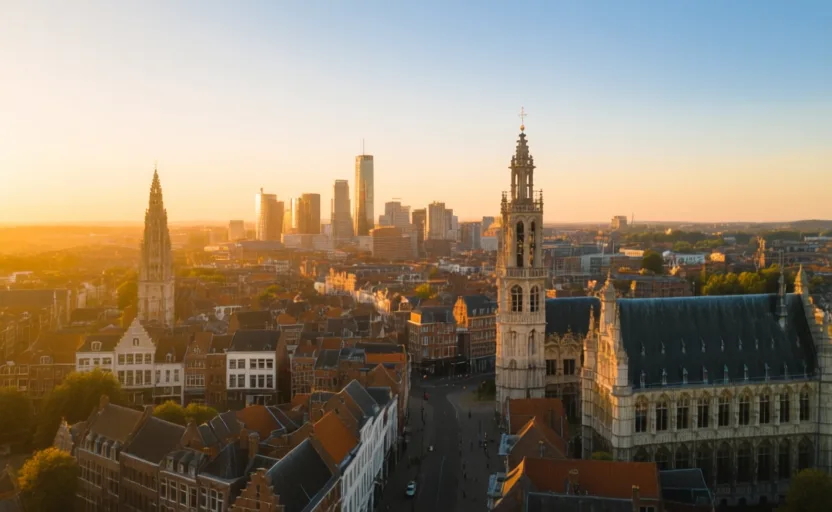 Leuven · AI city illustration · Artistic impression
City · Europe
Leuven
Saved in this browser — no account needed. Sign in later and it comes with you.
Where it is
Leuven lies about 25 kilometres east of Brussels on the river Dyle, a small stream that once powered its cloth trade and defined the line of its streets. It is the capital of Flemish Brabant and, with just over 100,000 residents, smaller than its fame suggests, because a large international student population lives around its centre. The municipality gathers several former villages around the old town, from Heverlee to Kessel-Lo, and the Voer stream that used to run through the town was vaulted over in the 19th century.
The land and water around it
The Dyleriver
The small river beside which the town grew. Its shores were stained, the legend says, by the blood of the 891 battle, and the red and white of the city’s arms recall that. It carried the cloth trade that made the town rich.
The Voer streamriver
A stream running through the old town that was vaulted over in the 19th century, together with the central channels in the streets, as the city widened roads and put in sewers.
Its history, in short
The city first appears in 891, in an account of a Frankish victory over a Viking army on the Dyle. Beside the river and close to the stronghold of the dukes of Brabant, it became the duchy’s chief trading centre between the 11th and 14th centuries, and its linen was so well known that the word lewyn meant ordinary linen cloth in late medieval texts. The second golden age came with the founding of the university in 1425, the oldest in the Low Countries. By 1500 humanists such as Erasmus were working there, the Collegium Trilingue taught Latin, Greek and Hebrew from 1517, and Thomas More’s Utopia was printed in the town in 1516. Religious persecution from the 1560s drove many scholars abroad. Gas lighting arrived in 1835. In the First World War German soldiers burned the university library, and in the Second the new library burned again in the fighting of May 1940. Today the university and its spin-off research firms dominate the local economy.
Timeline
Dates are shown on a timeline rather than as changing shapes on the map. The globe draws modern boundaries only, and tinting a modern outline to stand for a historical one would state something we cannot source.
Post-classical world
891
Battle of Leuven
The first mention of the town (as Loven) is the defeat of a Viking army by the Frankish king Arnulf of Carinthia.
Well attestedWikipedia11th–14th centuries
Trade and cloth
Leuven becomes the most important trading centre in the duchy of Brabant, known for linen cloth.
Approximate dateWikipedia1425
The university
The University of Leuven is founded, the oldest in the Low Countries. Saint Peter’s Church was built between 1425 and 1500, and the Town Hall between 1439 and 1463.
Well attestedWikipedia
Early modern & oceanic
1516–1517
Utopia and the Collegium Trilingue
Thomas More’s Utopia is printed in Dirk Martens’s press in 1516, and in 1517 Hieronymus van Busleyden founds the Collegium Trilingue for Latin, Greek and Hebrew.
Well attestedWikipediaFrom the late 1560s
Persecution and brain drain
The persecution of Protestants and wider turmoil push many professors and alumni abroad. The new University of Leiden gained greatly from the exodus, but Leuven kept its strength in theology and classics.
Approximate dateWikipedia
Industrial & imperial
1835
Gas lighting and a rebuilt centre
Streets are lit by gas, narrow lanes widened, sewers installed and new squares laid out during the century.
Well attestedWikipedia25 August 1914
The library burned
German troops set fire to the university library, destroying about 230,000 volumes, including 750 medieval manuscripts, and about 300 civilians die in the town. Germany described it as a reprisal for civilian resistance; the destruction caused worldwide outrage.
DisputedWikipediaGerman authorities, who claimed Belgian civilians had fired on their troops; outside accounts called it an atrocity
May 1940
A second library fire
Shelling during the German assault ignites the newer library building on 16 May, and close to a million books are lost; the library had opened in 1928 after the first war’s destruction.
Well attestedWikipedia
Places that carry meaning
Town Hall1439–1463
A Brabantian late-Gothic building by Sulpitius van Vorst, Jan II Keldermans and Matheus de Layens.
Saint Peter’s Church1425–1500
The church was damaged in the Second World War, and its restoration uncovered an 11th-century Romanesque crypt. Painters such as Dirk Bouts worked in the city when it was built.
The Ladeuzeplein libraryOpened 1928
The Central Library rebuilt on what is now Ladeuzeplein to replace the one burned in 1914, itself lost again in 1940. A reminder that this town’s heritage is a story of repeated rebuilding.
Languages here
Places are usually multilingual. This lists what is actually spoken, not one language per border.
DutchGermanic family
The language of the city, its university and local government.
Leuven is a Dutch-speaking municipality in Flanders, and KU Leuven is the largest Dutch-speaking university in the world.
English and other student languagesGermanic family
Used by the large international student population, mostly around the centre.
More than 50,000 students attend the university’s campuses in the town, a good share from abroad.
Latin, Greek and Hebrew
The three ancient languages taught at the Collegium Trilingue.
Founded in 1517 to promote critical study of classical literature and the Bible.
Learn the language here
- 1Understand which languages are spoken hereLeuven is multilingual. Start with which languages are used, by whom, and for what — the phrase list only covers one of them.Written by Globe Quest
- 2Learn 12 phrasesCurated everyday phrases for Leuven, with audio and a written form.Written by Globe Quest
- 3Say them out loudSpeaking practice with pronunciation feedback, one phrase at a time.Globe Quest material, your own additions
- 4Come back to themSpaced review, so what you learned this week is still there next month.Written by Globe Quest
Check yourself
What gives Leuven its distinction among Low Countries cities?
A university founded in 1425, the oldest in the Low Countries
The university gave a trading town a second golden age in the 15th and 16th centuries and still shapes its economy today.
How many times was Leuven’s university library lost to fire in the 20th century?
Twice, in 1914 and 1940
The 1914 fire destroyed about 230,000 volumes, and after rebuilding the library was set alight again by shelling in May 1940, with nearly a million books lost.
Worth arguing about
- The 1914 burning was justified by the German army as a legal reprisal at the time, yet provoked worldwide outrage. How do we judge acts that were lawful but widely condemned?
- A town of 100,000 with 50,000 students: whose city is it?
Sources
- Wikipedia · LeuvenWikipedia · encyclopedia · checked 2026-11-24
Reviewed by Globe Quest editorial on 2026-11-24. Drafted with AI assistance and checked against the sources above before publication.