 Globe Quest
 Human Quest · LearningSign in
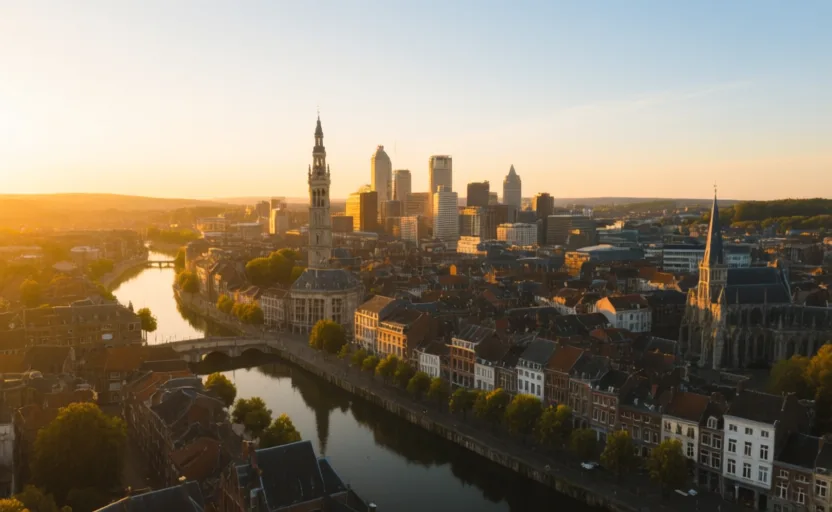 Liège · AI city illustration · Artistic impression
City · Europe
Liège
Saved in this browser — no account needed. Sign in later and it comes with you.
Where it is
In the east of Belgium, Liège fills a narrow stretch of the Meuse valley where the river Ourthe joins it, with steep hills pressing in on the west bank. Maastricht lies about 33 kilometres to the north and Aachen about 53 kilometres to the north-east, so the city sits close to both the Dutch and German borders, within the Meuse-Rhine cross-border region. It belongs to the old industrial belt, the sillon industriel, which follows the Haine, Sambre and Meuse valleys. Despite the inland position, winds off the Atlantic keep winters mild for the latitude.
The land and water around it
The Meuse valleyvalley
The river carved the site and carried the city’s trade. Near the city its Sunday Batte market runs along the water, and the valley is the spine of the former industrial belt.
The meeting of Meuse and Ourtheriver
The Ourthe flows into the Meuse in Liège, so the city sits where two valleys meet.
The hill above the western sidemountains
A steep hill overlooking the city’s western side was fortified early with a castle, because of Liège’s strategic position, which made it a frequent target. In the 1880s a ring of twelve forts was built around it.
Its history, in short
The earliest mention of the place is from 558. Around 705 Saint Lambert of Maastricht was killed here, and his successor built a basilica over his relics that became the true nucleus of the city. For 800 years, from 985 to 1794, Liège was the capital of a prince-bishopric, nominally part of the Holy Roman Empire but in practice largely independent, and a centre of learning and church music. In 1345 its citizens beat their prince-bishop and put the city’s 32 guilds in charge of its government, a system thought the most democratic the Low Countries had known. Burgundy’s duke destroyed much of the city in 1468. A revolution began in 1789, French troops ended the prince-bishopric in 1794, and the cathedral of Saint Lambert was destroyed. After 1830, rapid industrial growth and John Cockerill’s ironworks made Liège one of the first large steelmaking centres on the Continent. The decline of coal and steel after the Second World War brought unemployment and unrest, and in 1960–1961 a winter general strike ended in street fighting.
Timeline
Dates are shown on a timeline rather than as changing shapes on the map. The globe draws modern boundaries only, and tinting a modern outline to stand for a historical one would state something we cannot source.
Post-classical world
558
First mention
The settlement appears in the record as Vicus Leudicus. Around 705 Saint Lambert, who is credited with completing the region’s Christianisation, is murdered in Liège and venerated as a martyr.
Approximate dateWikipedia985–1794
The prince-bishopric
Under its first prince-bishop, Notger, Liège becomes an intellectual and ecclesiastical centre. Musicians recruited from the city for the papal court at Avignon helped bring polyphony into church music.
Well attestedWikipedia1345
The guilds take power
Citizens rebel against Prince-Bishop Engelbert III de la Marck and defeat him in battle, after which 32 guilds share control of city government, each with an equal voice.
Well attestedWikipedia
Early modern & oceanic
1468
Charles the Bold destroys the city
After a bitter siege that ended in a surprise attack, the Duke of Burgundy captures Liège and largely destroys it, in the Liège Wars against Burgundian rule.
Well attestedWikipedia18 August 1789
The Liège Revolution
Inspired by French Encyclopédiste ideas, a revolution begins in the city and creates the Republic of Liège, invaded by Habsburg forces in 1791. French revolutionary troops end the prince-bishopric in 1794.
Well attestedWikipedia
Industrial & imperial
1817
University and ironworks
The University of Liège is founded, and John Cockerill begins building the iron and steel industry that made the Seraing complex, in time, the largest in the world.
Well attestedWikipedia1886
The Walloon Jacquerie
A large working-class revolt spreads through the industrial belt; at least 6,000 regular troops are brought into Liège to put it down.
Well attestedWikipedia
Contemporary
1950–1961
Strikes
In July 1950 a general strike led from Liège helps force King Leopold III to abdicate. Industrial decline follows, and the 1960–1961 winter general strike ends in street battles, with 75 people injured in seven hours on 6 January 1961.
Well attestedWikipedia
Places that carry meaning
Outre-MeuseModern festival quarter
A quarter of narrow pedestrian streets and old courtyards where the crowded 15 August festival takes place, with a procession, beer, peket and boûkètes.
SeraingFrom 1817
The site of the Cockerill works, once the largest industrial complex in the world, with numerous blast furnaces and mills; it lies in the metropolitan area of Liège.
St Martin’s Church682
The oldest of Liège’s many churches. The city was known for its churches long before it was known for steel.
Languages here
Places are usually multilingual. This lists what is actually spoken, not one language per border.
FrenchRomance family
The everyday language of most of the city’s people.
French dominates, and smaller groups of German and Dutch speakers live in the city. Liège is the main economic and cultural centre of Wallonia.
WalloonRomance family
A regional language of the south, with its own local dialect in Liège.
Walloon as spoken in Liège has a dialect reckoned among the most distinctive in the country.
Italian and immigrant languages
Spoken in long-established and newer immigrant communities.
A large Italian community means Italian is heard widely around town. The city is also home to many Algerian, Moroccan, Turkish and Vietnamese immigrants and a significant African community.
Learn the language here
- 1Understand which languages are spoken hereLiège is multilingual. Start with which languages are used, by whom, and for what — the phrase list only covers one of them.Written by Globe Quest
- 2Learn 12 phrasesCurated everyday phrases for Liège, with audio and a written form.Written by Globe Quest
- 3Say them out loudSpeaking practice with pronunciation feedback, one phrase at a time.Globe Quest material, your own additions
- 4Come back to themSpaced review, so what you learned this week is still there next month.Written by Globe Quest
Check yourself
What kind of state was Liège for most of the Middle Ages and early modern period?
A prince-bishopric, nominally in the Holy Roman Empire but largely independent
From 985 to 1794 the city was the capital of a state ruled by a prince-bishop. It was formally part of the empire but kept considerable independence until French revolutionary troops ended it.
What made Liège a major industrial city after Belgian independence?
Coal and the iron and steel industry
The coal seams around the city and the ironworks of John Cockerill at Seraing made it one of the Continent’s first large steelmaking centres, and the focus of industrial growth in Belgium after the 1880s.
Worth arguing about
- A city that once gave its guilds equal power and later led the general strikes has a long record of collective action. What in its geography and history sustains that?
- Liège was the heart of Belgium’s heavy industry. What should a city built around coal and steel become once both decline?
Sources
- Wikipedia · LiègeWikipedia · encyclopedia · checked 2026-11-24
- Wikipedia · BelgiumWikipedia · encyclopedia · checked 2026-11-24
Reviewed by Globe Quest editorial on 2026-11-24. Drafted with AI assistance and checked against the sources above before publication.