 Globe Quest
 Human Quest · LearningSign in
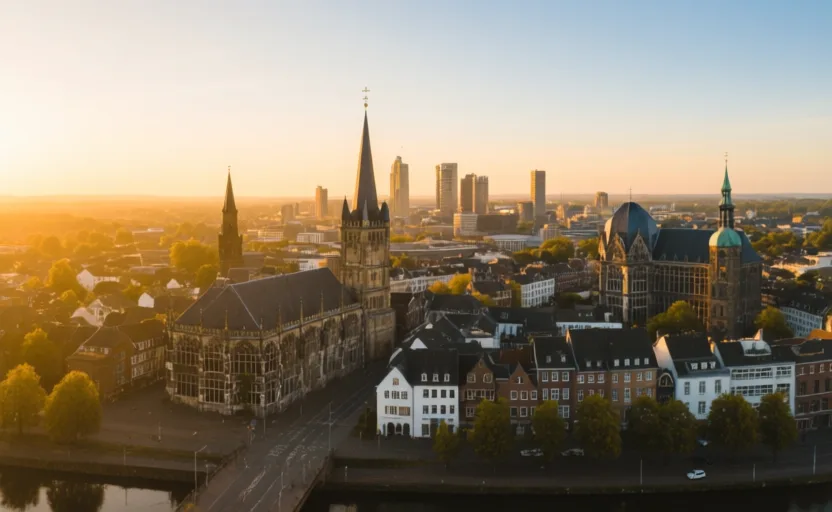 Aachen · AI city illustration · Artistic impression
City · Europe
Aachen
Saved in this browser — no account needed. Sign in later and it comes with you.
Where it is
Aachen is Germany's westernmost major city, wedged against the Belgian and Dutch borders about 61 kilometres west of Cologne. It lies below the High Fens and the Eifel uplands, at the head of the little valley of the Wurm, a tributary of the Rur, so its waters drain to the Meuse rather than the Rhine. Land inside the city runs from 125 metres in the north to 410 metres in the far south-east. Hot sulphur springs rise in the basin, and the surrounding hills trap smog and heat. Westerly weather and the nearby uplands bring about 805 millimetres of rain a year, more than Bonn gets.
The land and water around it
The hot springsbasin
Sulphur springs rise in the marshy basin around the Wurm and drew settlement from the Neolithic onward. The Roman name Aquae Granni means waters of Grannus, a Celtic god of healing, and the city's name descends from a word for a stream.
The High Fens and Eifelmountains
The upland lies about 30 kilometres to the south, on the northern edge of the Rhenish Massif. Its position shapes the weather, with westerly rain and warm foehn winds on southerly flows, and the hills ringing the city produce inversion smog.
The Meuse–Rhine borderlandvalley
The city lies close to the point where Germany, Belgium and the Netherlands meet. Vaals in the Netherlands is about 6 kilometres from the centre, and about a quarter of the city boundary runs along each frontier.
Its history, in short
The springs made Aachen. People came here in the Neolithic, Celts worshipped the healing god Grannus at the hot water, and Rome built baths and called the place Aquae Granni. The Frankish king Pepin the Short built a castle residence in the town, and Charlemagne turned it into his main seat; his palace chapel, built between 793 and 813, is the core of the cathedral, and he was buried in it in 814. Thirty-one kings were crowned here between 936 and 1531, after which Frankfurt took over. Barbarossa granted city rights in 1166. A great fire in 1656 destroyed most of the city, and the rebuilding was mainly baroque. France held Aachen from 1801 and Prussia from 1815. The Jewish community of 1,345 in 1933 had fallen to 62 by the end of the war. The Battle of Aachen ended on 21 October 1944, and today the city is known for its technical university and hospital.
Timeline
Dates are shown on a timeline rather than as changing shapes on the map. The globe draws modern boundaries only, and tinting a modern outline to stand for a historical one would state something we cannot source.
Post-classical world
765–766
Pepin at Aquis
Pepin the Short spends Christmas and Easter in a royal residence in the town, which must have been able to support the court for months. Charlemagne makes his first Christmas visit in 768.
Well attestedWikipedia793–813
The Palatine Chapel
Charlemagne's own chapel is built to an octagonal plan under a dome. Its construction is taken as a symbol of political and spiritual revival in the West, and Charlemagne is buried there in 814.
Well attestedUNESCO World Heritage Centre936–1531
Coronation city
Thirty-one Holy Roman Emperors are crowned Kings of the Germans in Aachen, sitting on a Carolingian stone throne. Frankfurt then becomes the usual place of coronation.
1166
City rights
Emperor Frederick Barbarossa grants city rights and makes Aachen an imperial city.
Well attestedWikipedia1372
A dated coin
Aachen's mint puts the Christian year on a groschen meant for everyday circulation, the first mint anywhere to do this as a regular practice.
Well attestedWikipedia
Early modern & oceanic
1656
The great fire
Most of the city is destroyed by fire, following the religious conflicts of earlier decades. It is rebuilt mostly in the baroque style.
Well attestedWikipedia
Industrial & imperial
1801–1815
French, then Prussian
The Peace of Lunéville in 1801 gives the left bank of the Rhine, Aachen included, to France, where it becomes the chief town of the Roer department. The Congress of Vienna passes it to Prussia in 1815.
Well attestedWikipedia21 October 1944
The Battle of Aachen ends
German surrender ends the battle. The city had suffered more than 120 air raids between 1940 and 1944, and an Allied military government took over, and the city later fell in the British zone.
Well attestedWikipedia
Places that carry meaning
Aachen Cathedral793–813 and later
Built around Charlemagne's octagonal Palatine Chapel, with a Gothic choir and chapels added over the Middle Ages. Its Carolingian throne served for the coronation of kings, and the treasury is among the most important church treasuries in northern Europe.
The Town HallCarolingian palace site
It stands on the site of the Carolingian coronation hall, the aula regia, one of the main buildings of Charlemagne's palace.
RWTH Aachen and the university hospital20th and 21st centuries
One of Germany's leading technical universities, with a hospital that is Europe's largest single-building hospital. It has made the city a technology centre, known for mechanical engineering and electric vehicles.
Languages here
Places are usually multilingual. This lists what is actually spoken, not one language per border.
GermanGermanic family
The official and everyday language.
Aachen lies at the western end of the Benrath line, which divides High German in the south from the other West Germanic speech to the north.
Öcher PlattGermanic family
The local dialect.
A Ripuarian dialect of the Central Franconian group, with strong Limburgish influence from the dialects of the neighbouring Netherlands.
Learn the language here
- 1Understand which languages are spoken hereAachen is multilingual. Start with which languages are used, by whom, and for what — the phrase list only covers one of them.Written by Globe Quest
- 2Learn 12 phrasesCurated everyday phrases for Aachen, with audio and a written form.Written by Globe Quest
- 3Say them out loudSpeaking practice with pronunciation feedback, one phrase at a time.Globe Quest material, your own additions
- 4Come back to themSpaced review, so what you learned this week is still there next month.Written by Globe Quest
Check yourself
What was Aachen's role from 936 to 1531?
The place where Holy Roman Emperors were crowned Kings of the Germans
Thirty-one rulers were crowned here, sitting on Charlemagne's stone throne in the cathedral, until the custom moved to Frankfurt.
What do the springs have to do with the city's name?
Aachen's name descends from a word for water or stream
The Roman name Aquae Granni meant waters of Grannus, a Celtic healing god. Aachen comes from Old High German ahha, which corresponds to the Latin for waters.
Worth arguing about
- Charlemagne chose a hot-spring estate for his capital. What makes a site a seat of power: strategy, comfort or symbolism?
- Aachen sits where three countries meet and speaks a dialect close to Dutch neighbours. How much does a border matter to everyday life there?
Sources
- Wikipedia · AachenWikipedia · encyclopedia · checked 2026-11-24
- UNESCO · Aachen CathedralUNESCO World Heritage Centre · intergovernmental · checked 2026-11-24
Reviewed by Globe Quest editorial on 2026-11-24. Drafted with AI assistance and checked against the sources above before publication.