 Globe Quest
 Human Quest · LearningSign in
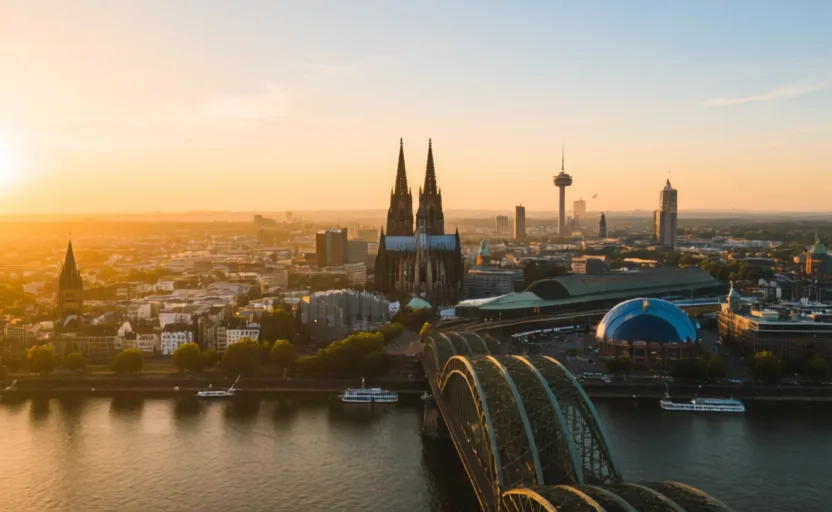 Cologne · AI city illustration · Artistic impression
City · Europe
Cologne
Also known as Köln, Colonia Agrippina
Saved in this browser — no account needed. Sign in later and it comes with you.
Where it is
Cologne grew on the left bank of the Lower Rhine, in the Cologne Lowland, a cone-shaped piece of the central Rhineland between Bonn, Aachen and Düsseldorf. The ground is low, between 37.5 and 118 metres above sea level, and the river is both the reason for the city and its main hazard. Cologne is regularly flooded by the Rhine and is considered Europe’s most flood-prone city, with permanent and mobile flood walls and pumping stations, a system redesigned after a damaging flood in 1993. It is one of Germany’s warmest and cloudiest cities, with an average annual temperature of 10.7 °C.
The land and water around it
The Rhineriver
Cologne has been a harbour and transport hub from Roman times. Its position where east–west trade routes crossed the river made it, in the Middle Ages, one of the largest cities in Europe. Constantine had a bridge built over the Rhine here in 310.
The Cologne Lowlandplain
A low, wide basin of the central Rhineland. Its highest point, the Monte Troodelöh, is only 118 metres above sea level, and its lowest, the Worringer Bruch, 37.5 metres.
Flood zoneclimate
Flooding from the Rhine is a regular fact of life. The city’s drainage agency maintains flood walls, building protection, forecasting, pumping stations and programmes to protect floodplains.
Its history, in short
The Ubii, a Germanic tribe allied with Rome, settled on the left bank in the last decades BC. In AD 50 Agrippina the Younger, born there and wife of the emperor Claudius, had her home town raised to a Roman colony, and its name, Colonia, gave Cologne and Köln. It became the capital of Lower Germany and the base of the Roman army in the region, and the Franks took it in 462. A bishop sat here from Roman times, and in 795 Charlemagne’s chaplain became its first archbishop. The archbishops built a semicircular city wall and began the Gothic cathedral in 1248, but the citizens, who grew rich on the Rhine trade between Italy and England and sat among the leaders of the Hanseatic League, fought them for control. After the Battle of Worringen in 1288 the archbishops were largely kept out of the city, and from 1475 it was formally a free imperial city. French rule from 1794 ended that status, and Prussia took over in 1815. The cathedral was only finished in 1880. Wartime bombing destroyed around 80 percent of the old centre and cut the population by 93 percent, mostly through evacuation. Rebuilding followed the old street layout.
Timeline
Dates are shown on a timeline rather than as changing shapes on the map. The globe draws modern boundaries only, and tinting a modern outline to stand for a historical one would state something we cannot source.
Classical world
AD 50
Colonia Agrippinensis
At the request of Agrippina the Younger, the Romans raise the Ubii settlement to a colony named for Claudius and for her. Later in the century it becomes capital of the province of Germania Inferior.
321
Jews on the city council
An edict of Constantine allows Jews to be elected to the council. The Jewish community of Cologne says it is the oldest north of the Alps, though when Jews first arrived is not known.
Approximate dateWikipedia462
Franks take the city
The Ripuarian Franks capture Cologne, ending Roman rule in the city. Earlier, in 355, the Alemanni had besieged and plundered it.
Post-classical world
1248
The cathedral begins
Construction of the Gothic cathedral starts under Archbishop Konrad von Hochstaden. The choir is consecrated in 1322 and work on the western part stops in 1475, leaving it unfinished for four centuries.
1288
Battle of Worringen
Brabant’s army and the citizens of Cologne capture the archbishop, who has to accept the city’s political independence while keeping certain rights, notably the administration of justice.
Well attestedWikipedia
Early modern & oceanic
1475
Free imperial city
Cologne is formally recognised as a free imperial city. The archbishops usually could not enter and lived at Bonn and later Brühl, and the status lasted until the French annexed the city in 1796.
Well attestedWikipedia
Industrial & imperial
1880
The cathedral completed
The building is finished following the medieval plans, and for ten years it is the tallest in the world. It is presented as a monument of German imperial unity.
Contemporary
1945
A heap of rubble
Architect Rudolf Schwarz describes Cologne as the world’s greatest heap of rubble. His 1947 plan adds new through-roads, including the Nord-Süd-Fahrt, to the rebuilt centre.
Well attestedWikipedia
Places that carry meaning
Cologne Cathedral1248–1880
A High Gothic five-aisled basilica with a 157-metre tower facade, built over some six centuries to the original plan. It holds the Shrine of the Magi, the largest reliquary shrine in Europe, and the Gero Crucifix of the late 10th century. UNESCO inscribed it in 1996.
City Hall (Rathaus)12th century onward
Founded in the 12th century and still in use, the oldest city hall in Germany. A Renaissance-style loggia and a tower came in the 15th century.
Medieval gatesMiddle Ages
Twelve gates once pierced the semicircular wall. Only three stand: the Eigelsteintorburg, the Hahnentor and the Severinstorburg.
The Roman riverfront1st–4th century
Roman remains lie near the old wharf area, where a Roman boat about 1,900 years old was found in late 2007.
Languages here
Places are usually multilingual. This lists what is actually spoken, not one language per border.
GermanGermanic family
The official language of the city.
Standard German is used across public life. The city name comes from Latin Colonia, and English took the French form Cologne.
KölschGermanic family
The local dialect of Cologne.
Kölsch, or Colognian, is a set of closely related Ripuarian dialects spoken over the former archdiocese, from Neuss south to Bonn, west to Düren and east to Olpe. It is one of the few real city dialects in Germany.
Turkish
The language of the largest immigrant community.
About 90,000 people of Turkish origin live in Cologne, the second-largest Turkish population of any German city after Berlin. Keupstraße, with its restaurants and markets, is known as Little Istanbul.
Learn the language here
- 1Understand which languages are spoken hereCologne is multilingual. Start with which languages are used, by whom, and for what — the phrase list only covers one of them.Written by Globe Quest
- 2Learn 12 phrasesCurated everyday phrases for Cologne, with audio and a written form.Written by Globe Quest
- 3Say them out loudSpeaking practice with pronunciation feedback, one phrase at a time.Globe Quest material, your own additions
- 4Come back to themSpaced review, so what you learned this week is still there next month.Written by Globe Quest
Check yourself
Whom does the Roman name of Cologne honour, besides the emperor Claudius?
Agrippina the Younger, his wife, who was born there
In AD 50 she asked for her home town to be made a Roman colony. The name Colonia is what turned into Köln and Cologne.
How long did it take to finish Cologne Cathedral?
About six centuries, from 1248 to 1880
Work stopped in 1475 with the western part unfinished, and it was completed only in 1880 following the medieval plans. For a decade it was the tallest building in the world.
Worth arguing about
- Cologne’s citizens spent centuries keeping their archbishop outside the walls, yet built his cathedral. How should we read a monument that two rival powers shaped?
- After 1945 the city followed its old street layout but built in the style of the 1950s. Is that a faithful rebuilding or a break with the past?
What we have not established
These are open questions, listed rather than filled in. We would rather show a gap than a plausible guess.
When did the Ubii settle at Cologne?
Accounts of the first urban settlement, the Oppidum Ubiorum, give 38 BC in one telling and 39 BC in another, linked to an agreement with the Roman general Agrippa. Both are close, and the exact year is not settled.
Sources
- Wikipedia · CologneWikipedia · encyclopedia · checked 2026-11-24
- Wikipedia · History of CologneWikipedia · encyclopedia · checked 2026-11-24
- UNESCO · Cologne CathedralUNESCO World Heritage Centre · intergovernmental · checked 2026-11-24
Reviewed by Globe Quest editorial on 2026-11-24. Drafted with AI assistance and checked against the sources above before publication.