 Globe Quest
 Human Quest · LearningSign in
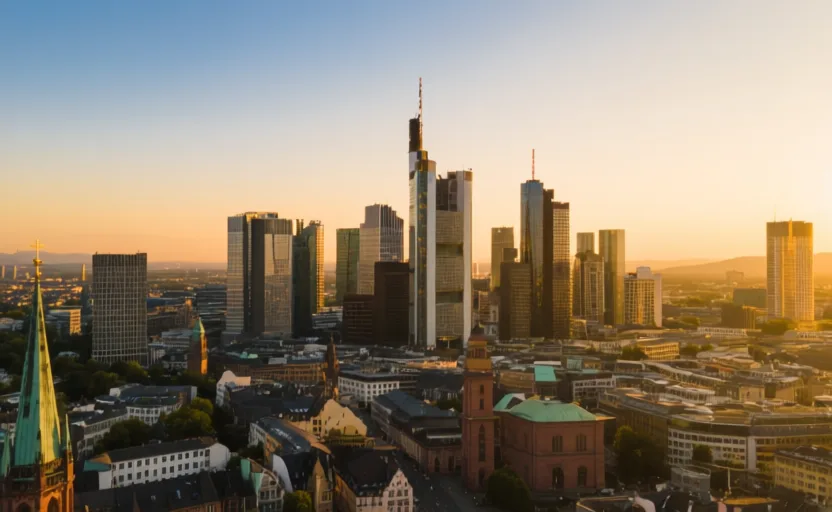 Essen · AI city illustration · Artistic impression
City · Europe
Essen
Saved in this browser — no account needed. Sign in later and it comes with you.
Where it is
Essen occupies the middle of the Ruhr, the belt of eleven independent cities and four districts that holds some 5.3 million people. Most of the city lies north of the River Ruhr, and the small Emscher runs along its northern side. The ground is gently rolling: the lowest point is about 26.5 metres above sea level in the north, the highest 202.5 metres in the south, and the average is 116. The climate is oceanic, with about 934 millimetres of rain a year. South of the Ruhr the city turns green and almost rural, a sharp contrast with the dense coal-and-steel districts to the north.
The land and water around it
The River Ruhr and Lake Baldeneyriver
The Ruhr is dammed inside the city to make two reservoirs, Lake Baldeney and Lake Kettwig. Baldeney was dug out between 1931 and 1933 by thousands of unemployed miners using simple tools, and is now the city's main recreational water.
The Emscherriver
A small river on the northern side of the city, in the part of the Ruhr where the heavy industry sat. The lowest ground in Essen, in the northern borough of Karnap, is found here.
The southern green beltforest
Land south of the Ruhr, including the old districts of Werden and Kettwig, stays far greener than the centre. Essen counts as the greenest city in North Rhine-Westphalia by recreational area, and was named European Green Capital for 2017.
Its history, in short
Essen began as a convent rather than a market. Around 845 a bishop founded a house for women of the Saxon nobility, and over the following centuries the abbesses became princes of the Empire, holding the town under their rule. The townspeople won a charter in 1244 but lost their brief independence in 1290. Mining rights came in the fourteenth century, coal was being dug by 1450, and by the late sixteenth century the town had a name for weapons. The Krupp family, resident since the sixteenth century, then turned the place into one of Germany's great coal and steel centres. Workers arrived from all over the country until the 1970s, and Essen became one of the five biggest German cities before shrinking as heavy industry contracted across the region. Forced labour in the Nazi years, the French and Belgian occupation of 1923 and the closing of the last mines in 1993 are the sharp edges of that story. Since then offices, energy firms and culture have replaced the furnaces.
Timeline
Dates are shown on a timeline rather than as changing shapes on the map. The globe draws modern boundaries only, and tinting a modern outline to stand for a historical one would state something we cannot source.
Post-classical world
c. 845
A convent founded
Altfrid, later Bishop of Hildesheim, founds an abbey for women of the higher Saxon nobility. The settlement that grows around it is the origin of the city.
Approximate dateWikipedia1244
Town charter and wall
The Archbishop of Cologne gives Essen a charter and seal, and the town builds a wall with its people. In 1290 King Rudolph I restores the abbesses to full sovereignty, over the objections of a growing town.
Well attestedWikipedia
Early modern & oceanic
1450
Coal mining begins
Coal had been named in records since 1371, but digging only starts in the mid-fifteenth century. By around 1570 gunsmiths were doing well, and in 1620 they made 14,000 rifles and pistols a year.
Well attestedWikipedia
Industrial & imperial
1923–1925
Occupation of the Ruhr
French and Belgian troops enter the region in January 1923. On 31 March a small French unit seizing vehicles at the Krupp works causes 13 deaths and 28 injuries. The occupation ends in the summer of 1925.
Well attestedWikipediaNazi era
Forced labour
Tens of thousands of forced labourers work in some 350 camps across Essen, in mining and for firms including Krupp and Siemens. Alfried Krupp is later convicted at Nuremberg for his part and pardoned by the United States in 1951.
Approximate dateWikipedia
Contemporary
1962 or 1965
Population peak
Essen reaches its highest population, above 730,000 by one count and above 745,000 by another. It was then the fifth-largest city in Germany. Numbers fall from the 1970s as coal and steel jobs disappear.
Approximate dateWikipedia1993
Zollverein closes
The Zollverein coal mine and coking plant, once the largest complex of its kind in Europe, shut down. Both are inscribed as a World Heritage Site in 2001.
2010
Capital of Culture
Essen holds the European Capital of Culture title on behalf of the whole Ruhr area, and is named European Green Capital for 2017.
Well attestedWikipedia
Places that carry meaning
Zollverein Coal Mine Industrial Complex1920s to 1993
A whole mining site kept intact: pits, coking plants, railway lines, spoil heaps and miners' housing. The pit buildings were designed by Fritz Schupp and Martin Kemmer in a Bauhaus-influenced style, so the place is valued as much for architecture as for coal.
Essen Abbeyc. 845 onward
The house for noblewomen that predates the industrial city by a thousand years. Its abbesses ruled the town, and the old centre grew from the abbey grounds.
Old Synagogue1913
Opened in 1913 and sacked on 10 November 1938. The outside survived the war in almost untouched condition, unlike the synagogue in Steele, which was destroyed completely.
Languages here
Places are usually multilingual. This lists what is actually spoken, not one language per border.
GermanGermanic family
The everyday and official language.
Essen's northern and central districts historically belong to the Westphalian Low German dialect area, while the south falls within the Low Franconian Bergish area, so the local speech once changed across the Ruhr itself.
Low GermanGermanic family
A recognised regional language, now mostly in the background.
Westphalian dialects of Low German are the historic speech of the city's centre and north. Germany recognises Low German as a protected regional language.
Turkish, Arabic and Polish
Languages of the largest migrant communities.
The largest migrant groups come from Turkey, Syria and Poland, and Turkish, Arabic and Polish are among the most common immigrant languages in Germany as a whole.
Learn the language here
- 1Understand which languages are spoken hereEssen is multilingual. Start with which languages are used, by whom, and for what — the phrase list only covers one of them.Written by Globe Quest
- 2Learn 12 phrasesCurated everyday phrases for Essen, with audio and a written form.Written by Globe Quest
- 3Say them out loudSpeaking practice with pronunciation feedback, one phrase at a time.Globe Quest material, your own additions
- 4Come back to themSpaced review, so what you learned this week is still there next month.Written by Globe Quest
Check yourself
How did Essen begin?
As a convent for noblewomen, founded around 845
The abbey came first, and its abbesses ruled the town for centuries. Industry arrived roughly a thousand years later.
Who dug Lake Baldeney?
Thousands of unemployed coal miners between 1931 and 1933
The reservoir on the Ruhr was dredged with simple tools by out-of-work miners in the early 1930s, and it later became the city's main place for leisure.
Worth arguing about
- A city built by a convent, then a gun-making family, then a mining company. Who really governed Essen at each stage?
- Zollverein is protected as architecture, not only as industry. What should a place keep when the work that justified it has ended?
What we have not established
These are open questions, listed rather than filled in. We would rather show a gap than a plausible guess.
What was Essen's peak population?
Accounts give over 730,000 for 1962 and over 745,000 for 1965. The two figures may rest on different counting years or boundaries, so the peak is left as a range.
Sources
- Wikipedia · EssenWikipedia · encyclopedia · checked 2026-11-24
- UNESCO · Zollverein Coal Mine Industrial Complex in EssenUNESCO World Heritage Centre · intergovernmental · checked 2026-11-24
- Wikipedia · GermanyWikipedia · encyclopedia · checked 2026-11-24
Reviewed by Globe Quest editorial on 2026-11-24. Drafted with AI assistance and checked against the sources above before publication.