 Globe Quest
 Human Quest · LearningSign in
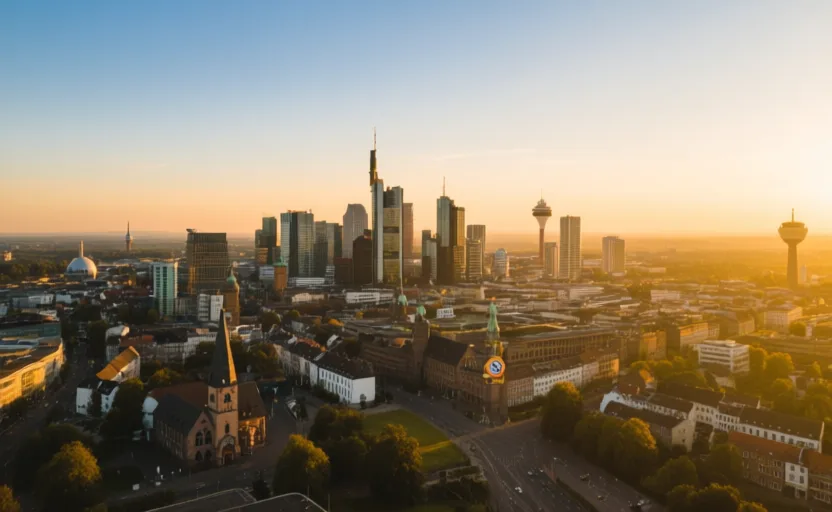 Dortmund · AI city illustration · Artistic impression
City · Europe
Dortmund
Saved in this browser — no account needed. Sign in later and it comes with you.
Where it is
Dortmund is the largest city in the Ruhr and in Westphalia, lying in the east of the Ruhr urban belt, with the Emscher rising just beyond its eastern edge and the Ruhr running along the south. It sits on the Westphalian Lowland, and to the south the Ardey Hills lead up toward the Sauerland. Heights run from 48.9 metres in the north to 254.3 metres on the Klusenberg, beside the Hengsteysee reservoir. The climate is oceanic and mild, with around 800 millimetres of rain spread through the year. Nearly half the municipal area is water, woodland, farmland and parkland, which sits oddly beside a century of mining and steelmaking.
The land and water around it
The Ardey Hills and Hohensyburgmountains
A low ridge at the southern edge of the city, where the Ruhr meets the Lenne. The Hohensyburg castle ruins stand on the site of the Sigiburg hillfort, which Charlemagne's Franks took in 772 and again in 775.
The Emscher and the Ruhrriver
The Emscher is a small river that begins at Holzwickede, just east of the city, and crosses Dortmund westward on its way to the Rhine. The Ruhr is dammed on the southern edge to form the Hengsteysee, which also serves a pumped-storage power plant.
Phoenix Lakelake
An artificial lake in Hörde, made on a site with some 160 years of industrial history. Work began in 2005, and the flooding started on 1 October 2010.
Its history, in short
Dortmund appears in records around 882 as Throtmanni, and its position at a crossroads and market gave it weight early. Frederick Barbarossa had the town rebuilt after a fire in 1152. It became an Imperial Free City, received one of Europe's first brewing rights in 1293, and in the thirteenth and fourteenth centuries was the lead city of its circle in the Hanseatic League. In 1389 it adopted a motto of being as firm as Dortmund after surviving a siege. The Thirty Years' War left it much diminished until industry arrived. The state mining authority moved here in 1815, and the population rose from 57,742 in 1875 to 379,950 in 1905 on coal, steel and beer. Bombing in 1945 destroyed 98 per cent of the buildings in the inner city, so most of today's centre is post-war. The last pit, Minister Stein, closed in 1987, and the economy has since turned to biomedicine, micro-systems, logistics and services.
Timeline
Dates are shown on a timeline rather than as changing shapes on the map. The globe draws modern boundaries only, and tinting a modern outline to stand for a historical one would state something we cannot source.
Post-classical world
772–775
The Sigiburg changes hands
Charlemagne's Franks take the hillfort above the Ruhr in 772, the Saxons retake it in 774, and Charlemagne refortifies it in 775. Dortmund's own written record begins a century later.
Well attestedWikipediac. 882
First mention
A Latin entry in the records of Werden Abbey names a free man at Throtmanni, who pays eight pfennigs. This is the earliest written trace of the town.
Approximate dateWikipedia1293
Brewing right
Dortmund, by now an Imperial Free City, receives an official right to brew, among the first granted anywhere in Europe.
Well attestedWikipedia1388–1389
The siege
The Count of Mark joins the Archbishop of Cologne in a feud against the town. After a siege of some 18 months, peace is negotiated with Dortmund still standing, and its motto about firmness dates from this.
Approximate dateWikipedia
Industrial & imperial
1815
Mining authority arrives
After the Congress of Vienna places the area in Prussia, the state mining authority for the Ruhr moves from Bochum to Dortmund, tying the city to coal.
Well attestedWikipedia1875–1905
Industrial boom
Between 1875 and 1905 the number of residents climbs from 57,742 to 379,950. Over the nineteenth century the Ruhr drew up to half a million Poles, Masurians and Silesians, most of the newcomers from Eastern Europe.
Well attestedWikipedia
Contemporary
12 March 1945
The largest raid on a single city
More than 1,110 aircraft take part in a raid that destroys 98 per cent of the buildings in the inner city. Only about 30 per cent of today's buildings date from before the war.
Well attestedWikipedia1987
The last pit closes
The Minister Stein mine closes, ending more than 150 years of coal mining in the city.
Well attestedWikipedia
Places that carry meaning
Reinoldikirche1233–1450
The Protestant church of St Reinold, rebuilt after the war, built over more than two centuries. With St Mary's, it is one of the main churches restored or rebuilt when most of the historic centre was not.
The Old Synagogue site1900–1938
The synagogue opened in 1900 with 1,300 seats, one of the largest in Germany, and was destroyed in 1938. The city's opera house, built in 1966, stands on its site.
Nordstadt19th century onward
The northern inner district, covering 14.42 square kilometres, shaped by a wide mix of cultures. Like the other districts around the medieval core, it escaped much of the damage that fell on the centre.
Languages here
Places are usually multilingual. This lists what is actually spoken, not one language per border.
GermanGermanic family
The everyday and official language.
Almost all descendants of the nineteenth-century Polish, Masurian and Silesian arrivals now speak German as a mother tongue, and often only the surnames survive.
Low GermanGermanic family
The old regional speech.
Only Hamburg is larger within the Low German dialect area, and traditional societies still uphold the city motto in its Westphalian form.
Turkish and Spanish
Languages of long-settled migrant communities.
About 30 per cent of residents in 2012 were of non-German origin. The city has large Turkish and southern European communities, notably Spanish, and more than 30 mosques serve its Muslim population.
Learn the language here
- 1Understand which languages are spoken hereDortmund is multilingual. Start with which languages are used, by whom, and for what — the phrase list only covers one of them.Written by Globe Quest
- 2Learn 12 phrasesCurated everyday phrases for Dortmund, with audio and a written form.Written by Globe Quest
- 3Say them out loudSpeaking practice with pronunciation feedback, one phrase at a time.Globe Quest material, your own additions
- 4Come back to themSpaced review, so what you learned this week is still there next month.Written by Globe Quest
Check yourself
What happened to Dortmund's inner city on 12 March 1945?
A bombing raid destroyed 98 per cent of its buildings
The raid, with more than 1,110 aircraft, was the largest on a single city in the war. This is why only about 30 per cent of the city's buildings are older than 1945.
What did Dortmund receive in 1293, as one of the first cities in Europe?
An official brewing right
The brewing right, granted when Dortmund was an Imperial Free City, helped set up the beer industry that later stood beside coal and steel.
Worth arguing about
- Dortmund rebuilt its centre in 1950s style rather than restoring the old streets. Was that a loss, or an honest record of what happened?
- Phoenix Lake turned a steelworks site into water and homes. Who gains and who loses when an industrial district is made over like this?
What we have not established
These are open questions, listed rather than filled in. We would rather show a gap than a plausible guess.
How many people live in Dortmund?
Counts of about 603,000 for 2024 and 614,000 appear for different dates, and the 2011 census revised the official count downward by about 9,000. The figure depends on the year and counting method used.
Sources
- Wikipedia · DortmundWikipedia · encyclopedia · checked 2026-11-24
Reviewed by Globe Quest editorial on 2026-11-24. Drafted with AI assistance and checked against the sources above before publication.