 Globe Quest
 Human Quest · LearningSign in
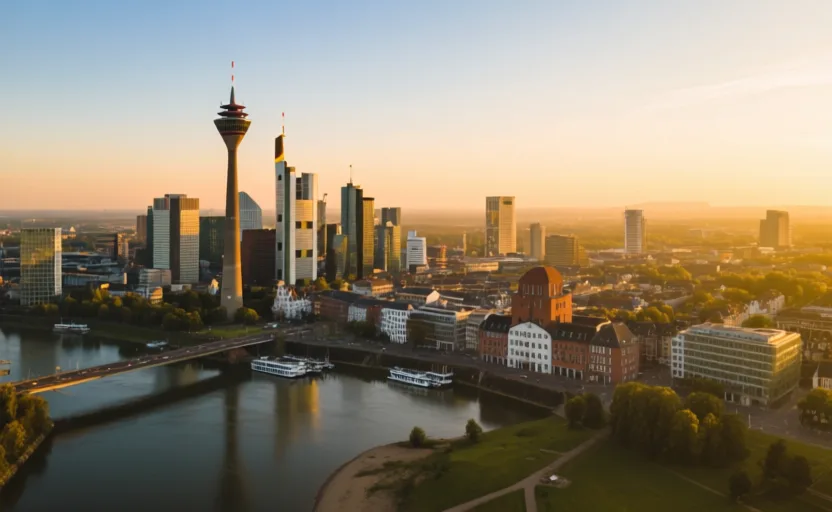 Dusseldorf · AI city illustration · Artistic impression
City · Europe
Dusseldorf
Saved in this browser — no account needed. Sign in later and it comes with you.
Where it is
The city is named after a stream. The Düssel is a small river that enters the Rhine here, and the village that grew beside its mouth became Düsseldorf, literally the village on the Düssel. It lies in the middle of the Lower Rhine basin, mostly on the east bank, on ground of alluvium, mud, sand and clay with hardly any rock. Across the Rhine, Neuss stands on the Erft’s delta. The terrain is low, with a high point of 165 metres in the far east and a low of 28 metres in the north. The climate is oceanic and mild, around 11 °C on average, with about 751 mm of rain a year and prevailing westerly winds.
The land and water around it
The Düssel mouthriver
The stream joins the Rhine at the city’s heart and gave the settlement its name. A town grew here in the 13th century on the delta of the little river, where fishing and farming gave way to a ferry and a toll point.
The Lower Rhine basinplain
Düsseldorf sits wholly on alluvial ground at the centre of the basin, south-west of the Ruhr and in the middle of the Rhine-Ruhr region. It has grown together with Neuss, Krefeld, Ratingen and several other towns.
The right bankriver
Almost the whole city stands on the east side of the Rhine. Only district 4, which includes Oberkassel, Niederkassel, Heerdt and Lörick, lies on the left bank.
Its history, in short
A fishing and farming settlement of the 7th and 8th centuries, it is first mentioned between 1135 and 1159. It passed to the County of Berg in 1186 and became a town on 14 August 1288, a month after the Count of Berg’s forces, backed by townspeople and farmers, destroyed the Archbishop of Cologne’s army at Worringen. The rivalry with Cologne that began then is still played out in carnival, football and beer. Growth was slow for a century, until Duke William II of Berg in 1380 added a new town and a ring of stone fortifications. The city later became capital of the combined duchies of Jülich, Cleves and Berg, and its court was an early patron of art. Prussia took the Rhineland in 1815 and stripped Düsseldorf of its capital role, yet it earned the name City of Art and Gardens. From the 1850s iron, steel and chemical firms moved in, and the population climbed to 100,000 by 1882, from 40,000 in 1850. Wartime raids destroyed much of the old town, and the city was captured by American troops in April 1945. In 1946 it became capital of North Rhine-Westphalia. Japanese companies began opening offices in the 1950s, and by the 1980s the city held Germany’s largest Japanese community.
Timeline
Dates are shown on a timeline rather than as changing shapes on the map. The globe draws modern boundaries only, and tinting a modern outline to stand for a historical one would state something we cannot source.
Post-classical world
1135–1159
First mention
Düsseldorf appears in a document for the first time, and in 1162 as Thusseldorp. The nearby outpost of Kaiserswerth, fortified under Barbarossa, watched traffic on the Rhine.
Approximate dateWikipedia14 August 1288
Town privileges
Count Adolf VIII of Berg grants town status after the victory at Worringen. A monument on the Burgplatz commemorates the day.
Well attestedWikipedia1380
Duke William II
He enlarges the town with a new quarter of about 22.5 hectares, extends the ducal palace and builds stone fortifications around the whole settlement.
Well attestedWikipedia
Industrial & imperial
1815
Prussian rule
After the Congress of Vienna the Rhineland, including Düsseldorf, joins Prussia. The city loses its capital status but becomes the seat of a regional governor and, from 1824, of the Rhenish provincial diet.
Well attestedWikipedia1850–1882
Industrial city
Iron, steel and chemical firms settle here and railway links arrive. The population grows from 40,000 to 100,000.
Well attestedWikipedia
Contemporary
18 April 1945
Captured
American troops take the city after bomber raids that included one in 1943 using over 700 aircraft in a single night. A local resistance group launched Aktion Rheinland as the advance arrived.
Well attestedWikipedia1946
State capital
Düsseldorf is made capital of the new state of North Rhine-Westphalia, even though Cologne is bigger. Ministries and the state parliament remain.
Well attestedWikipedia1964
Japanese Club founded
The club is an early sign of a community that grows to be the largest in Germany. A Chamber of Commerce follows in 1966, an international school in 1971 and a Japanese garden in the Nordpark in 1975.
Well attestedWikipedia
Places that carry meaning
Burgplatz1288 onward
The square by the Rhine where the monument to the 1288 town charter stands, close to the site of the early settlement.
Kaiserswerth12th century
A small town north of the centre, fortified under Barbarossa to watch the river, which became a suburb of Düsseldorf in 1929.
ImmermannstraßeFrom the 1950s
The street at the centre of the city’s Japanese quarter, with shops, restaurants and cultural institutions. A Jōdo Shinshū temple on the grounds of the Japanese Ekō House in Niederkassel is the only one of its kind in Europe.
Kunstakademie Düsseldorf18th century onward
The art academy has counted Joseph Beuys, August Macke, Gerhard Richter and Sigmar Polke among its members, and Andreas Gursky too.
Languages here
Places are usually multilingual. This lists what is actually spoken, not one language per border.
GermanGermanic family
The official language, used in a city with a strongly international population.
In 2019, 42.6 percent of residents had a migration background, and about 25.5 percent held foreign citizenship in 2024.
Düsseldorfer PlattGermanic family
The local dialect of the Rhineland.
In it the city is called Düsseldörp. The suffix -dorf is unusual for a major German city, since it normally marks small villages.
Japanese
Spoken by the largest Japanese community in Germany.
About 11,000 Japanese live in the city and its surroundings, making it the third-largest Japanese community in Europe. In the city proper there were 6,265 Japanese nationals in 2023.
Turkish and other immigrant languages
The languages of the biggest groups of foreign citizens.
At the end of 2023 the largest groups were Turkish, Ukrainian, Greek, Polish and Italian nationals. Turkish citizens formed the largest single group, at around 12,800.
Learn the language here
- 1Understand which languages are spoken hereDusseldorf is multilingual. Start with which languages are used, by whom, and for what — the phrase list only covers one of them.Written by Globe Quest
- 2Learn 11 phrasesCurated everyday phrases for Dusseldorf, with audio and a written form.Written by Globe Quest
- 3Say them out loudSpeaking practice with pronunciation feedback, one phrase at a time.Globe Quest material, your own additions
- 4Come back to themSpaced review, so what you learned this week is still there next month.Written by Globe Quest
Check yourself
What happened on 14 August 1288?
Count Adolf VIII of Berg granted Düsseldorf town privileges
The grant followed the Battle of Worringen, where the Archbishop of Cologne’s army was beaten. It also started the long commercial rivalry between Düsseldorf and Cologne.
Which community in Düsseldorf is the largest of its kind in Germany?
Japanese
Japanese firms began opening offices in the 1950s. By the 1980s the city held Germany’s largest Japanese community and a Little Tokyo around Immermannstraße.
Worth arguing about
- A town that began in a victory over the neighbouring archbishop still jokes about its rival nearly eight centuries later. What keeps a rivalry between two cities alive?
- Düsseldorf is the state capital although Cologne is larger. What does a capital gain from not being the biggest city?
What we have not established
These are open questions, listed rather than filled in. We would rather show a gap than a plausible guess.
How many people live in Düsseldorf?
A 2025 figure of 619,444 sits beside a count of 658,245 inhabitants at the end of 2024. They come from different counting bases, so no single total is given here.
Sources
- Wikipedia · DüsseldorfWikipedia · encyclopedia · checked 2026-11-24
Reviewed by Globe Quest editorial on 2026-11-24. Drafted with AI assistance and checked against the sources above before publication.