 Globe Quest
 Human Quest · LearningSign in
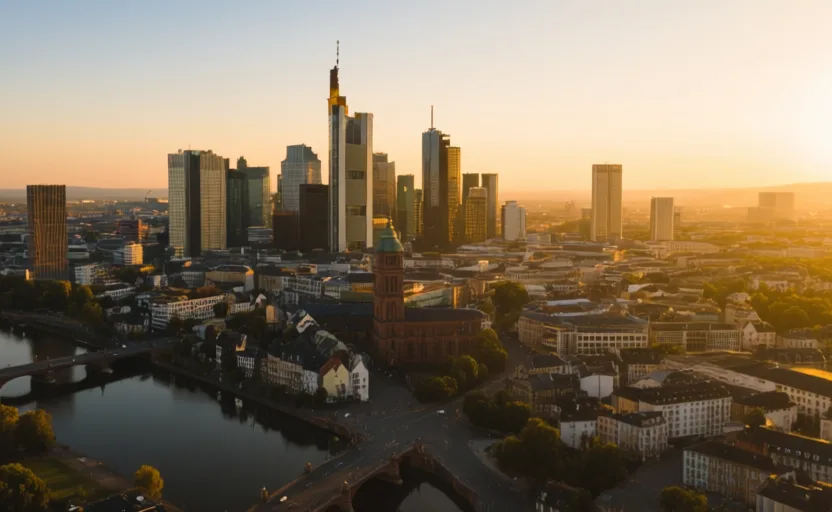 Bonn · AI city illustration · Artistic impression
City · Europe
Bonn
Saved in this browser — no account needed. Sign in later and it comes with you.
Where it is
Bonn straddles the Rhine about 24 kilometres south-south-east of Cologne, with roughly three quarters of its 141 square kilometres on the left bank. The river here leaves the flat Cologne Lowland behind: the Eifel rises to the south and west, the Siebengebirge, or Seven Hills, close the view to the east, and the Sieg marks a natural boundary to the north-east. The city sits in the Rhine valley in one of the warmest parts of Germany, with an oceanic climate. It is also the southern tip of the Rhine-Ruhr region, and the border with Rhineland-Palatinate lies just beyond its limits.
The land and water around it
The Rhineriver
The river divides the city, with almost three quarters of it on the left bank. The towns on the right bank, among them Beuel, were separate until 1969, when Bonn merged them to become more than twice its former size.
The Siebengebirgemountains
The Seven Hills form the natural eastern boundary of the city. The river Sieg forms the other natural boundary, to the north-east.
The Cologne Lowland and the Eifelplain
North of Bonn the land opens into the Cologne Lowland, and to the south and west the Eifel uplands begin. The Rhine valley here is one of the warmest areas in Germany.
Its history, in short
Bonn is among the oldest cities in Germany. Rome settled the Ubii here in 38 BCE and built a fortified camp, and after the defeat in the Teutoburg Forest in 9 CE a legion was stationed in a legionary fortress with a town of traders and craftsmen alongside. The place declined after Roman rule, and Norman raiders burned it twice in 882 and again in 883. A religious centre grew around the minster, a market followed, and full city rights came in 1243. After the Battle of Worringen in 1288 the archbishops of Cologne made Bonn their residence city, and their baroque palaces shaped it until French troops arrived in 1794. Prussia took it in 1815 and founded the university in 1818. The best-known chapter is 1949 to 1990, when Bonn was the capital of West Germany, and then the seat of government until 1999. Today it keeps about a third of the federal ministerial jobs, and hosts 20 United Nations institutions.
Timeline
Dates are shown on a timeline rather than as changing shapes on the map. The globe draws modern boundaries only, and tinting a modern outline to stand for a historical one would state something we cannot source.
Classical world
38 BCE
The Ubii are settled
The Roman governor Agrippa settles the Ubii at the site. A fortified Roman camp follows in 12 BCE, which Bonn took as its starting point when it celebrated 2,000 years in 1989.
Well attestedWikipedia
Post-classical world
882–883
Burned by the Normans
Viking raiders burn Bonn twice in 882, and in 883 attack, burn and loot the newly rebuilt town.
Well attestedWikipedia1243
Full city rights
Bonn is considered to have received full city rights this year. Its religious centre had grown around the minster in the ninth and tenth centuries.
Well attestedWikipedia1288
Battle of Worringen
The outcome of the battle leads the Cologne prince-electors to adopt Bonn as a residence, and in time as their main seat. The palaces they built in the seventeenth and eighteenth centuries gave Bonn its baroque appearance.
Well attestedWikipedia
Early modern & oceanic
1794
French occupation
French troops enter on 8 October. Taxes in food, clothing and lodging, and the end of the electoral administration, bring poverty and cut the population by about 20 per cent.
Well attestedWikipedia
Industrial & imperial
18 October 1818
University founded
Prussia establishes the university, named for King Frederick William III, as a sister to the new institutions in Berlin and Breslau. It becomes known as the Princes' University for the Hohenzollern princes who studied there.
Well attestedWikipedia
Contemporary
1949–1990
Capital of West Germany
The Basic Law is written here, and the period is known to historians as the Bonn Republic. The government stays on until 1999, and the Berlin-Bonn Act keeps a large federal presence afterwards.
Well attestedWikipedia1 August 1969
The Bonn Act
Bad Godesberg, Beuel, Duisdorf and a ring of villages are folded into Bonn, which roughly doubles its population.
Well attestedWikipedia
Places that carry meaning
Bonn Minster9th and 10th centuries onward
The church around which the religious centre of the medieval town grew. The market settlement that followed lay on what is now the market square.
Beethoven's birthplaceBonngasse
On Bonngasse close to the market place, near the rococo Old City Hall of 1737. St Remigius, where Beethoven was baptised, is another of the city's churches.
The federal quarter and the UN Campus1949 onward
The government district holds buildings from the Bonn Republic. The Langer Eugen, once offices for members of parliament, has been the heart of the United Nations Campus since 2006.
Languages here
Places are usually multilingual. This lists what is actually spoken, not one language per border.
GermanGermanic family
The official and everyday language.
About 70 per cent of residents in 2011 were entirely of German origin, and roughly 30 per cent were at least partly of non-German origin.
Bönnsch PlattGermanic family
The local Ripuarian dialect.
A dialect of Ripuarian spoken by all generations, especially during carnival. It belongs to the same group as the speech of nearby Cologne.
Learn the language here
- 1Understand which languages are spoken hereBonn is multilingual. Start with which languages are used, by whom, and for what — the phrase list only covers one of them.Written by Globe Quest
- 2Learn 12 phrasesCurated everyday phrases for Bonn, with audio and a written form.Written by Globe Quest
- 3Say them out loudSpeaking practice with pronunciation feedback, one phrase at a time.Globe Quest material, your own additions
- 4Come back to themSpaced review, so what you learned this week is still there next month.Written by Globe Quest
Check yourself
For how long was Bonn the capital of West Germany?
1949 to 1990
Bonn served from 1949 until reunification in 1990, and remained the seat of government until 1999 when the government moved to Berlin.
Which rulers made Bonn their residence city after 1288?
The prince-electors of Cologne
The archbishops of Cologne ruled from Bonn until 1794, and their electoral palace is now the main building of the university.
Worth arguing about
- Bonn lost its government in 1999 but kept ministries, United Nations bodies and two large companies. What does a city need to hold on to once the state leaves?
- The Rhine splits the city, and 1969 joined its separate towns. Do places on different banks of a river belong in the same city?
Sources
- Wikipedia · BonnWikipedia · encyclopedia · checked 2026-11-24
Reviewed by Globe Quest editorial on 2026-11-24. Drafted with AI assistance and checked against the sources above before publication.