 Globe Quest
 Human Quest · LearningSign in
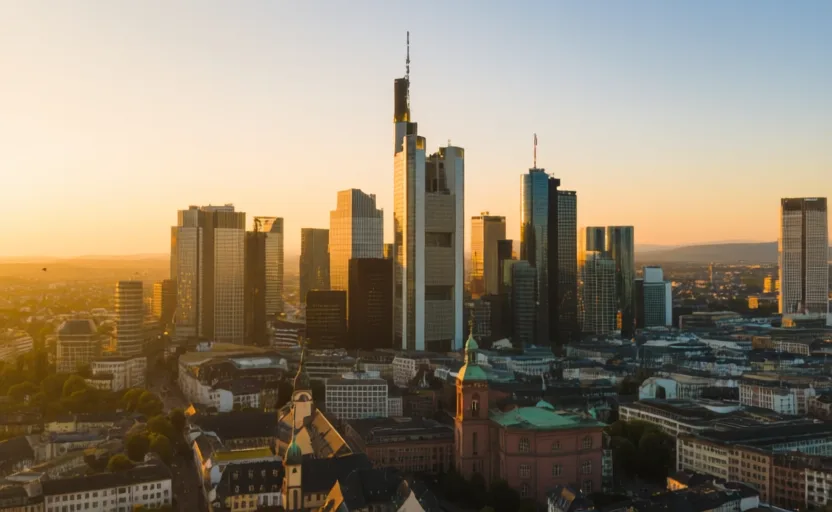 Frankfurt · AI city illustration · Artistic impression
City · Europe
Frankfurt
Saved in this browser — no account needed. Sign in later and it comes with you.
Where it is
The name means “ford of the Franks”, and the ford explains the city. The Main here ran in several channels through a swampy lowland, and the earliest settlement sat on a low hill that the river’s arms turned into an island, reachable on foot only from the west. South-east of the Taunus range, with the Odenwald and Spessart hills on other sides, the area gave natural defence and a crossing on a major route. The built-up city now spans both banks and covers about 248 square kilometres, with Germany’s largest city forest in the south. Winters are among the mildest in the country, and the average temperature is 11.4 °C.
The land and water around it
The Mainriver
The river gave Frankfurt its ford and its name, and later its bridges and port. The city spreads on both banks, with the historical centre to the north and Sachsenhausen to the south.
Cathedral Hillisland
The oldest part of the old town stands on a rise surrounded by arms of the Main, so that only from the west could it be approached on foot without getting wet. That, together with the ford, gave it military and trading advantage.
The Taunus foreland and City Forestforest
North-west of the city rise the Taunus hills, with Celtic settlements and a Stone Age site on the Kapellenberg. South of the Main lies Germany’s largest city forest.
Its history, in short
Romans occupied the cathedral hill in the last quarter of the 1st century and left in the 2nd, and Nida, on the Nidda river, was a Roman district capital in the same area. Frankfurt first appears in the written record in the 790s, when Charlemagne held a church synod there. After 843 it was the principal seat of the eastern Frankish realm, and its importance in the later empire rested on elections. German kings were elected in Frankfurt from 1147, the Golden Bull of 1356 confirmed the custom, and from 1562 emperors were also crowned in the cathedral, a practice that lasted until 1792. In 1372 it became an Imperial Free City. A trade fair is recorded from 1150, and traders in 1585 set up a system of exchange rates that was an early root of the stock exchange. The city lost sovereignty in 1806, regained it as a free city in 1815 and hosted the diet of the German Confederation. In 1848 the Frankfurt Parliament met in St Paul’s Church. Prussia annexed the city in 1866. Bombing in 1944 destroyed the old centre, and rebuilding kept its street plan.
Timeline
Dates are shown on a timeline rather than as changing shapes on the map. The globe draws modern boundaries only, and tinting a modern outline to stand for a historical one would state something we cannot source.
Post-classical world
793–794
First written mention
Charlemagne holds a church council at his court at Franconofurd, the “ford of the Franks”. Records give 793 or 794 for the name’s first appearance.
1240
Fair privilege
Emperor Frederick II places visitors to the trade fair under imperial protection. The fair is first mentioned in 1150 and gains importance from about 1380, when a rival fair in France declines.
Well attestedWikipedia1372
Imperial Free City
Frankfurt answers directly to the emperor rather than to a regional lord, a status it keeps, with interruptions, until 1866.
Well attestedWikipedia
Early modern & oceanic
1562
Coronations begin
Maximilian II is the first king both elected and crowned in Frankfurt. The custom ends in 1792, with the election of Francis II.
Well attestedWikipedia
Industrial & imperial
18 May 1848
The Frankfurt Parliament
The first democratically elected German parliament opens in St Paul’s Church and drafts a constitution for a unified Germany. It fails in 1849 when the Prussian king refuses what he calls a crown from the gutter.
1866
Annexed by Prussia
After the Austro-Prussian War the Free City is absorbed into the Prussian province of Hesse-Nassau. Many in Frankfurt regarded it as a grave injustice.
Well attestedWikipedia1914
A university founded by citizens
The University of Frankfurt, later named after Goethe, is founded by the city’s citizens and is the only civic university foundation in Germany.
Well attestedWikipedia22 March 1944
The old town destroyed
A British attack destroys the whole old town and kills 1,001 people. The city decides to rebuild its historical centre on the old road system.
Well attestedWikipedia
Places that carry meaning
The Cathedral (Kaiserdom)From the 9th century
Louis the German founded a collegiate church on the hill, later rededicated to St Bartholomew. Elections and coronations took place there, and the spire, to plans of 1415, is 95 metres tall.
St Paul’s Church1848–1849
Home of the first democratically elected German parliament, now a national historic monument.
RömerMedieval to modern
A complex of nine houses forming the city hall, the seat of the city council.
Saalhof12th century
The oldest preserved building in the old town.
Languages here
Places are usually multilingual. This lists what is actually spoken, not one language per border.
GermanGermanic family
The official language, with a strong local accent.
The local dialect is Hessian. Words such as Dippe for a jar and Wäldches for a small wood belong to a regional vocabulary that people elsewhere in Germany would not understand.
Languages of immigrant communities
Spoken in a city where half the residents have a migration background.
In 2015, 51.2 percent of residents had a migration background and 27.7 percent held foreign citizenship. Of the immigrants, 46.7 percent came from other EU countries and 24.5 percent from non-EU European countries. Among Muslim migrants, the most common countries of origin were Turkey and Morocco.
Learn the language here
- 1Understand which languages are spoken hereFrankfurt is multilingual. Start with which languages are used, by whom, and for what — the phrase list only covers one of them.Written by Globe Quest
- 2Learn 12 phrasesCurated everyday phrases for Frankfurt, with audio and a written form.Written by Globe Quest
- 3Say them out loudSpeaking practice with pronunciation feedback, one phrase at a time.Globe Quest material, your own additions
- 4Come back to themSpaced review, so what you learned this week is still there next month.Written by Globe Quest
Check yourself
Why did the Frankfurt Parliament’s constitution fail in 1849?
The Prussian king refused the crown it offered him
The 1848 assembly drafted a constitution with the Prussian king as monarch. Frederick William IV declined, and the attempt at a unified constitutional Germany collapsed.
What made Cathedral Hill an early advantage for settlement?
It was an island between arms of the Main, next to a ford
The river’s channels surrounded the hill and left a single dry approach from the west. Being next to the ford, it controlled the crossing.
Worth arguing about
- For centuries Frankfurt was where emperors were chosen, and it later became a centre of banking. Is there a link between a city that hosts elections and a city that hosts markets?
- After the 1944 bombing the city kept the old street plan but not the old buildings. What does a rebuilt street plan keep of a place?
What we have not established
These are open questions, listed rather than filled in. We would rather show a gap than a plausible guess.
When was Frankfurt first mentioned in writing?
Accounts give 793 for the earliest written mention and 794 for the document naming Franconofurd, linked to Charlemagne’s synod. Which counts depends on which text is meant, so the entry shows both dates.
How many people live in Frankfurt?
Counts of 763,380 for 2019 and 778,589 for 2025 are both given for the city proper, while the urban area is placed at 2.3 to 2.7 million depending on source and year. The boundary decides the answer.
Sources
- Wikipedia · FrankfurtWikipedia · encyclopedia · checked 2026-11-24
- Wikipedia · History of FrankfurtWikipedia · encyclopedia · checked 2026-11-24
Reviewed by Globe Quest editorial on 2026-11-24. Drafted with AI assistance and checked against the sources above before publication.