 Globe Quest
 Human Quest · LearningSign in
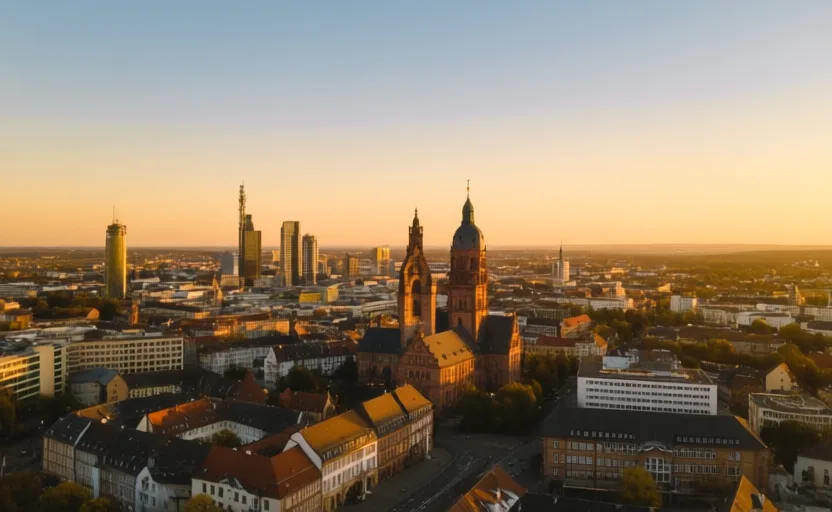 Mannheim · AI city illustration · Artistic impression
City · Europe
Mannheim
Saved in this browser — no account needed. Sign in later and it comes with you.
Where it is
Two rivers meet here: the Neckar runs into the Upper Rhine, and the city occupies the angle between them in the old Electoral Palatinate. The ground is the flat Upper Rhine Plain, between the Palatine Forest to the west and the Oden Forest to the east, in what is Germany's warmest region. Summers are humid, thunderstorms are frequent, and snow is rare. Across the river lies Ludwigshafen in Rhineland-Palatinate, and the two together form a continuous urban zone of about 500,000 people, while some of Mannheim's northern suburbs reach into Hesse.
The land and water around it
The Rhine and Neckar confluenceriver
The city's reason for being. The Rhine gives it Germany's largest inland port, and the position between Frankfurt and Stuttgart makes it a major rail and road junction.
The Upper Rhine Plainplain
A wide, flat lowland bordered by the Palatine Forest and the Oden Forest. It is known as Germany's warmest region, with a high summer humidity that raises the heat index.
The Rhine-Neckar conurbationplain
Mannheim, Ludwigshafen and Heidelberg form the centre of a metropolitan region of nearly 2.4 million people, the seventh largest in Germany.
Its history, in short
A village called Mannenheim is first recorded in 766, and it stayed a village through the Middle Ages. In 1606 the Elector Palatine Frederick IV began a fortress, the Friedrichsburg, and a town of straight streets beside it; it received city status in 1607. Tilly's forces levelled it around 1622 in the Thirty Years' War, and French armies damaged it again in 1689. After rebuilding, the electors moved their capital from Heidelberg to Mannheim in 1720 and built the great palace, finished in 1760. The court supported one of Europe's best orchestras and the Mannheim School of composers, but it left for Munich in 1778, and in 1802 the city passed to Baden. The National Theatre, founded in 1779, outlived it. Then the rivers and railways took over: a harbour in 1828, the first Baden railway in 1840, and a run of inventions from the bicycle to the automobile. Air raids destroyed the centre in the Second World War, and the University was founded in 1967.
Timeline
Dates are shown on a timeline rather than as changing shapes on the map. The globe draws modern boundaries only, and tinting a modern outline to stand for a historical one would state something we cannot source.
Post-classical world
766
First record
The name Mannenheim, probably meaning the home of a man called Manno, appears in a legal transaction preserved in a twelfth-century copy from Lorsch Abbey.
Well attestedWikipedia
Early modern & oceanic
1606–1607
Fortress and grid town
Frederick IV begins the Friedrichsburg in 1606 and lays out a grid of streets beside it. He gives the settlement official city status on 24 January 1607.
Well attestedWikipedia1720
Capital of the Palatinate
Elector Karl III Philip moves the court from Heidelberg and starts the palace and the Jesuit church, both finished by 1760.
Well attestedWikipedia
Industrial & imperial
1817
The first bicycle
Karl Drais builds the first two-wheeled draisine. It is one of the inventions that give Mannheim its nickname as the city of inventions.
Well attestedWikipedia1828–1840
Harbour and railway
The Rhine Harbour opens in 1828, and the first Baden railway, from Mannheim to Heidelberg, in 1840.
Well attestedWikipedia1886–1888
The automobile
Karl Benz drives the first automobile on Mannheim's streets in 1886. In August 1888 his wife Bertha makes the first long road trip by car, from Mannheim to Pforzheim and back.
Well attestedWikipedia16 December 1940
Bombing begins
A Royal Air Force night raid is described by some sources as the first deliberate strategic bombing of the war. Later raids destroy the city centre, and about a third of the city is older than 1950.
DisputedWikipediaSome accounts, which call this raid the first deliberate strategic bombing of the war.
Contemporary
1967
University
The University of Mannheim is founded. It is now housed in Mannheim Palace, which was reconstructed after the war.
Well attestedWikipedia
Places that carry meaning
Mannheim Palace1720–1760
Once the home of the Prince-elector, it stands at the base of the grid and is now the home of the university. It was rebuilt after wartime destruction.
The Quadratefrom 1606
The central streets are laid out on a grid, and most of them have no names. City blocks are referred to by a letter and number, which gave Mannheim the nickname of the Square City.
Water Tower1886
A tower of 60 metres above the art nouveau Friedrichsplatz, and the symbol of the city. It was rebuilt after the war.
Languages here
Places are usually multilingual. This lists what is actually spoken, not one language per border.
GermanGermanic family
The official and everyday language.
German is the official and mainly spoken language across the country.
Palatine GermanGermanic family
The regional dialect of the Palatinate.
In this speech the city's name comes out as Mannem or Monnem.
Balkan languages
Languages of the largest immigrant groups.
About 49.4 per cent of residents have origins in 168 nationalities, and a large share of the immigrants come from the Balkans and other European countries. Serbo-Croatian, Bulgarian and other Balkan languages are among the most used immigrant languages in Germany.
Learn the language here
- 1Understand which languages are spoken hereMannheim is multilingual. Start with which languages are used, by whom, and for what — the phrase list only covers one of them.Written by Globe Quest
- 2Learn 12 phrasesCurated everyday phrases for Mannheim, with audio and a written form.Written by Globe Quest
- 3Say them out loudSpeaking practice with pronunciation feedback, one phrase at a time.Globe Quest material, your own additions
- 4Come back to themSpaced review, so what you learned this week is still there next month.Written by Globe Quest
Check yourself
What is unusual about the streets of central Mannheim?
They are arranged as a grid, with blocks named by letter and number
The grid goes back to the plan of 1606, and it is the reason for the city's nickname, the Square City.
Which two rivers meet at Mannheim?
The Rhine and the Neckar
The Neckar joins the Upper Rhine here. The junction fed an industrial city that also produced the first bicycle and, later, the first automobile.
Worth arguing about
- A grid imposed on a village in 1606 still organises how the city finds its way. Does a planned city feel different to live in?
- Mannheim and Ludwigshafen form one urban zone across a state border. Who should plan for such a place?
What we have not established
These are open questions, listed rather than filled in. We would rather show a gap than a plausible guess.
Was Mannheim the first city to be strategically bombed?
Some sources describe the Royal Air Force night raid of 16 December 1940 as the first deliberate strategic bombing of the war. No agreed first date for such bombing is given, so the claim stays open.
Sources
- Wikipedia · MannheimWikipedia · encyclopedia · checked 2026-11-24
- Wikipedia · GermanyWikipedia · encyclopedia · checked 2026-11-24
Reviewed by Globe Quest editorial on 2026-11-24. Drafted with AI assistance and checked against the sources above before publication.