 Globe Quest
 Human Quest · LearningSign in
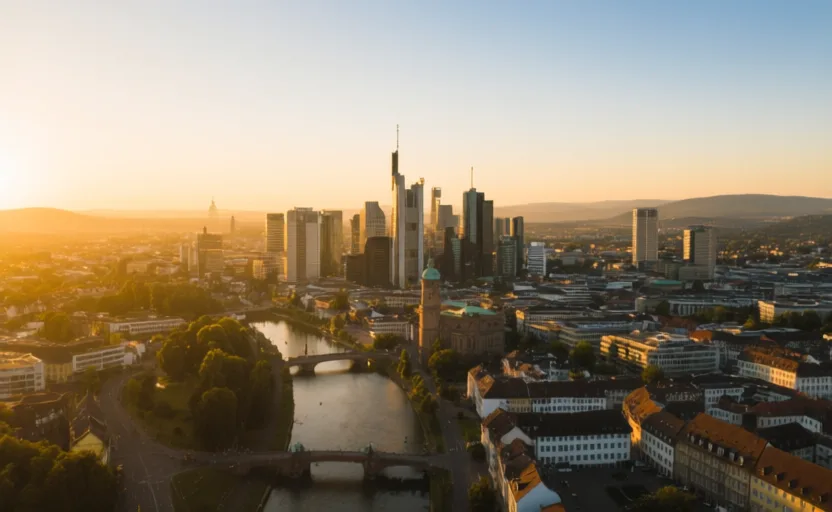 Stuttgart · AI city illustration · Artistic impression
City · Europe
Stuttgart
Saved in this browser — no account needed. Sign in later and it comes with you.
Where it is
Stuttgart lies in a bowl. Locals call the basin the Kessel, the cauldron, and the Neckar runs through its floor at about 207 metres while the surrounding hills climb to 549. The slopes are planted with vines and capped with forest, so the city describes itself as lying between forest and vines. The rim shelters it from harsh weather, with the Swabian Alb and the Black Forest further out, but it also traps air: the basin is prone to stagnant air and hot summers. The average annual temperature is about 9 °C, with some 719 mm of rain and 1,807 hours of sun.
The land and water around it
The Stuttgart basinvalley
A fertile bowl on the Neckar, an hour from the Black Forest and the Swabian Jura. Farmers have worked its soil since the seventh millennium BC, and the Romans placed a fort at its rim.
Vineyard slopeshills
The Birkenkopf at 511 metres and the Württemberg at 411 metres rise above the valley, and some slopes are terraced for wine. The height range between the river and the top hill is unusual for a large German city.
Ventilation corridorsclimate
Because the basin traps heat and air pollution, planners drew a Climate Atlas of wind patterns and cold-air flows. Zoning keeps corridors free of building so that cool night air from the forests and vineyards can reach the centre. The method is often cited in urban climatology.
Its history, in short
The earliest settlement was not Stuttgart but Cannstatt, a Roman fort of about AD 90 on the Neckar crossing and the road between Mainz and Augsburg, with mineral springs that were probably already in use. Stuttgart itself began around 950 as a stud farm, founded by Liudolf, Duke of Swabia, to breed warhorses; the name means exactly that. It stayed in Cannstatt’s shadow until it received a charter in 1320. The fortunes of the House of Württemberg then carried it: it became the seat of the county, the duchy from 1495, and finally the kingdom, until 1918. Württemberg went Protestant in 1534. The first Cannstatter Volksfest was held in 1818 to mark a good harvest after the Year Without Summer. The city’s modern identity came with industry. Robert Bosch opened a workshop in 1886, and Daimler and Benz made it the cradle of the automobile. After heavy bombing it recovered by 1952. Since the 1960s the car industry has drawn foreign workers, and by 2022 47 percent of residents had a foreign background.
Timeline
Dates are shown on a timeline rather than as changing shapes on the map. The globe draws modern boundaries only, and tinting a modern outline to stand for a historical one would state something we cannot source.
Classical world
c. AD 90
Roman fort at Cannstatt
A permanent fort is built on the ridge to guard the river crossing and the road to Augsburg. Cannstatt first appears in the archives of St Gall in 708 as “Canstat ad Neccarum”.
Post-classical world
c. 950
A stud farm
Duke Liudolf of Swabia founds a stud farm for warhorses. The Old High German word Stuotgarten, meaning stud farm, gives the city its name.
Approximate dateWikipedia1320
Town charter
The growing town receives its charter, though it remains overshadowed by Cannstatt.
Well attestedWikipedia
Early modern & oceanic
1495
Duchy of Württemberg
Eberhard becomes the first duke and makes Stuttgart seat of the duchy as well as the county. It had been the count’s residence since 1488.
Well attestedWikipedia1534
The Reformation arrives
Württemberg becomes predominantly Protestant. Since 1975 the number of Protestants in the city has dropped from about 300,000 to 200,000.
Well attestedWikipedia
Industrial & imperial
1818
First Volksfest
King Wilhelm I and Queen Catherine introduce the Cannstatter Volksfest to celebrate a plentiful harvest, after the famine that followed the Year Without Summer.
Well attestedWikipedia1886
Bosch opens a workshop
Robert Bosch starts his first workshop. The car and motorbike are said to have been invented in the region, and Daimler, Maybach and Benz industrialised them from 1887.
Contemporary
6 September 1946
A speech at the opera house
US Secretary of State James Byrnes presents an early concept of the Marshall Plan at the Stuttgart Opera House. American forces remain in the city, at their height over 45,000 people on more than 40 installations.
Well attestedWikipedia
Places that carry meaning
Cannstatt and its Roman fortFrom c. AD 90
The original settlement of the area, on a hill rim overlooking the Neckar. Roman Cannstatt was one of the largest Roman towns in modern Baden-Württemberg.
Schlossplatz and the Green UMedieval to modern
The largest square in the city sits at the junction of shopping streets, the palace gardens and the central castles. The gardens, first mentioned in 1350, trace a U across the middle of the map and run down to the Neckar.
The State Gallery1843 onward
The Old State Gallery opened in 1843 and was extended in 1984. It holds art from the 14th to the 19th century, with works by Rubens, Rembrandt, Monet and Cézanne.
Mercedes-Benz and Porsche museums20th century onward
Two museums, with the city’s reputation as Germany’s car capital, display the industry that made Stuttgart prosperous.
Languages here
Places are usually multilingual. This lists what is actually spoken, not one language per border.
GermanGermanic family
The official language and the language of schools and business.
The city’s residents come from far and wide: more than half are not of Swabian background, as many Germans moved here for work.
SwabianGermanic family
The dialect of the region, which gives the city the nickname Schwabenmetropole.
In Swabian the name is pronounced roughly Schduagert, and in Alemannic Schtuegert. Both drop the middle T sound.
Languages of immigrant communities
Spoken by workers who came from the 1960s and by refugees of the 1990s.
At the end of 2018 the biggest foreign groups were Turks at 17,900, then Croats, Italians and Greeks, each between 13,000 and 15,500, and Serbs at 5,844. The Yugoslav wars of the 1990s brought another wave of refugees.
Learn the language here
- 1Understand which languages are spoken hereStuttgart is multilingual. Start with which languages are used, by whom, and for what — the phrase list only covers one of them.Written by Globe Quest
- 2Learn 11 phrasesCurated everyday phrases for Stuttgart, with audio and a written form.Written by Globe Quest
- 3Say them out loudSpeaking practice with pronunciation feedback, one phrase at a time.Globe Quest material, your own additions
- 4Come back to themSpaced review, so what you learned this week is still there next month.Written by Globe Quest
Check yourself
What does the name Stuttgart originally mean?
Stud farm
Old High German Stuotgarten means stud farm. Duke Liudolf of Swabia founded it around 950 to breed warhorses.
Why is Stuttgart cited in urban climatology?
Its planners keep ventilation corridors free so cool air reaches the centre
The basin traps heat and air pollution, so a Climate Atlas maps wind and cold-air drainage, and zoning prevents building in designated corridors.
Worth arguing about
- Stuttgart started as a stud farm and became the cradle of the automobile. How much does a city’s founding purpose shape what it later makes?
- The city’s shape forces it to manage air as carefully as land. What would your own city have to protect if its geography were taken seriously?
What we have not established
These are open questions, listed rather than filled in. We would rather show a gap than a plausible guess.
How many people live in Stuttgart?
Counts include 613,111 for 2023 and a rounded 630,000 elsewhere in the record. They come from different dates and bases, so no single total is given.
Sources
- Wikipedia · StuttgartWikipedia · encyclopedia · checked 2026-11-24
- Wikipedia · History of StuttgartWikipedia · encyclopedia · checked 2026-11-24
Reviewed by Globe Quest editorial on 2026-11-24. Drafted with AI assistance and checked against the sources above before publication.