 Globe Quest
 Human Quest · LearningSign in
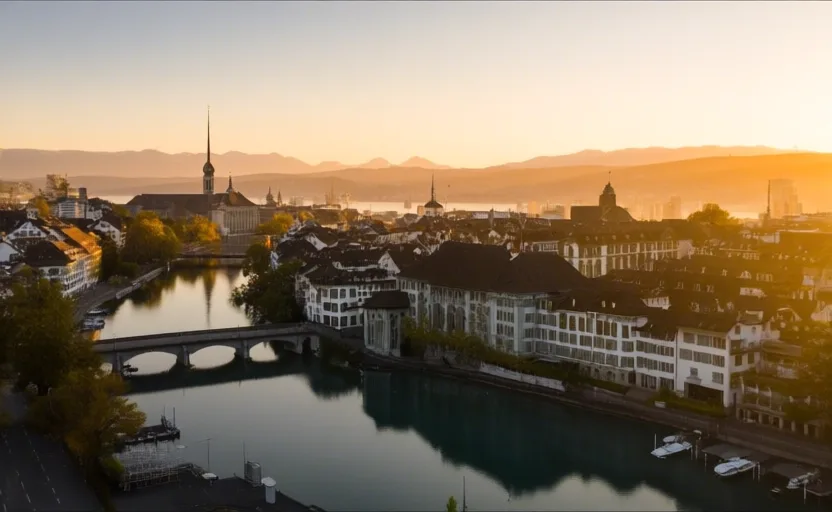 Basel · AI city illustration · Artistic impression
City · Europe
Basel
Saved in this browser — no account needed. Sign in later and it comes with you.
Where it is
Basel stands where the High Rhine gives way to the Upper Rhine, in a flat basin close to the point where Switzerland, France and Germany meet. The river divides the city in two, Grossbasel (Greater Basel) to the left and Kleinbasel (Lesser Basel) to the right as it flows downstream, and the urban area spills into both neighbouring countries as a trinational region of roughly 900,000 people. The city is beyond the Jura, on the Swiss frontier itself, and its climate is temperate and oceanic, with about 842 millimetres of rain a year. Barges can reach it from the sea, and it holds Switzerland's only cargo port.
The land and water around it
The Rhineriver
The river runs through the middle of the city and is crossed by five bridges and four cable ferries that glide on the current. For centuries the first bridge of 1225 was the only permanent crossing between Lake Constance and the sea, and today the river links Basel's port to Rotterdam.
The trinational basinvalley
A flat basin at the corner of three countries. The Dreiländereck, where the borders meet, has its own monument. Because the city lies beyond the Jura on the frontier itself, Swiss military planners are reported to have thought it hard to defend.
Its history, in short
A Celtic village and then a Celtic hill settlement preceded Roman Basel, where a fort stood on the site of the later minster and the name Basilia is first recorded in the 3rd century. From 999 until the Reformation, prince-bishops ruled the town. Work on the cathedral began in 1019, in 1225 the first bridge was thrown over the Rhine, and guilds and a council of nobles and burghers gradually took a share of power. The university, founded in 1460, drew scholars, and the city later sheltered thinkers and artists from unrest elsewhere. Basel joined the Swiss Confederacy on 9 June 1501, the only canton asked to join rather than asking, because it controlled grain imports and sat on a strategic crossing. It turned Protestant in 1529. In 1833, after a short civil war, the countryside split away to form Basel-Landschaft. The city walls were pulled down between 1861 and 1878. In the 20th century Basel became Switzerland's centre of chemical and pharmaceutical industry and a place where international bodies meet.
Timeline
Dates are shown on a timeline rather than as changing shapes on the map. The globe draws modern boundaries only, and tinting a modern outline to stand for a historical one would state something we cannot source.
Classical world
2nd century BC
A Celtic village near the Rhine bend
The Raurici have a village at Basel-Gasfabrik. It is abandoned in the 1st century BC for a fortified hill settlement where the minster now stands, probably in response to the Roman invasion of Gaul.
Approximate dateWikipedia237/238
Basilia named
The name Basilia is first recorded in the 3rd century and then referred to the Roman castle. It probably derives from a personal name.
Approximate dateWikipedia
Post-classical world
1019
Cathedral begun
Work on the cathedral, known locally as the Münster, begins under the Emperor Henry II, while prince-bishops hold the town.
Well attestedWikipedia1225
The first Rhine bridge
Bishop Heinrich von Thun has a bridge built at the site of today's Middle Bridge, largely funded by the Jewish community. Kleinbasel gradually forms around its far end.
Well attestedWikipedia
Early modern & oceanic
1460
University of Basel founded
The University of Basel, the oldest in Switzerland, opens with a faculty of medicine, starting a tradition of chemical and medical research.
9 June 1501
Joins the Swiss Confederacy
Basel becomes the eleventh canton and, unusually, the one that was invited. It agrees to stay neutral in disputes between other cantons and offer mediation.
Well attestedWikipedia
Industrial & imperial
1833
The countryside secedes
After three years of agitation and a short civil war, the disadvantaged rural districts leave to form the half canton of Basel-Landschaft.
Well attestedWikipedia1897
First World Zionist Congress
Theodor Herzl chooses Basel for the congress, which met in the city ten times over fifty years, more often than anywhere else.
Well attestedWikipedia
Places that carry meaning
The Münster and its hillCeltic oppidum, Roman castrum, 1019 cathedral
The same high ground by the Rhine has held a Celtic hill settlement, a Roman fort and the cathedral begun in 1019.
Middle Bridge1225; present structure 1905
The crossing that created Kleinbasel. The medieval bridge was funded in large part by Basel's Jewish community, who had settled in the city a century earlier.
Kunstmuseum17th century collection
The collection began in 1661 as the first art collection open to the public anywhere. In 1967 voters approved the purchase of three Picasso works at risk of being sold, a first for a political community, and Picasso gave three more in thanks.
Languages here
Places are usually multilingual. This lists what is actually spoken, not one language per border.
GermanGermanic family
The majority language and the official language of the canton.
At the 2000 census 77.8 per cent of residents spoke German as their main language. Even Romansh, the smallest national language, had 202 speakers in the city.
ItalianRomance family
The second most common language in the 2000 census.
About 5.4 per cent of residents spoke Italian, ahead of French at 2.6 per cent, reflecting migration from Italy and the proximity of France.
FrenchRomance family
A neighbour's language, heard across the border and in a minority at home.
Basel has a French railway station, and the French frontier lies within the trinational urban area. About 36.9 per cent of the canton's residents were foreign nationals in 2021.
Learn the language here
- 1Understand which languages are spoken hereBasel is multilingual. Start with which languages are used, by whom, and for what — the phrase list only covers one of them.Written by Globe Quest
- 2Learn 11 phrasesCurated everyday phrases for Basel, with audio and a written form.Written by Globe Quest
- 3Say them out loudSpeaking practice with pronunciation feedback, one phrase at a time.Globe Quest material, your own additions
- 4Come back to themSpaced review, so what you learned this week is still there next month.Written by Globe Quest
Check yourself
What was unusual about how Basel joined the Swiss Confederacy in 1501?
It was the only canton asked to join
The confederates invited Basel because of its strategic location and its control of grain from Alsace, and required it to stay neutral in disputes among the other cantons.
Why did the 1225 Rhine bridge matter for centuries?
It was the only permanent crossing from Lake Constance to the sea
No other permanent bridge crossed the Rhine between Lake Constance and the sea for many centuries, which made Basel a gateway and led to the growth of Kleinbasel.
Worth arguing about
- Basel sits at the meeting point of three countries and shares a metropolitan area with two. What decisions does it have to make with its neighbours rather than alone?
- A city that votes to buy art for a public museum, hosts a university from 1460 and houses global drug makers. How do these traditions fit together?
What we have not established
These are open questions, listed rather than filled in. We would rather show a gap than a plausible guess.
How large is Basel's population?
Figures vary with the boundary: 177,595 inside the municipality, a larger canton of 201,971 in 2021, a Swiss agglomeration of 541,000 and a trinational region of around 900,000. Counts are made on different dates and by different authorities.
Sources
- Wikipedia · BaselWikipedia · encyclopedia · checked 2026-11-24
- Wikipedia · SwitzerlandWikipedia · encyclopedia · checked 2026-11-24
Reviewed by Globe Quest editorial on 2026-11-24. Drafted with AI assistance and checked against the sources above before publication.