 Globe Quest
 Human Quest · LearningSign in
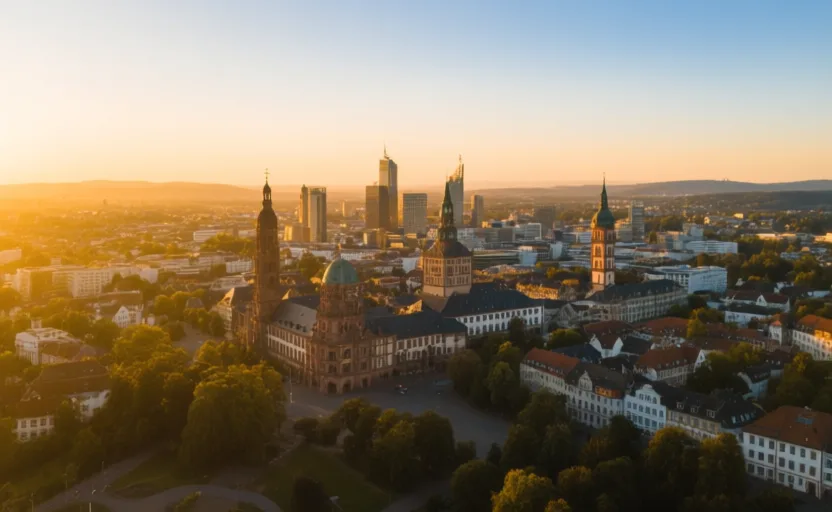 Wiesbaden · AI city illustration · Artistic impression
City · Europe
Wiesbaden
Saved in this browser — no account needed. Sign in later and it comes with you.
Where it is
Wiesbaden fills a wide basin on the right bank of the Rhine, just above the point where the Main joins it and the Rhine turns from a northward to a westward course. Across the water is Mainz. To the north the Taunus hills rise as a wall, up to 608 metres at the Hohe Wurzel, while the city centre sits at about 115 metres in the valley of the small Salzbach. That shelter gives a mild climate, and vineyards and farmland cover about a third of the municipal area and forest over a quarter. Fifteen mineral springs, 14 of them hot, rise under the old town. They have drawn people to this spot since Roman times.
The land and water around it
The Rhine bend at the Mainriver
Wiesbaden stands on the northern bank, at the elbow where the Rhine stops flowing north and swings west. The Rhine forms 10.3 kilometres of the municipal boundary, and the Schierstein harbour entrance, 83 metres above sea level, is the lowest point.
The Taunusmountains
A range trending north-east, protecting the city from the north and west. It carries the forest that covers 27.4 per cent of the municipality, and the Roman frontier ran through it.
The hot springs of the Salzbach valleyvalley
The old town sits in the narrow valley of the Salzbach, which collects several smaller streams and the outflow of the thermal springs. About two million litres of mineral water a day make the city the second-most productive spa in Germany after Aachen.
Its history, in short
The springs drew the Romans first. A fort for auxiliary cavalry stood here from 6 AD, Pliny the Elder wrote about the hot water, and the place appears in 121 as Aquae Mattiacorum, the waters of a Germanic tribe, behind the frontier wall in the Taunus. The name Wiesbaden, meadow baths, is first recorded around 828 to 830. The counts of Nassau held it from the 1170s, and it became an imperial city in 1232, only to be ordered destroyed by the Archbishop of Mainz in 1242. Lutheran from 1543, it had barely 40 residents left in 1648 after the Thirty Years' War. In 1806 it became capital of the Duchy of Nassau, and the spa and casino, opened in 1810, made it a resort until Prussian authorities banned gambling in 1872. In 1946 it became capital of Hesse. American forces have been stationed here since the Second World War, and the city is now home to the headquarters of United States Army Europe and Africa.
Timeline
Dates are shown on a timeline rather than as changing shapes on the map. The globe draws modern boundaries only, and tinting a modern outline to stand for a historical one would state something we cannot source.
Classical world
6 AD
A Roman fort
A fort is built for an auxiliary cavalry unit, beginning continuous occupation. Pliny mentions the hot springs, and a Roman name, Aquae Mattiacorum, is recorded in 121.
Approximate dateWikipedia
Post-classical world
828–830
First use of the name
Einhard, Charlemagne's biographer, mentions Wisabada. The Frankish kings had a palace here in the eighth century.
Approximate dateWikipedia1232–1242
Imperial city, then destroyed
Wiesbaden becomes an imperial city in 1232. In 1242, during the emperor's war with the Pope, Archbishop Siegfried III of Mainz orders it destroyed.
Well attestedWikipedia
Early modern & oceanic
1543
Reformation
The first Lutheran pastor is named on 1 January, and the first Latin school opens the same day. The town had lost its privileges after joining the Peasants' War of 1525 and recovered them in 1566.
Well attestedWikipedia1648
A near-empty town
At the end of the Thirty Years' War chronicles say Wiesbaden had barely 40 residents left. The oldest standing building, the old city hall, dates from 1609 to 1610, because fires in 1547 and 1561 took earlier ones.
Approximate dateWikipedia
Industrial & imperial
1806
Capital of Nassau
Wiesbaden becomes the capital of the Duchy of Nassau. The new City Palace, built from 1841, serves as the main residence of the House of Nassau.
Well attestedWikipedia10 November 1938
The synagogue destroyed
On Kristallnacht the large synagogue on the Michelsberg, designed by Phillip Hoffmann and built in 1869, is destroyed, along with another in Bierstadt. Some 2,700 Jews lived in the city in 1933, and nearly all were deported by June 1942.
Well attestedWikipedia
Contemporary
1946
Capital of Hesse
After the war Wiesbaden becomes the capital of the new state, although Frankfurt is far larger and is the economic centre. Wiesbaden suffered much less bombing than Frankfurt, and air force sources call the rumour that it was spared on purpose a myth.
Well attestedWikipedia
Places that carry meaning
The Kurhaus district19th century
The spa quarter around the Kurhaus, where the old casino opened in 1810, and where the hot springs flow out. The city has been called the Nice of the North for its climate and architecture.
Biebrich Palacefrom 1744
The riverside palace that served from 1744 as the chief residence of the Nassau-Usingen line, before the court moved into the town itself.
The AKK boroughsuntil 1945
Mainz-Amöneburg, Mainz-Kastel and Mainz-Kostheim were part of Mainz on the right bank until 1945. They still carry Mainz in their names, and the dispute over them lies behind much of the rivalry between the two cities.
Languages here
Places are usually multilingual. This lists what is actually spoken, not one language per border.
GermanGermanic family
The official and everyday language.
German is the official and mainly spoken language across the country.
EnglishGermanic family
Heard around the American military community.
American forces have been present since the Second World War, and many Americans came in the 1950s for jobs at the bases. The headquarters of United States Army Europe and Africa is at Erbenheim.
Immigrant languages
Languages of residents from over 180 countries.
Few German cities draw residents from so many places. Turkish, Arabic, Polish and Italian are among the main immigrant languages across the country.
Learn the language here
- 1Understand which languages are spoken hereWiesbaden is multilingual. Start with which languages are used, by whom, and for what — the phrase list only covers one of them.Written by Globe Quest
- 2Learn 12 phrasesCurated everyday phrases for Wiesbaden, with audio and a written form.Written by Globe Quest
- 3Say them out loudSpeaking practice with pronunciation feedback, one phrase at a time.Globe Quest material, your own additions
- 4Come back to themSpaced review, so what you learned this week is still there next month.Written by Globe Quest
Check yourself
What does the name Wiesbaden mean?
Meadow baths
The name refers to the baths in the meadows beside the hot springs, which Romans used long before the name is first written down.
Which city is the capital of Hesse, even though Frankfurt is larger?
Wiesbaden
Wiesbaden became the capital in 1946. Frankfurt remained the economic and financial centre, and Wiesbaden had suffered much less in the bombing.
Worth arguing about
- Three Wiesbaden boroughs still carry the name of Mainz across the river. How much does a name matter once the boundary has moved?
- A spa town became a state capital and then an American military hub. How does a place hold onto a single identity through that?
Sources
- Wikipedia · WiesbadenWikipedia · encyclopedia · checked 2026-11-24
- Wikipedia · GermanyWikipedia · encyclopedia · checked 2026-11-24
Reviewed by Globe Quest editorial on 2026-11-24. Drafted with AI assistance and checked against the sources above before publication.