 Globe Quest
 Human Quest · LearningSign in
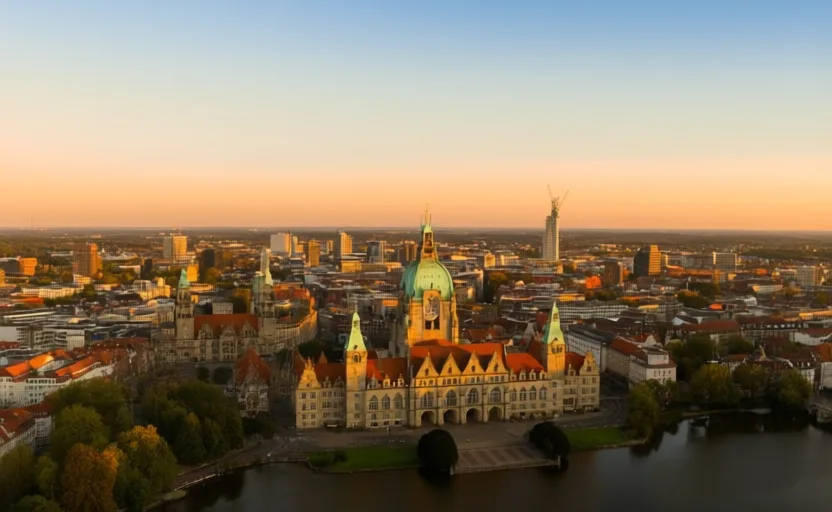 Hannover · AI city illustration · Artistic impression
City · Europe
Hannover
Saved in this browser — no account needed. Sign in later and it comes with you.
Where it is
Where the River Leine is joined by its tributary the Ihme, the land is flat: this is the southern margin of the North German Plain, with the Harz mountains lying away to the south-east. That position decided the city's role. Roads and railways running east to west, between Berlin and the Rhine and Ruhr, cross those running north to south, between Hamburg and Frankfurt, right here. The Leine was navigable this far upstream and linked the town to Bremen, so goods and people met at the river bank. The climate is oceanic, shaped by air from the Atlantic although the sea is far away.
The land and water around it
The Leine and the Ihmeriver
The city grew on the east bank of the Leine, at the upper end of the stretch that boats could use. The river tied Hannover to the Hanseatic port of Bremen and made the crossing point valuable before any railway existed.
The North German Plainplain
Hannover lies at the southern edge of this wide lowland, with open ground to the north and east. The plain made east-west travel easy, which is why the city became a junction for rail and motorway lines.
The Harz foothillsmountains
The Harz mountains lie south-east of the city. Iron and silver from the northern Harz fed Hannover's trade, and east-west traffic had to pass around them.
Its history, in short
Hannover started as a village of ferrymen and fishermen on the east bank of the Leine, and received town privileges in 1241 because it sat on a natural crossroads. In 1636 the Duke of Brunswick-Lüneburg made it his residence, and in 1692 his house was raised to electors of the Empire. In 1714 the Elector became King George I of Great Britain, beginning a personal union that left the two states legally separate. The link broke in 1837, because Hanoverian law barred a woman from succeeding, so Victoria took the British throne and her uncle Ernest Augustus became king in Hannover. Prussia annexed the kingdom in 1866. In the Nazi years the city's Jewish community was destroyed; of about 2,271 Jews living there in 1939, fewer than 100 remained in 1945. Bombing destroyed over 90 per cent of the city centre. From 1946 Hannover has been the capital of Lower Saxony, and its fairground, enlarged for Expo 2000, is the largest in the world.
Timeline
Dates are shown on a timeline rather than as changing shapes on the map. The globe draws modern boundaries only, and tinting a modern outline to stand for a historical one would state something we cannot source.
Post-classical world
1241
Town privileges
Hannover, a small crossroads settlement, receives town rights. Its name probably meant a high river bank, though the meaning is debated.
Well attestedWikipedia
Early modern & oceanic
1636
A ducal residence
George, Duke of Brunswick-Lüneburg, moves his seat to Hannover. The dukes become electors of the Empire in 1692, confirmed by the Imperial Diet in 1708.
Well attestedWikipedia1714
Union with Britain
Elector George Louis becomes George I of Great Britain. The two states share a monarch but remain legally independent, and the union lasts until 1837.
Well attestedWikipedia
Industrial & imperial
1837
The thrones part
Hanoverian succession law prefers male lines, so Victoria inherits Britain while her uncle Ernest Augustus becomes King of Hannover. His annulment of the 1833 constitution provokes protests from the city authorities.
Well attestedWikipedia1866
Annexed by Prussia
After the Austro-Prussian War the kingdom is absorbed into Prussia and Hannover becomes the capital of a Prussian province.
Well attestedWikipedia9 November 1938
The synagogue burns
On Kristallnacht the Hannover synagogue, built in 1870 to a design by Edwin Oppler, is burnt. The pogrom followed the expulsion of 484 Hanoverian Jews of Polish origin that October, among them the family of Herschel Grynszpan.
Well attestedWikipedia15 December 1941
Deportations to Riga
The first Hannover Jews are deported to Riga, part of a total of about 2,400 people sent from the city. Very few survive.
Well attestedWikipedia
Contemporary
1946
Capital of Lower Saxony
In the British occupation zone, Hannover becomes capital of the new state of Lower Saxony and grows rapidly through the 1950s and 1960s.
Well attestedWikipedia
Places that carry meaning
The Hannover fairgroundExpanded for Expo 2000
Extended repeatedly, above all for Expo 2000, it is the largest exhibition ground in the world. The city holds more than 60 national and international exhibitions every year.
Memorial at the Opera SquareMemorial
A monument on the Opera Square recalls the persecution of Hannover's Jews. After the war a group of Orthodox survivors from the nearby Bergen-Belsen camp settled in the city.
Viên Giác PagodaMittelfeld district
In the southern district of Mittelfeld, the largest Vietnamese pagoda in Germany and among the largest in Europe. It reflects one of the biggest Vietnamese communities in former West Germany.
Languages here
Places are usually multilingual. This lists what is actually spoken, not one language per border.
GermanGermanic family
The everyday and official language.
The city is the capital of Lower Saxony and the headquarters of several large Protestant church organisations, all of which work in German.
Low GermanGermanic family
The traditional regional language of the north.
Only four cities in the Low German dialect area are larger: Hamburg, Dortmund, Essen and Bremen.
Turkish, Greek, Italian and Vietnamese
Languages of the postwar migrant communities.
Growth in the 1950s and 1960s drew a large migrant population, mostly from Turkey, Greece and Italy. Its Vietnamese community is among the biggest in the former West.
Learn the language here
- 1Understand which languages are spoken hereHannover is multilingual. Start with which languages are used, by whom, and for what — the phrase list only covers one of them.Written by Globe Quest
- 2Learn 12 phrasesCurated everyday phrases for Hannover, with audio and a written form.Written by Globe Quest
- 3Say them out loudSpeaking practice with pronunciation feedback, one phrase at a time.Globe Quest material, your own additions
- 4Come back to themSpaced review, so what you learned this week is still there next month.Written by Globe Quest
Check yourself
Why did the British and Hanoverian crowns separate in 1837?
Hanover's succession law excluded a woman from the throne
Victoria could inherit Britain but not Hannover, where the male line took precedence, so the throne passed to her uncle Ernest Augustus.
What made Hannover a natural crossroads?
Its place at a river crossing on the edge of the North German Plain
East-west and north-south routes meet where the Leine is joined by the Ihme, and the flat land to the north and east made overland travel simple.
Worth arguing about
- For 123 years Hannover shared a monarch with Britain but stayed a separate state. What does that arrangement suggest about how loyalty to a crown differs from loyalty to a country?
- More than 90 per cent of the centre was destroyed in 88 raids. How should a rebuilt city remember what it lost?
What we have not established
These are open questions, listed rather than filled in. We would rather show a gap than a plausible guess.
How many people live in Hannover?
Figures of 535,932 for 2021 and about 540,000 are given for different dates, and counts for the wider region and metropolitan area use much larger boundaries.
Sources
- Wikipedia · HanoverWikipedia · encyclopedia · checked 2026-11-24
Reviewed by Globe Quest editorial on 2026-11-24. Drafted with AI assistance and checked against the sources above before publication.