 Globe Quest
 Human Quest · LearningSign in
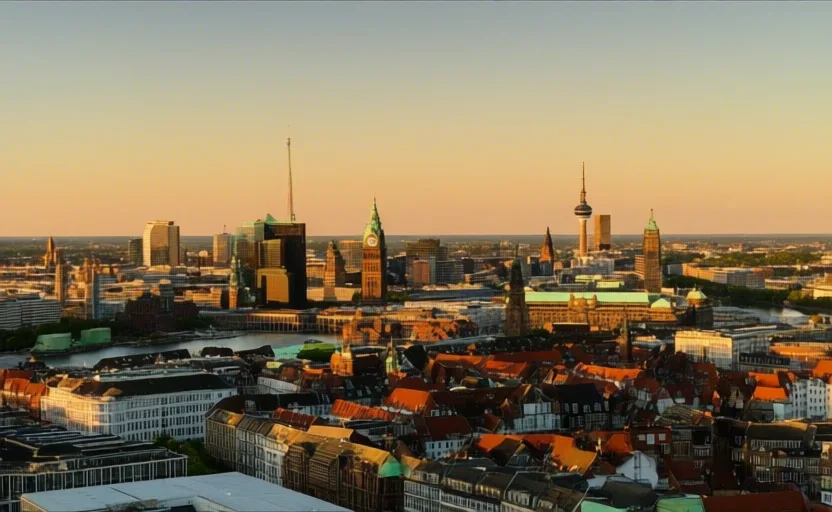 Hamburg · AI city illustration · Artistic impression
City · Europe
Hamburg
Saved in this browser — no account needed. Sign in later and it comes with you.
Where it is
Hamburg is a river port a long way from the open sea. It lies where the Alster and the Bille join the Elbe, at the point where the Jutland peninsula fans out toward the continent, with the North Sea lying west and the Baltic north-east. The Elbe’s 110-km estuary begins here. The old centre is built around two lakes, the Binnenalster and the Außenalster, made by damming the Alster. Canals, streams and rivers are crossed by about 2,500 bridges, and the highest ground in the city, the Hasselbrack, reaches only 116 metres. Westerly winds from the Atlantic keep the climate oceanic.
The land and water around it
The Elbe estuaryestuary
Hamburg’s harbour is a natural one, sheltered far inland on a river that carries ships to the North Sea. In 1962 a storm drove the Elbe to an all-time high, flooding a fifth of the city and killing more than 300 people.
The Alster lakeslake
The Binnenalster and Außenalster, formed by damming the Alster, give the centre its form. A 1664 law protected the swans on the river, and a popular belief says Hamburg will remain free as long as swans live on the Alster.
Altes Land and the Wadden Sea islandsmarsh
Some southern districts form part of the Altes Land, the largest continuous fruit-growing region in Central Europe. Far out in the Wadden Sea, 100 km away, the islands of Neuwerk, Scharhörn and Nigehörn belong to the city as well.
Its history, in short
The name comes from a castle, the Hammaburg, which Charlemagne ordered built in 808 on firm ground in the marsh between the Alster and the Elbe as a defence against Slavs. The town became a bishopric in 834 and was destroyed by a Viking fleet in 845, burned by Poles in 1030, and occupied by the Danes in 1201 and 1214. The turning point was 1189, when Barbarossa made it a Free Imperial City with tax-free passage down the Lower Elbe. Its alliance with Lübeck in 1241 is counted as the start of the Hanseatic League, and for centuries Hamburg answered only to the emperor, which is why it is still a city-state. It adopted Lutheranism in 1529, took in Dutch and French Reformed refugees, and from the 1580s hosted a Portuguese Jewish community. Fire in 1842 destroyed a quarter of the inner city. Around 1900 the Hamburg-America Line was the world’s largest transatlantic shipping company, and the port was where many Germans and Eastern Europeans left for the New World. In July 1943 a firestorm killed roughly 35,000 to 40,000 people. The inner German border, 50 km to the east, cut the port off from its hinterland until 1990.
Timeline
Dates are shown on a timeline rather than as changing shapes on the map. The globe draws modern boundaries only, and tinting a modern outline to stand for a historical one would state something we cannot source.
Post-classical world
808
The Hammaburg
Charlemagne has a castle built in marshland between the Alster and the Elbe, against Slavic attack. The origin of the first half of the name is uncertain.
Well attestedWikipedia845
Viking raid
A fleet of 600 ships sails up the Elbe and destroys the town, then home to about 500 people.
Well attestedWikipedia1189
Free Imperial City
Frederick Barbarossa grants a charter that lets ships go down the Lower Elbe to the sea without paying tax, a kind of free-trade zone.
Well attestedWikipedia1241
Alliance with Lübeck
Historians treat this pact as the moment the Hanseatic League began. In 1266 Hamburg’s merchants gained the right to set up a hanse in London.
Approximate dateWikipedia1350
Black Death
The plague kills at least 60 percent of the population.
Well attestedWikipedia
Industrial & imperial
4–8 May 1842
The Great Fire
About a quarter of the inner city burns, including three churches and the town hall. Fifty-one people die and an estimated 20,000 are left homeless. Rebuilding takes over forty years.
Well attestedWikipediaJuly 1943
Operation Gomorrah
Allied bombing raids create a firestorm that spreads from the central station and wipes out whole districts, among them Hammerbrook, Eilbek, Billbrook and Hamm South. Roughly 35,000 to 40,000 people die and 900,000 are evacuated.
Well attestedWikipedia
Contemporary
January 2017
Elbphilharmonie opens
The concert hall by Herzog & de Meuron, flagship of the HafenCity development that began in 2008 on the old harbour islands, is inaugurated.
Well attestedWikipedia
Places that carry meaning
Speicherstadt and Kontorhaus District1885–1950s
A 1.1-km run of narrow islands in the Elbe carries a very large, uniform complex of historic port warehouses, among the biggest anywhere, beside a district of eight large office complexes from the 1920s to 1950s. The Chilehaus, built in 1922 by Fritz Höger, is shaped like an ocean liner. Together they were inscribed in 2015.
The Town Hall1897
A Neo-Renaissance building with a 112-metre tower. Its facade shows the emperors of the Holy Roman Empire, since a Free Imperial City recognised no sovereign but the emperor.
The HauptkirchenMedieval to modern
Hamburg’s main churches, St Nicholas, St Michael’s (“Michel”), St Peter’s, St James’s and St Catherine’s, set the skyline with their spires. In the 19th century St Nicholas briefly held the title of tallest building in the world.
HafenCity2008 onward
A new district on part of the old port, planned for about 15,000 residents and 45,000 workers. It is the largest urban development in Europe since 2008, with flood protection built into the riverfront.
Languages here
Places are usually multilingual. This lists what is actually spoken, not one language per border.
GermanGermanic family
The official language of the city.
Standard German is used throughout, but speech in Hamburg has been coloured by Low German and the northern dialects since standardisation began in the 18th century.
Low GermanGermanic family
The original language of the city, called Hamborger Platt.
Typical of northern Germany. The park Planten un Blomen has a Low German name meaning “plants and flowers”, and it also survives in the local variants of German.
PortugueseRomance family
Spoken in the largest Portuguese community in Germany.
Sailors and merchants came from the 15th century, and about 30,000 people of Portuguese heritage live in the city. A Portuguese quarter has existed since the 1970s.
Afghan and Chinese community languages
Spoken by two long-established port communities.
Hamburg has about 50,000 Afghans, the largest community in Europe, who began arriving in the 1970s and almost doubled after 2015. A Chinese community of sailors and traders formed in the 1920s around Schmuckstraße in St Pauli.
Learn the language here
- 1Understand which languages are spoken hereHamburg is multilingual. Start with which languages are used, by whom, and for what — the phrase list only covers one of them.Written by Globe Quest
- 2Learn 12 phrasesCurated everyday phrases for Hamburg, with audio and a written form.Written by Globe Quest
- 3Say them out loudSpeaking practice with pronunciation feedback, one phrase at a time.Globe Quest material, your own additions
- 4Come back to themSpaced review, so what you learned this week is still there next month.Written by Globe Quest
Check yourself
What did Frederick Barbarossa grant Hamburg in 1189?
Free Imperial City status with tax-free passage down the Lower Elbe
The charter gave the city a form of free-trade zone on the river. The Hanseatic alliance with Lübeck came later, in 1241.
Why was the Hammaburg built in 808?
As a defence against Slavic incursion
Charlemagne ordered a castle on firm ground in the marsh between the Alster and the Elbe. A bishopric followed only in 834.
Worth arguing about
- For about 600 years Hamburg answered only to the emperor, and it is still a city-state. How much of that independence is visible in the city today?
- The port lost trade when the inner German border closed 50 km to the east, and won it back after 1990. What does that say about where a port’s value really comes from?
What we have not established
These are open questions, listed rather than filled in. We would rather show a gap than a plausible guess.
How many people live in Hamburg?
Figures include over 1.9 million for the current population and 1,860,759 registered residents at the end of 2016. They come from different years, so no single total is given. The metropolitan region, at about 5.1 million, is counted on a separate basis.
Sources
- Wikipedia · HamburgWikipedia · encyclopedia · checked 2026-11-24
- Wikipedia · History of HamburgWikipedia · encyclopedia · checked 2026-11-24
- UNESCO · Speicherstadt and Kontorhaus District with ChilehausUNESCO World Heritage Centre · intergovernmental · checked 2026-11-24
Reviewed by Globe Quest editorial on 2026-11-24. Drafted with AI assistance and checked against the sources above before publication.