 Globe Quest
 Human Quest · LearningSign in
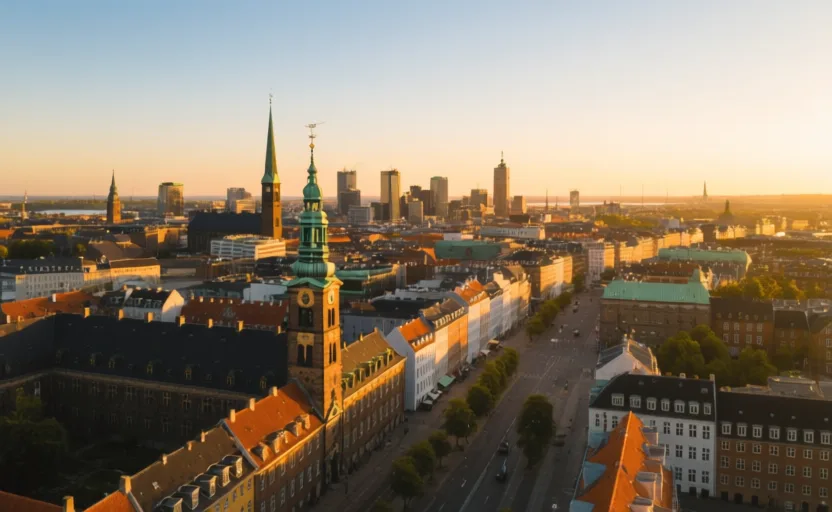 Copenhagen · AI city illustration · Artistic impression
City · Europe
Copenhagen
Also known as København
Saved in this browser — no account needed. Sign in later and it comes with you.
Where it is
Copenhagen faces east across the Øresund, the narrow strait that connects the North Sea with the Baltic, on the island of Zealand and the smaller Amager. Malmö in Sweden is 42 kilometres away on the far shore. The ground is a low, flat moraine left by the last ice age, over a bed of flint-bearing limestone, rising to about 50 metres in the hills to the north and west. The land is still rising slowly as the ice's weight lifts. The Gulf Stream makes the city about 5 degrees warmer than its latitude suggests, though November to February give only an hour or two of sun a day.
The land and water around it
The Øresundstrait
The strait between Zealand and Sweden links the North Sea and the Baltic. Copenhagen's name means merchants' harbour, and the town grew at this narrow passage between two seas.
Amager and the harbour isletsisland
Part of the city lies on Amager, with a chain of natural and artificial islets between it and Zealand. Between the main islands, the harbour runs through the middle of the built-up area.
The glacial moraine and the lakesplain
Ice-age glaciers eroded the surface and left a moraine layer up to 15 metres thick. Close to the centre lie the lakes Sortedams Sø, Peblinge Sø and Sankt Jørgens Sø, which run beside the old line of the ramparts.
Its history, in short
The first town grew along the old shore at Gammel Strand, where a natural harbour and herring shoals drew fishermen and merchants from about the eleventh century. In 1186 King Valdemar I handed the castle and town to Bishop Absalon, and the town received a charter in 1254. Hanseatic attacks were frequent, and in 1368 it was invaded. It became the capital in the fifteenth century and grew on Baltic trade, especially under Christian IV, who from 1596 enlarged it with new districts and bastioned earthworks. It survived a Swedish siege in 1658 to 1659. Fires in 1728 and 1795 destroyed most of the medieval town, so few old buildings survive. British fleets attacked in 1801 and again in 1807, when bombardment burned about 1,000 buildings. After the war the Finger Plan of 1947 steered housing along five railway lines, and the Øresund Bridge of 2000 tied the city to Malmö in a single region.
Timeline
Dates are shown on a timeline rather than as changing shapes on the map. The globe draws modern boundaries only, and tinting a modern outline to stand for a historical one would state something we cannot source.
Post-classical world
c. 1020
A merchant house
Excavations for the rail system found the remains of a large merchant mansion near Kongens Nytorv, evidence of a town in the eleventh century. Many historians date the town to the late Viking Age and suggest Sweyn I Forkbeard may have founded it.
Approximate dateWikipedia1186
Given to Bishop Absalon
A letter from Pope Urban III records that King Valdemar I gave the castle and town of Hafn to Absalon, Bishop of Roskilde. Around 1200 the Church of Our Lady is built on higher ground to the north-east.
Well attestedWikipedia1254
City charter
Bishop Jakob Erlandsen grants the town its charter, which it holds while repeatedly attacked by the Hanseatic League.
Well attestedWikipedia
Early modern & oceanic
1658–1659
The Swedish siege
The city withstands a severe siege by Charles X of Sweden and repels a major assault. By Christian IV's death in 1648 it had become the kingdom's chief fortress and naval port.
Well attestedWikipedia20–23 October 1728
The great fire
The largest fire in the city's history burns for three days and destroys 28 per cent of the whole city and 47 per cent of the medieval part. About a fifth of the population is left homeless.
Well attestedWikipedia
Industrial & imperial
16 August – 5 September 1807
The British bombardment
A British fleet and 30,000 troops seize the Dano-Norwegian navy after Denmark refuses to hand it over. Several hundred people are killed or injured and about 1,000 buildings burn.
Well attestedWikipedia
Contemporary
1947
The Finger Plan
A planning scheme sends new housing and business along five railway routes radiating out from the centre, with green wedges left between them.
Well attestedWikipedia2000
Øresund Bridge
A rail and road link joins Copenhagen to Malmö, creating a metropolitan region that crosses a national border. The Metro opens in 2002.
Places that carry meaning
Gammel Strand11th century
The old shore where the first habitations probably gathered, close to the natural harbour.
Frederiksstaden and Amalienborgfrom 1749
A prestigious planned district begun in 1749, with Amalienborg Palace at its centre. It belongs to the rebuilding after the 1728 fire, which also brought the royal residence of Christiansborg, begun in 1733.
Freetown Christianiafrom 1971
A self-governing community in the former Bådsmandsstræde barracks in Christianshavn, founded in September 1971 after students occupied the site in the unrest of the late 1960s.
Languages here
Places are usually multilingual. This lists what is actually spoken, not one language per border.
DanishGermanic family
The national language and the language of the city.
Danish is a North Germanic language, partly intelligible to speakers of Swedish and Norwegian. The Swedish name for the city, Köpenhamn, is a direct translation of København.
Immigrant languages
Languages of the roughly one in five residents who are immigrants.
In 2022 immigrants made up 20.3 per cent of the municipality's population and their descendants a further 6 per cent. The statistics do not record ethnic groups, so the exact mix of languages is not counted.
Learn the language here
- 1Understand which languages are spoken hereCopenhagen is multilingual. Start with which languages are used, by whom, and for what — the phrase list only covers one of them.Written by Globe Quest
- 2Learn 11 phrasesCurated everyday phrases for Copenhagen, with audio and a written form.Written by Globe Quest
- 3Say them out loudSpeaking practice with pronunciation feedback, one phrase at a time.Globe Quest material, your own additions
- 4Come back to themSpaced review, so what you learned this week is still there next month.Written by Globe Quest
Check yourself
What does the name Copenhagen originally mean?
Merchants' harbour
The Old Norse name Kaupmannahǫfn meant merchants' harbour. The English form came by way of Low German.
Why do few old buildings survive in the centre?
Great fires in 1728 and 1795
The 1728 fire alone destroyed 28 per cent of the city, and the 1795 fire took a large part of what was left, so little of the medieval town remains.
Worth arguing about
- The Øresund Bridge joined two countries into one commuting region, but the two currencies still divide it. How far can a region be integrated across a border?
- Christiania began as an occupation of an army barracks and has outlasted the era that produced it. What decides when an informal community becomes part of the city?
What we have not established
These are open questions, listed rather than filled in. We would rather show a gap than a plausible guess.
When did Copenhagen become the capital of Denmark?
One account places it in the early fifteenth century and another gives 1443. The two may refer to different steps, so no single year is fixed here.
Sources
- Wikipedia · CopenhagenWikipedia · encyclopedia · checked 2026-11-24
- Wikipedia · History of CopenhagenWikipedia · encyclopedia · checked 2026-11-24
- Wikipedia · DenmarkWikipedia · encyclopedia · checked 2026-11-24
Reviewed by Globe Quest editorial on 2026-11-24. Drafted with AI assistance and checked against the sources above before publication.