 Globe Quest
 Human Quest · LearningSign in
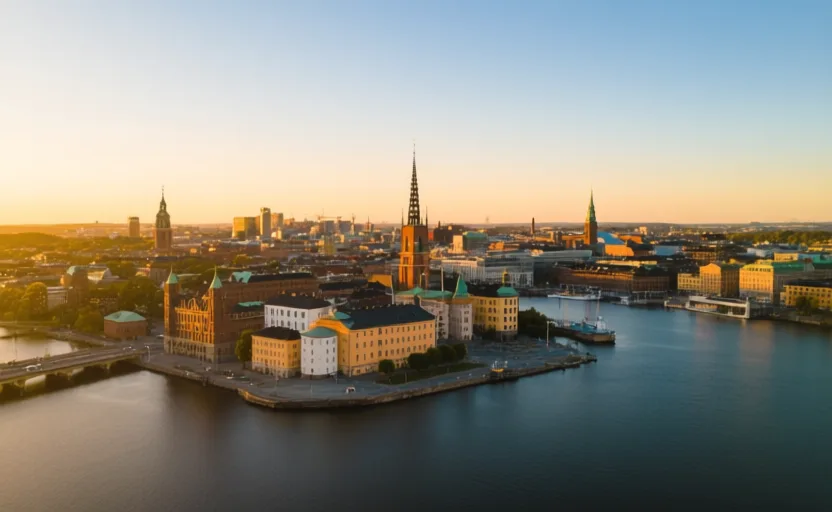 Gothenburg · AI city illustration · Artistic impression
City · Europe
Gothenburg
Also known as Göteborg
Saved in this browser — no account needed. Sign in later and it comes with you.
Where it is
Gothenburg stands on the Swedish west coast where the Göta älv reaches the Kattegat, about 400 kilometres from Stockholm and roughly halfway between Copenhagen and Oslo. The river drains the largest watershed in Scandinavia, and its mouth is the country's only direct outlet to the North Sea. Offshore, the archipelago is made of bare rocks and cliffs, much like the Bohuslän coast to the north. The Gulf Stream keeps the climate oceanic and milder than Stockholm's, with snow mainly from December to March and daylight of about 18 hours in midsummer against under seven in late December. The island of Hisingen lies across the river from the old centre.
The land and water around it
The Göta älvriver
The river carries the outflow of Scandinavia's largest drainage basin into the Kattegat. For centuries it was Sweden's only door to the North Sea, and its mouth was a frontier with Norwegian and Danish territory.
The rock archipelagocoast
Gothenburg's islands are rough, barren rock and cliff, the same landscape as the coast of Bohuslän. Stone Age people left rock carvings and a settlement at Sandarna near the river mouth, in a culture dated to 8400–6000 BC.
Hisingen and the marshy shoreisland
Hisingen is separated from the old city by the river and is home to the Volvo headquarters. The first city sat on low ground that had to be drained, which is why Dutch planners were hired.
Its history, in short
Sweden wanted a harbour on the Atlantic side for a long time. Until the 1650s its holding here was a sliver of land at the river mouth, hemmed in by Danish Halland to the south and Norwegian Bohuslän to the north, and an earlier town founded in 1604 was burned in 1611 by Danish forces. Gustavus Adolphus founded the present city by charter in 1621 as a fortified trading colony, and hired Dutch engineers to lay out streets and canals on marshy ground. Dutch, German and Scottish merchants were offered privileges, so that the council of 1641 held four Swedes, three Dutch, three Germans and two Scots, and the last Dutch councillor died in 1652. In 1658 the Treaty of Roskilde moved Halland and Bohuslän to Sweden, which made the city secure. The Swedish East India Company, founded in 1731, brought trade with China, and in the 1800s the port became the main departure point for emigrants to the United States. The population grew from 13,000 in 1800 to 130,000 in 1900, and Volvo was founded here in 1927.
Timeline
Dates are shown on a timeline rather than as changing shapes on the map. The globe draws modern boundaries only, and tinting a modern outline to stand for a historical one would state something we cannot source.
First cities & states
8400–6000 BC
Sandarna culture
A Stone Age settlement at Sandarna near the mouth of the Göta älv gives its name to a wider culture of south-west Scandinavia.
Approximate dateWikipedia
Early modern & oceanic
1621
The royal charter
Gustavus Adolphus founds Gothenburg as a fortified trading colony after several failed attempts, with Dutch planners draining and building on marshy ground.
Well attestedWikipedia1652
End of Dutch rule on the council
The last Dutch politician on the city council dies, and Swedes take political control of a town that had followed Dutch town law.
Well attestedWikipedia1658
Treaty of Roskilde
Denmark–Norway cedes Halland and Bohuslän. Gothenburg is no longer on the border and grows into the main trading port of the west coast.
Well attestedWikipedia1731
Swedish East India Company
The company's profitable expeditions to China make the city prosperous, and neoclassical stone houses rise around the canals.
Well attestedWikipedia
Industrial & imperial
1841
Götaverken
The Scot Alexander Keiller founds the shipbuilding company that operated until 1989, one of the Scottish imprints on a city that later received William Chalmers's bequest for its technical university.
Well attestedWikipedia1927
Volvo
Volvo is founded in Gothenburg. Volvo Cars is still the largest employer in the city, and its truck and bus parent is also headquartered here.
Well attestedWikipedia
Places that carry meaning
The canals and the old town grid17th century
Streets and canals were laid out on Dutch lines, and most of the ramparts that once enclosed them were pulled down from 1810. Almost nothing of the 17th-century town survives except military and royal buildings, since everything else was wooden.
East India House18th century
A neoclassical stone building from the East India Company's heyday, now the city museum. It stands for the period when trade with China first gave the town grand architecture.
Feskekörka1874
The indoor fish market beside the Rosenlundskanalen, named for its resemblance to a Gothic church, opened on 1 November 1874. Fishing was the city's main industry in the 18th century before the East India trade took over.
Languages here
Places are usually multilingual. This lists what is actually spoken, not one language per border.
SwedishGermanic family
The national language and the one used in public life.
The Swedish name Göteborg comes from the river Göta älv, and the city's English and German name Gothenburg was given in the same 1621 charter.
DutchGermanic family
The language of the first planners and councillors, now historical.
Dutch merchants and engineers held early political power, the town followed Dutch town law, and Dutch was proposed as its official language. Scots, English and German also had long histories in the port.
ArabicSemitic family
A widely spoken immigrant language in Sweden as a whole.
About 28% of Gothenburg's residents in 2019 were born abroad and 46% had at least one foreign-born parent. Sweden keeps no official language statistics, but Arabic is thought to be more widespread nationally than the officially recognised minority language Finnish.
Learn the language here
- 1Understand which languages are spoken hereGothenburg is multilingual. Start with which languages are used, by whom, and for what — the phrase list only covers one of them.Written by Globe Quest
- 2Learn 12 phrasesCurated everyday phrases for Gothenburg, with audio and a written form.Written by Globe Quest
- 3Say them out loudSpeaking practice with pronunciation feedback, one phrase at a time.Globe Quest material, your own additions
- 4Come back to themSpaced review, so what you learned this week is still there next month.Written by Globe Quest
- 5Practise with people: Arabic practice · DohaAn in-person practice circle. It is a prepared plan and needs a host before it runs.Run by members
Check yourself
Who founded Gothenburg in 1621, and in what role?
Gustavus Adolphus, as a fortified trading colony
The King of Sweden chartered the city in 1621 as a heavily fortified colony. The East India Company came much later, in 1731.
Why did the Treaty of Roskilde in 1658 matter for Gothenburg?
It moved Halland and Bohuslän to Sweden and made the city secure
Until then the city's land was a narrow strip between Danish and Norwegian territory. After 1658 it was no longer on the frontier and could grow as a port.
Worth arguing about
- A Swedish king hired Dutch engineers and offered privileges to Dutch, German and Scottish merchants. What does it say about a national port when its first elite is foreign?
- Volvo, SKF and the shipyards shaped the city for a century. What should a port and industrial city do with its identity when the factories move away?
Sources
- Wikipedia · GothenburgWikipedia · encyclopedia · checked 2026-11-24
- Wikipedia · History of GothenburgWikipedia · encyclopedia · checked 2026-11-24
- Wikipedia · SwedenWikipedia · encyclopedia · checked 2026-11-24
Reviewed by Globe Quest editorial on 2026-11-24. Drafted with AI assistance and checked against the sources above before publication.