 Globe Quest
 Human Quest · LearningSign in
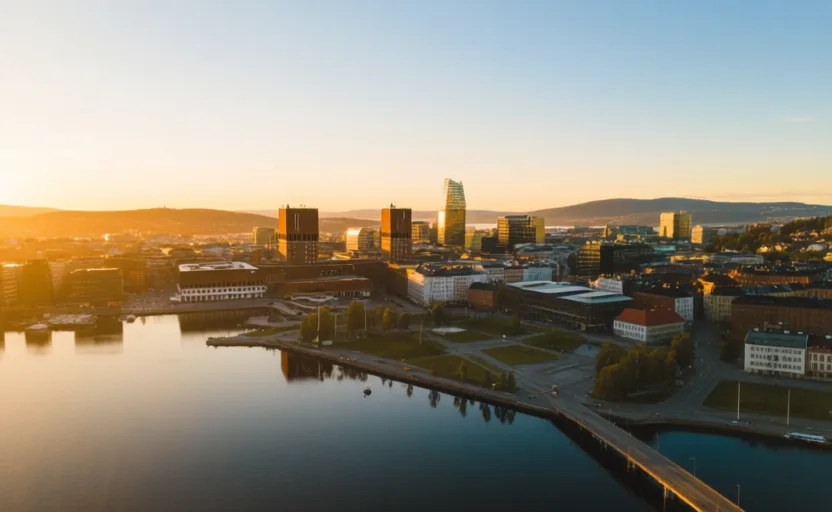 Oslo · AI city illustration · Artistic impression
City · Europe
Oslo
Saved in this browser — no account needed. Sign in later and it comes with you.
Where it is
At the northern end of the Oslofjord, the city fills an arc of land with the water to the south and forested hills rising on every other side, like a giant amphitheatre. No big river reaches the sea here. Two small ones, the Akerselva and the Alna, drain into the fjord, and the city has 40 islands and 343 lakes within its limits. Two-thirds of the municipal area is protected forest, hill and lake. Winters are cold, summer days run past 18 hours of light, and midwinter gives about six.
The land and water around it
The Oslofjordestuary
The city centre sits at the inner end of the fjord, which is nearly split by the Nesodden peninsula opposite. The urban area spreads from there in three arms, north-eastward inland and south along both shores, giving it the outline of an upside-down “Y”.
Markaforest
Wide forested hills lie above the city to the north and east. They give the site its amphitheatre shape and keep a large share of the municipal area free of building. The highest point, Kirkeberget, is 629 metres.
The Akerselvariver
The river drains the lake Maridalsvannet, which also supplies much of the city's drinking water, and meets the fjord at Bjørvika. Its waterfalls powered some of Norway's first modern industry in the 1840s, and the labourers' districts on its banks became the basis of the city's east-west social divide.
Its history, in short
The sagas credit Harald Hardrada with founding the city around 1049, but burials from before AD 1000 pushed the city's own millennium celebrations back to 2000. Haakon V, who reigned from 1299, was the first king to live here permanently, which is why the city counts as capital from his time. Fire destroyed much of the wooden town again and again. After the fourteenth blaze, in 1624, Christian IV of Denmark ordered a new town built near Akershus Fortress and named it Christiania after himself. In 1814 it became the capital of an independent kingdom, and the Royal Palace, the Storting and the university buildings followed. The original name returned in 1925, and in 1948 the city absorbed Aker, a municipality 27 times larger. Since the early 2000s growth has come mostly from immigration, and about a third of residents are immigrants or children of immigrants.
Timeline
Dates are shown on a timeline rather than as changing shapes on the map. The globe draws modern boundaries only, and tinting a modern outline to stand for a historical one would state something we cannot source.
Post-classical world
c. 1049 (disputed)
The founding
The Norse sagas say Harald Hardrada founded the city in about 1049. Christian burials from before AD 1000 point to an earlier urban settlement, which is why the city marked its millennium in 2000.
DisputedWikipediaThe saga tradition against modern archaeological findings
1070
A bishopric
Oslo is raised to a bishopric, and under Olaf III it becomes a cultural centre for Eastern Norway.
Approximate dateWikipediaAround 1300
Haakon V makes it the capital
Haakon V is the first king to reside here permanently, and begins building Akershus Fortress.
Approximate dateWikipedia
Early modern & oceanic
1624
Fire and Christiania
A three-day fire, the fourteenth in the city's history, leads Christian IV to move the town across the bay near Akershus. It is laid out in regular square blocks and named for the king.
Well attestedWikipedia
Industrial & imperial
1814
Capital of a kingdom
Christiania becomes the capital of independent Norway as the union with Denmark ends. The new state needs buildings, and the population grows quickly.
Well attestedWikipedia1 January 1925
Oslo again
After full independence in 1905, Norwegians argue that a name honouring a Danish king does not suit their capital. The original name is restored.
Well attestedWikipedia
Contemporary
1948
The merger with Aker
Oslo merges with the surrounding, mostly affluent and green municipality of Aker, which was 27 times larger. The merger was unpopular there but created the modern municipality.
Well attestedWikipedia2011
The Government Quarter bombing
A bomb damages several buildings in the Government Quarter, including the one housing the Prime Minister's office, and eight people die in the blast.
Well attestedWikipedia
Places that carry meaning
Akershus FortressFrom about 1300
Begun under Haakon V. After the 1624 fire the new town was laid out beside it, so the fortress anchors the grid that became central Oslo.
GamlebyenMedieval origin
The Old Town, east of the Aker river, is the district that kept the name Oslo after the city moved. It was a village outside the city border until 1859.
Karl Johans gate and the Royal Palace1825–1848
The avenue joining the palace and the city was part of a plan for a monumental square of national institutions. Only the university buildings were completed as intended.
Hovedøya Abbey1174
An island abbey in the fjord. Churches and abbeys owned much land around Oslo, and that wealth drove the medieval city's economy until the Black Death.
Languages here
Places are usually multilingual. This lists what is actually spoken, not one language per border.
NorwegianGermanic family
The language of government, school and daily life.
Most residents are ethnically Norwegian, about 70 per cent in the census figure given for the city. Written standards are Bokmål and Nynorsk.
Immigrant languages
Spoken at home by a large share of the schoolchildren.
In 2013, 40 per cent of primary pupils had a first language other than Norwegian. The largest minority groups come from Pakistan, Poland, Somalia and Sweden, with others from Sri Lanka, Vietnam, Turkey, Morocco, Iraq and Iran. The east of the city is far more mixed than the west.
SámiUralic family
The indigenous language group, mainly of the north.
Sámi languages are recognised nationally, and are co-official in the northern Sámi administrative area, not in the capital.
Learn the language here
- 1Understand which languages are spoken hereOslo is multilingual. Start with which languages are used, by whom, and for what — the phrase list only covers one of them.Written by Globe Quest
- 2Learn 11 phrasesCurated everyday phrases for Oslo, with audio and a written form.Written by Globe Quest
- 3Say them out loudSpeaking practice with pronunciation feedback, one phrase at a time.Globe Quest material, your own additions
- 4Come back to themSpaced review, so what you learned this week is still there next month.Written by Globe Quest
Check yourself
Why was the city called Christiania for about three centuries?
Christian IV rebuilt it after a fire in 1624 and named it after himself
Christian IV of Denmark ordered the new town laid out near Akershus after the 1624 fire. The old name came back in 1925, when a Danish king's name no longer felt right for a fully independent capital.
What is unusual about the rivers of Oslo?
None of the large eastern rivers reaches the sea here
Eastern Norway has many rivers, but none of them flows into the sea at Oslo. The city has two smaller ones, the Akerselva and the Alna, and the first of them powered early industry.
Worth arguing about
- The city's name was changed twice in 300 years, each time for political reasons. When should a place keep a name that honours a former ruler?
- A river once split the city into an east end and a west end, and the divide is still visible in schools. Can a city undo a divide that geography and industry made?
What we have not established
These are open questions, listed rather than filled in. We would rather show a gap than a plausible guess.
How many people live in Oslo?
The number depends on the boundary. The municipality had 724,290 residents on 1 January 2025, the greater urban area 1,110,887 in 2025, and the wider agglomeration 1,546,706 in 2023, so we give the figure with its boundary rather than one total.
Sources
- Wikipedia · OsloWikipedia · encyclopedia · checked 2026-11-24
- Wikipedia · NorwayWikipedia · encyclopedia · checked 2026-11-24
Reviewed by Globe Quest editorial on 2026-11-24. Drafted with AI assistance and checked against the sources above before publication.