 Globe Quest
 Human Quest · LearningSign in
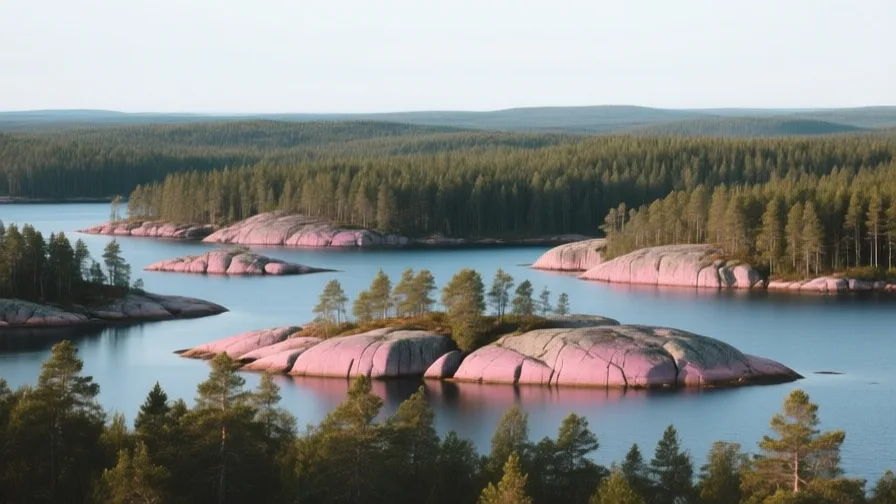 Sweden · AI landscape illustration · Artistic impression
Country · Europe
Sweden
Saved in this browser — no account needed. Sign in later and it comes with you.
Where it is
Sweden is the eastern half of the Scandinavian Peninsula, a long country that runs for around fifteen degrees of latitude between the mountain wall on the Norwegian border and the Baltic Sea and Gulf of Bothnia. About 69 per cent of it is forest and woodland, and it holds roughly 95,700 lakes, but only 8 per cent is farmland. The people live mostly in the south and centre, in a country with about 25 people per square kilometre, and nearly nine in ten of them live in towns and cities. The climate is milder than the latitude would suggest, temperate in most of the country, humid continental in the middle and subarctic in the far north.
The land and water around it
The Scandinavian mountains and Norrlandmountains
The Scandinavian mountain chain forms the border with Norway, and Kebnekaise, at 2,096.8 metres, is the highest point in Sweden. Most of the north and west of the country is hilly or mountainous Norrland, covered by boreal forest, and the border with Norway, 1,619 kilometres long, is the longest unbroken border in Europe.
The Central Swedish lowlandplain
A broad belt of fertile ground runs east–west from Gothenburg to Stockholm, and it contains the four biggest lakes in Sweden: Vänern, Vättern, Mälaren and Hjälmaren. Farmland, hydropower, forest and the mineral resources of the Bergslagen district make it the traditional heartland of Sweden.
Scania and the limestone islandsplain
The far south has plains with productive farmland, crossed by a chain of elongated hills along the Tornquist Zone. Offshore, Gotland and Öland, Sweden’s two largest islands, are made of limestone and marl, with sea stacks called rauks and large cave systems unlike anywhere else in the country.
Its history, in short
After the ice retreated around 12,000 BC, reindeer hunters reached the south, and later the Svear and the Götar emerged as the peoples of the Norse world. Swedish Vikings travelled mainly east, through Russia to Constantinople and even Baghdad. Historians usually date the kingdom from the 10th century, when one king ruled both Svealand and Götaland. Sweden joined Denmark and Norway in the Kalmar Union in 1397 and left in 1523. In the 17th century, entering the Thirty Years’ War, it became a great power that controlled much of the Baltic. The empire lost most of its overseas possessions in the following two centuries, and Finland, the eastern half of the realm, was taken by Russia in 1809. In 1814 Sweden forced Norway into a union that lasted until 1905, and it has not fought a war since. Industrialisation from the 1860s turned a rural society into an urban one, while over a million Swedes left for America between 1850 and 1910. Officially neutral in both world wars, Sweden joined the European Union in 1995 and NATO in 2024.
Timeline
Dates are shown on a timeline rather than as changing shapes on the map. The globe draws modern boundaries only, and tinting a modern outline to stand for a historical one would state something we cannot source.
Early human world
c. 12,000 BCE
The first hunters
During a warm period called the Allerød oscillation, reindeer hunters of the Bromme culture camp beside the ice sheet in what is today the province of Scania, relying on flint tools.
Approximate dateWikipedia
Post-classical world
Around 1000
One king for Svealand and Götaland
Olof Skötkonung is the earliest known king with authority over both Svealand and Götaland. Historians usually begin the line of Swedish monarchs here, though the exact age of the kingdom is unknown and depends on what counts as a united realm.
1397
The Kalmar Union
Sweden, Denmark and Norway are united under Queen Margaret, with the approval of the Swedish nobility. A series of rebellions loosens Sweden’s ties over the next century, and it leaves the union in 1523.
Early modern & oceanic
1630s
Sweden enters the Thirty Years’ War
Under Gustavus Adolphus, Sweden fights on the Protestant side, defeats the Imperial army at Breitenfeld in 1631 and conquers about half the Holy Roman states. The king dies at Lützen in 1632, but the Swedish Empire remains a great power into the early 18th century.
Well attestedWikipedia1658
Roskilde and the empire’s height
The Treaty of Roskilde makes Scania, until then Danish, part of Sweden, and the empire reaches its greatest extent that year, across Finland and Estonia and into lands now in Poland, Russia, Latvia, Germany, Denmark and Norway.
Industrial & imperial
1809
The loss of Finland
After a war lasting from February 1808 to September 1809, the eastern half of the kingdom passes to Russia and becomes a grand duchy. Sweden’s present borders largely date from this loss.
1814
Union with Norway
After the Treaty of Kiel gives Norway to the Swedish king, Norway declares its independence and Sweden invades, in the last war it has fought. The result is a personal union under the shared king, which Norway ends in 1905.
1850–1910
Emigration
The population doubled between 1750 and 1850, and over a million Swedes crossed the Atlantic to the United States in the decades after 1850. Some scholars think emigration was the only way to avoid famine and rebellion.
Some scholars of the emigration
Places that carry meaning
The rock carvings of BohuslänFrom 5000 BCE, mostly 2300–500 BCE
Sweden has a very large number of petroglyphs, with the highest concentration in Bohuslän. The earliest images, in Jämtland, show elk, reindeer, bears and seals, and the most intense carving period shows ships, farming and warfare.
UppsalaBefore the 11th century onward
The centre of Norse paganism, with its temple, before Christianisation in the 11th century. The Uppsala Synod of 1593 completed the country’s adoption of Lutheranism, and the kings of Uppsala held most of present-day Sweden until 1060.
Stockholm14th century onward
King Magnus was crowned king of Sweden and Norway here in 1336. In the Middle Ages half of the town’s people spoke Low German, the trading language of the Hanseatic League.
Gothenburg18th century onward
The wide mouth of the Göta älv gave the country’s best harbour for ocean voyages, and the Swedish East India Company made it its home port from 1731, which turned the small town into Sweden’s second city.
Languages here
Places are usually multilingual. This lists what is actually spoken, not one language per border.
SwedishGermanic family
The official language, spoken by nearly everyone.
A North Germanic language close to Danish and Norwegian, with about 9.5 million first-language speakers. It became the official language in law only in 2009. Scanian dialects bear Danish influence because Scania was Danish until 1658. Until the 1970s a policy of Swedification limited schooling to Swedish, and most Swedes now also speak English, which has been compulsory in school since 1952.
FinnishUralic family
The largest recognised minority language.
Sweden Finns are about 5 per cent of the population, reflecting the centuries when Finland was the eastern half of the Swedish kingdom, and in the north the Tornedalians speak Meänkieli, a related language that is mutually intelligible with northern Finnish. Both are among the five national minority languages, with Sámi, Romani and Yiddish.
Sámi languagesUralic family
The indigenous languages of the north.
Five Sámi languages are spoken in Sweden: Lule, Northern and Southern Sámi, and the critically endangered Ume and Pite Sámi. The Sámi people are indigenous to Scandinavia and the Kola Peninsula, and converted to Lutheranism in the 17th and 18th centuries.
ArabicSemitic family
A widely spoken immigrant language.
Following arrivals of Arabic speakers in the 21st century, Arabic is probably more widely used than Finnish, but Sweden keeps no official statistics on language use, so the number of speakers is not known.
Learn the language here
- 1Understand which languages are spoken hereSweden is multilingual. Start with which languages are used, by whom, and for what — the phrase list only covers one of them.Written by Globe Quest
- 2Practise with people: Arabic practice · DohaAn in-person practice circle. It is a prepared plan and needs a host before it runs.Run by members
Check yourself
When did Swedish become the official language of Sweden by law?
2009
A new language law passed in 2009 made Swedish the official language for the first time, while also confirming five national minority languages and Swedish Sign Language.
Why do the dialects of Scania show Danish influence?
Scania was part of Denmark until the treaty of 1658
Scania was Danish until the Treaty of Roskilde in 1658, so its speech grew up with Danish neighbours and some once regarded it as a dialect of Danish.
Worth arguing about
- Sweden has not fought a war since 1814 and was officially neutral in both world wars, though how neutral it really was is disputed. How should a country remember a neutrality it chose in its own interest?
- The empire that ruled much of the Baltic in the 17th century is now a country of 10.6 million, most of them living in the south and centre. How does a state cope with having once been far larger than it is?
What we have not established
These are open questions, listed rather than filled in. We would rather show a gap than a plausible guess.
How large is Sweden?
Published areas for Sweden differ slightly, between about 449,964 and 450,295 square kilometres, depending on which account is used, and other compilations give still different values. The country is the fifth largest in Europe either way.
Sources
- Wikipedia · SwedenWikipedia · encyclopedia · checked 2026-11-24
- Wikipedia · History of SwedenWikipedia · encyclopedia · checked 2026-11-24
- Wikipedia · Geography of SwedenWikipedia · encyclopedia · checked 2026-11-24
- Wikipedia · Languages of SwedenWikipedia · encyclopedia · checked 2026-11-24
Reviewed by Globe Quest editorial on 2026-11-24. Drafted with AI assistance and checked against the sources above before publication.