 Globe Quest
 Human Quest · LearningSign in
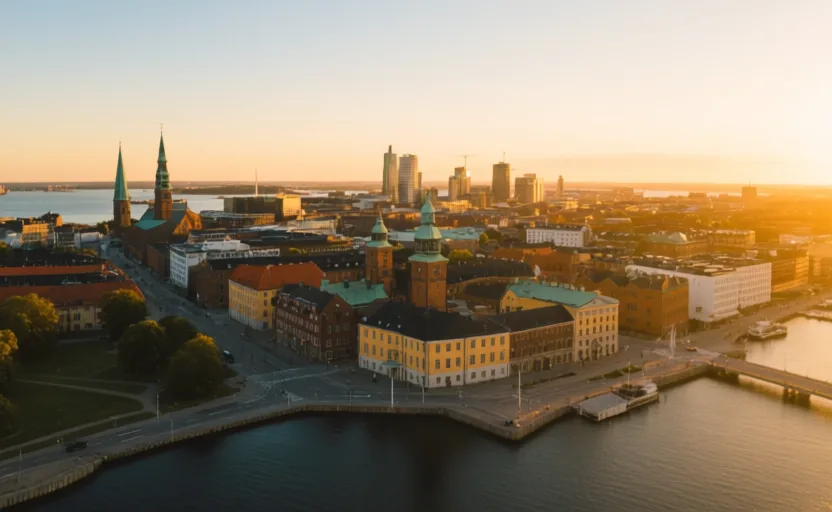 Malmö · AI city illustration · Artistic impression
City · Europe
Malmö
Saved in this browser — no account needed. Sign in later and it comes with you.
Where it is
Malmö lies near Sweden's south-western tip at 55° north, on the Öresund, the narrow strait that separates Scania from Denmark. Copenhagen is across the water and the two cities form the core of a transnational region of about four million people. The ground is flat, low and open, and the climate is oceanic and mild for the latitude: winter highs usually stay above freezing and snow rarely lies for long. Daylight lasts about 17.5 hours in midsummer and roughly seven in midwinter. The city is the largest in Scania, and its bridge is Sweden's only fixed direct link to continental Europe.
The land and water around it
The Öresundstrait
The strait between Scania and Denmark makes Malmö a ferry berth turned port turned bridgehead. The Öresund Bridge, opened on 1 July 2000, carries road and rail and is 8 kilometres long within a 16-kilometre link.
The Scanian plainplain
Malmö is the commercial centre of western Scania, a flat agricultural region. Scania's dialects carry Danish influence because it belonged to Denmark until 1658.
Ribersborgcoast
A man-made shallow beach runs along the south-western shore beyond the former harbour. The disused harbour area behind it was redeveloped for the Bo01 housing expo in 2001.
Its history, in short
For most of its early life Malmö was Danish. First recorded in 1275, it probably began shortly before as a fortified quay of the Archbishop of Lund, and by the 15th century it was among Denmark's largest and most visited cities, a herring-fishing market frequented by the Hanseatic League. It turned Lutheran between 1527 and 1529, earlier than most of Scandinavia. The Treaty of Roskilde in 1658 gave Scania to Sweden, and plague and war cut the town to 1,800 people by 1727. Recovery began with a new harbour in 1775, then the Kockums workshop of 1840 and the Southern Main Line of 1856–1864 made it an industrial centre. The population peaked at 265,000 in 1971, then fell as the shipyards declined, and Kockums closed its shipbuilding in 1986. The 1990s crisis cost 27,000 jobs. Since the Öresund Bridge opened in 2000 the city has turned to education, services and redevelopment, and it is now the country's most diverse city.
Timeline
Dates are shown on a timeline rather than as changing shapes on the map. The globe draws modern boundaries only, and tinting a modern outline to stand for a historical one would state something we cannot source.
Post-classical world
1275
First mention as a city
Malmö, then Malmhaug, appears in writing, probably founded shortly before as a fortified quay or ferry berth for the Danish Archbishop of Lund.
Approximate dateWikipedia1434
A new citadel
A fortress is built on the beach south of the town. It reaches its present form as Malmöhus in the mid-16th century.
Well attestedWikipedia
Early modern & oceanic
1527–1529
Lutheran conversion
Malmö becomes one of the first cities in Scandinavia to convert fully to the Protestant denomination.
Well attestedWikipedia1658
Treaty of Roskilde
Malmö and the Scania region pass from Denmark to Sweden. Fighting continues, and a Danish siege of one month in 1677 fails.
Well attestedWikipedia
Industrial & imperial
1840
Kockum's workshop
Frans Henrik Kockum founds the workshop that becomes one of the largest shipyards in the world, and the Southern Main Line of 1856–1864 follows.
Well attestedWikipedia
Contemporary
1986
Shipbuilding ends
Kockums stops building ships. Public confidence in the city drops and the economic base shifts, with the 1990s crisis costing 27,000 jobs.
Well attestedWikipedia1 July 2000
The Öresund Bridge
The bridge to Denmark opens, tying Malmö to Copenhagen and making it Sweden's only fixed direct link to the continent.
Well attestedWikipedia2005
Turning Torso
Completion of Scandinavia's tallest skyscraper replaces the Kockums crane, taken down in 2002, as the city's landmark.
Well attestedWikipedia
Places that carry meaning
St Peter's ChurchEarly 14th century
The oldest building in the city is in Baltic Brick Gothic, probably modelled on St Mary's in Lübeck, which reflects Malmö's Hanseatic trade links.
Malmöhus1434, present form mid-16th century
The citadel on the former beach is all that remains of the city's many fortifications, which once made it the most fortified city in Sweden.
The Öresund Bridge2000
A road and rail crossing of the strait, with pylons reaching 204.5 metres. It is the only fixed direct link between Sweden and the continent.
Languages here
Places are usually multilingual. This lists what is actually spoken, not one language per border.
SwedishGermanic family
The national language, with a Danish-tinged regional accent.
The dialects of Scania are influenced by Danish because the region belonged to Denmark until the Treaty of Roskilde.
DanishGermanic family
The language of the other side of the Öresund and of the town's first four centuries.
Denmark is one of the main sources of immigration to the city, and the Öresund Region around Malmö and Copenhagen has four million people.
ArabicSemitic family
A leading immigrant language, reflecting arrivals from the Middle East.
The Middle East, the Horn of Africa and the former Yugoslavia are the other main sources of immigration. Around 14% of residents have a Muslim background, and Malmö served as a primary entry point for migrants heading to Sweden in 2016.
Learn the language here
- 1Understand which languages are spoken hereMalmö is multilingual. Start with which languages are used, by whom, and for what — the phrase list only covers one of them.Written by Globe Quest
- 2Learn 12 phrasesCurated everyday phrases for Malmö, with audio and a written form.Written by Globe Quest
- 3Say them out loudSpeaking practice with pronunciation feedback, one phrase at a time.Globe Quest material, your own additions
- 4Come back to themSpaced review, so what you learned this week is still there next month.Written by Globe Quest
- 5Practise with people: Arabic practice · DohaAn in-person practice circle. It is a prepared plan and needs a host before it runs.Run by members
Check yourself
When did Malmö pass from Denmark to Sweden?
1658
The Treaty of Roskilde in 1658 gave Scania to Sweden. Malmö had been Danish for its first four centuries and kept a Danish-influenced dialect.
What does the Öresund Bridge connect Malmö to?
Copenhagen
The bridge across the strait, opened on 1 July 2000, joins Malmö to Copenhagen and is Sweden's only fixed direct link to continental Europe.
Worth arguing about
- Malmö was once one of Denmark's largest cities and is now a bridgehead of Sweden. Does a border region belong more to the state or to the strait around it?
- After the shipyards closed, the city's population fell for three decades and then grew again on education and services. Who benefits most from that second growth?
What we have not established
These are open questions, listed rather than filled in. We would rather show a gap than a plausible guess.
How many Malmö residents have a foreign background?
Counts differ by definition: almost half of the municipal population in 2024, but 55.5% in 2019 when anyone with at least one foreign-born parent is included. No official statistics are kept on language use or religion, so the speakers of each language cannot be counted.
Sources
- Wikipedia · MalmöWikipedia · encyclopedia · checked 2026-11-24
- Wikipedia · SwedenWikipedia · encyclopedia · checked 2026-11-24
Reviewed by Globe Quest editorial on 2026-11-24. Drafted with AI assistance and checked against the sources above before publication.