 Globe Quest
 Human Quest · LearningSign in
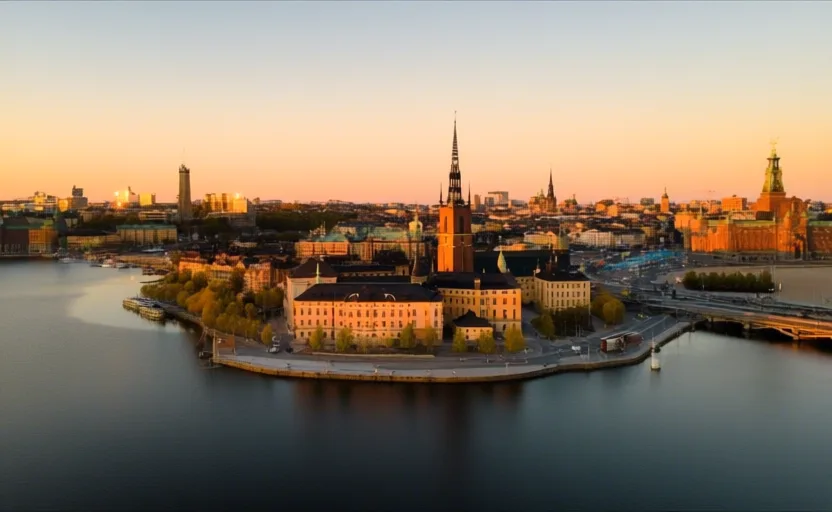 Stockholm · AI city illustration · Artistic impression
City · Europe
Stockholm
Saved in this browser — no account needed. Sign in later and it comes with you.
Where it is
Stockholm is built where a freshwater lake meets the Baltic. Lake Mälaren, the third-largest in Sweden, empties here through narrow channels, and fourteen islands in the centre run on into the archipelago to the east. More than 30% of the city's area is water and another 30% is park. The site is the eastern edge of the lowland that spans central Sweden, just south of the 60th parallel and close to the Bergslagen ore district, which is why its early trade faced the Baltic. Daylight runs from over 18 hours at midsummer to about six in late December, and the summer nights never fully darken.
The land and water around it
Lake Mälaren outletlake
Sweden's third-largest lake drains through the city into the Baltic. Viking-age Birka and medieval Sigtuna both stood on the lake, and Stockholm can be read as the capital of that lake region relocated to the point where it opens to the sea.
The Stockholm archipelagoisland
East of the centre the islands thicken into a chain along the coast. Vaxholm was fortified in the 16th century to guard the inlet from the Baltic, and the harbour that resulted was admired by 17th-century visitors as one of the best of its age.
Riddarfjärden and the ridgesbay
The geographical centre of the city lies on the water of Riddarfjärden bay. The 17th-century plans for Norrmalm, Östermalm, Kungsholmen and Södermalm were laid across the ridges that surround the old island core.
Its history, in short
The Mälaren basin had trading towns before Stockholm: Birka in the Viking Age, then Sigtuna, which dominated the region until the mid-13th century. Stockholm itself is first written down in 1252, by which time Bergslagen iron was passing through it, and the medieval town grew on the island that is now Gamla Stan. Through the Hanseatic period it traded with Lübeck, Hamburg, Gdańsk, Visby, Tallinn and Riga. In 1520 the Kalmar Union king Christian II had opposition leaders killed in the Stockholm Bloodbath, which fed the revolt that ended the union. Under Gustav Vasa the crown tightened its grip on the city. In the 1600s the Swedish empire made Stockholm its official capital in 1634, a fire in 1625 opened the way to straight new streets, and the population multiplied about sixfold between 1610 and 1680. A plague in 1710 killed 36% of the city. Industrialisation then pulled people in from rural Sweden, so that by 1900 fewer than 40% of residents had been born in the city. The Nobel Prizes, the 1912 Olympics and a metro opened in 1950 mark its modern profile.
Timeline
Dates are shown on a timeline rather than as changing shapes on the map. The globe draws modern boundaries only, and tinting a modern outline to stand for a historical one would state something we cannot source.
Post-classical world
c. 790–975
Birka
A major Viking Age trading centre stands on Lake Mälaren near the future Stockholm. Its restored remains are among the most visited sites in the county.
1252
First written mention
The name Stockholm appears in writing, and the city is credited to the statesman Birger Jarl. The medieval town takes shape on the central island that is now the Old Town.
Well attestedWikipedia1 May 1436
Letter of Privilege
The Privy Council grants the city its oldest preserved charter, affirming its political and economic role. It is taken to mark the start of Stockholm's status as de facto capital.
Well attestedWikipedia
Early modern & oceanic
8 November 1520
The Stockholm Bloodbath
Christian II enters the city and opposition figures are massacred. The killings set off uprisings that eventually broke up the Kalmar Union.
Well attestedWikipedia1625
The Great Fire
A fire destroys the south-western part of the island core. It leads to new boulevard-like streets and to the demolition of the medieval walls.
1634
Capital of the empire
Stockholm becomes the official capital of the Swedish empire, and trading rules give it a near monopoly on dealings between foreign merchants and Swedish, Baltic and Scandinavian lands.
Well attestedWikipedia1710
Plague
Plague kills about 20,000 people, 36% of the population. After the Great Northern War the city stagnates and has to find a role beyond that of an imperial capital.
Well attestedWikipedia
Contemporary
1950
The metro opens
The Stockholm Metro begins service. Its stations are known for their decoration, and the whole system is sometimes described as a very long art gallery.
Well attestedWikipedia
Places that carry meaning
Gamla StanMid-13th century onward
The Old Town stands on the original small islands of the settlement and keeps its medieval street plan. It is the core around which the whole city developed and, for centuries, the city.
Skogskyrkogården1917–1940
The Woodland Cemetery south of the centre was designed by Gunnar Asplund and Sigurd Lewerentz after an international competition. Footpaths wander through pine woodland and graves are laid out without rigid alignment, a design that has influenced cemeteries worldwide.
Drottningholm17th–18th century
On the island of Lovön stands a palace and garden ensemble that is now the royal family's private home. Its Palace Theatre still uses its original stage machinery, and the Chinese Pavilion records 18th-century links between Europe and Asia.
Languages here
Places are usually multilingual. This lists what is actually spoken, not one language per border.
SwedishGermanic family
The national language and the everyday language of the city.
Church services moved to Swedish in the 1520s under the Reformation, and Latin was abolished in 1530. Swedish is closely related to Danish and Norwegian.
FinnishUralic family
An officially recognised minority language with a long presence in the city.
Finns have lived in Stockholm since the 13th century and made up as much as a fifth of the population by the end of the 15th. A Finnish parish dates from the 1530s, and about 74,000 residents have a Finnish background, the largest such group in Sweden.
ArabicSemitic family
One of many immigrant languages, spoken alongside Kurdish, Turkish, Persian and Somali.
Iraqis are the largest foreign-born group, at about 16,000 in 2021, and 25.8% of residents were born abroad. Neo-Aramaic, Albanian, Bosnian and Serbian are also spoken, and English is widely used.
Learn the language here
- 1Understand which languages are spoken hereStockholm is multilingual. Start with which languages are used, by whom, and for what — the phrase list only covers one of them.Written by Globe Quest
- 2Learn 11 phrasesCurated everyday phrases for Stockholm, with audio and a written form.Written by Globe Quest
- 3Say them out loudSpeaking practice with pronunciation feedback, one phrase at a time.Globe Quest material, your own additions
- 4Come back to themSpaced review, so what you learned this week is still there next month.Written by Globe Quest
- 5Practise with people: Arabic practice · DohaAn in-person practice circle. It is a prepared plan and needs a host before it runs.Run by members
Check yourself
When did Stockholm become the official capital of the Swedish empire?
1634
1252 is the first written mention of the city and 1950 the opening of the metro. Capital status came in 1634, when the empire was at its height, though a charter of 1436 had earlier made the city the de facto centre.
What water meets at Stockholm?
Lake Mälaren and the Baltic Sea
Lake Mälaren flows out through the city into the Baltic. That junction explains why Birka, Sigtuna and then Stockholm each served as the gateway to the lake region.
Worth arguing about
- Stockholm lost 36% of its people to plague in 1710 and regrew largely through migrants from the Swedish countryside and abroad. What does a city built on newcomers owe its early arrivals, such as the Finns of the 13th century?
- The Old Town kept its medieval plan while the rest of the centre was rebuilt on 17th-century grids and again after 1945. Which layer of a city is worth protecting?
What we have not established
These are open questions, listed rather than filled in. We would rather show a gap than a plausible guess.
Where does the name Stockholm come from?
The first part means log and the second islet, but no explanation of why has been established. Logs driven into the strait north of the Old Town have been dated to around 1000, and how they relate to a 1252 founding is not settled.
Sources
- Wikipedia · StockholmWikipedia · encyclopedia · checked 2026-11-24
- Wikipedia · History of StockholmWikipedia · encyclopedia · checked 2026-11-24
- Wikipedia · SwedenWikipedia · encyclopedia · checked 2026-11-24
- UNESCO · SkogskyrkogårdenUNESCO World Heritage Centre · intergovernmental · checked 2026-11-24
- UNESCO · Royal Domain of DrottningholmUNESCO World Heritage Centre · intergovernmental · checked 2026-11-24
Reviewed by Globe Quest editorial on 2026-11-24. Drafted with AI assistance and checked against the sources above before publication.