 Globe Quest
 Human Quest · LearningSign in
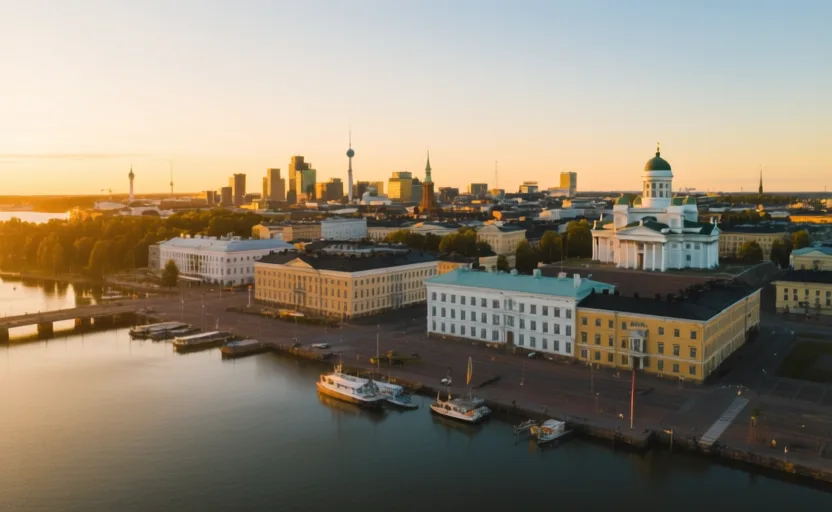 Helsinki · AI city illustration · Artistic impression
City · Europe
Helsinki
Also known as Helsingfors
Saved in this browser — no account needed. Sign in later and it comes with you.
Where it is
Few capitals sit this far north: only Reykjavík lies closer to the pole. Helsinki is built on a peninsula and 315 islands on the Gulf of Finland, with the centre on the southern cape, Vironniemi, known in Swedish as Helsinginniemi. Tallinn lies 80 kilometres south across the water, Stockholm 400 kilometres west and Saint Petersburg 300 kilometres east. The Baltic and the North Atlantic Current soften the climate, so January averages about minus 4 degrees, but latitude governs the light: around the winter solstice daylight lasts under six hours, and in midsummer almost nineteen. Outside the core, post-war suburbs are separated by patches of forest.
The land and water around it
The Gulf of Finland coastgulf
The city occupies a peninsula and 315 islands along the northern shore of the gulf. The shallow water at the river mouth defeated the first harbour and forced the move to the peninsula in 1640.
The Vantaa river and its rapidsriver
The original town was founded at the mouth of the Vantaa, below the Vanhankaupunginkoski rapids. One explanation of the name links Helsinki to these rapids, which gave the first town its name, Helsinge fors.
Helsinki Central Parkforest
A narrow green belt about 10 kilometres long, running from the centre to the northern edge of the city. Beyond it, forest patches separate the suburbs built after the war.
Its history, in short
The area was lightly settled for thousands of years, and its coastline was permanently colonised from Sweden in the late 13th century. King Gustav I founded Helsingfors on 12 June 1550 at the mouth of the Vantaa river, partly to rival Reval, today’s Tallinn. The shallow bay made a harbour impossible, and in 1640 the town moved south to the Vironniemi peninsula. For more than two centuries it stayed small, hit by fires, the plague of 1710 and the Russian occupation of 1713. The island fortress of Sveaborg, begun in 1748, raised its status. The turn came in 1809, when Russia took Finland from Sweden; in 1812 Alexander I moved the capital here from Turku to reduce Swedish influence and come closer to Saint Petersburg. The university followed after Turku burned in 1827, and the centre was rebuilt in a neoclassical style to a plan by C. L. Engel. Independence in 1917 was followed by a civil war in which Helsinki was a Red stronghold; it was bombed in the Winter War and the Continuation War. The Olympic Games of 1952 and rapid urbanisation in the 1970s, and then the metro of 1982, shaped the city now.
Timeline
Dates are shown on a timeline rather than as changing shapes on the map. The globe draws modern boundaries only, and tinting a modern outline to stand for a historical one would state something we cannot source.
Post-classical world
late 13th century
Swedish settlement of the coast
Settlers from Sweden permanently colonise the Helsinki coastline after the defeat of the Tavastians, who had used the area for fishing and hunting.
Approximate dateWikipedia
Early modern & oceanic
12 June 1550
Helsingfors founded
Gustav I of Sweden orders the burghers of several towns to move to a new trading town at the mouth of the Vantaa, to compete with Reval.
Well attestedWikipedia1640
The move to Vironniemi
Count Per Brahe the Younger and some descendants of the first settlers move the town to the sea-facing peninsula, today’s Kruununhaka district.
Well attestedWikipedia1748
Sveaborg begun
Construction starts on the island fortress at the harbour entrance, designed against Russian attack. It surrenders to Russia in 1808.
Industrial & imperial
8 April 1812
Capital of Finland
Emperor Alexander I of Russia moves the capital of the Grand Duchy from Turku to Helsinki.
Well attestedWikipedia1827
The university arrives
After the Great Fire of Turku, the country’s only university moves to Helsinki and later becomes the University of Helsinki.
Well attestedWikipedia26 January – 13 April 1918
Civil war in the capital
Helsinki lies in Red territory, and the Red government is set up there on 28 January; German troops allied with the Whites retake the city on 13 April. Thousands of Red prisoners later die in detention, including at Suomenlinna.
Well attestedWikipedia
Contemporary
1952
Summer Olympics
Helsinki hosts the Games of the XV Olympiad, a landmark in the city’s postwar recovery.
Well attestedWikipedia
Places that carry meaning
Senate Square1820s–1852
The focus of Engel’s plan: the Government Palace to the east, the main building of the university to the west and, to the north, Helsinki Cathedral, finished in 1852, twelve years after Engel died. The epithet “White City of the North” comes from this period.
SuomenlinnaFrom 1748
A sea fortress on six islands, built to Vauban-derived principles and used by Sweden, Russia and then Finland. It became a civilian district in 1973, and about 850 people live there.
Sederholm House1757
The oldest surviving building in the centre, by Senate Square. Most older buildings date from after the fire of 1808.
Languages here
Places are usually multilingual. This lists what is actually spoken, not one language per border.
FinnishUralic family
The first language of most residents.
A Finnic language, close kin of Estonian and Karelian, with Hungarian and the Sámi languages as more distant cousins. Helsinki slang, stadin slangi, arose among Finnish youngsters in the 1890s as a blend of Finnish and Swedish with German and Russian borrowings, and has since shifted towards Finnish and English.
SwedishGermanic family
The second official language of the municipality.
Helsinki is officially bilingual. At the start of the 20th century Finnish and Swedish speakers were about equal in number, though most workers spoke Finnish. Three of the city’s 21 Lutheran congregations use Swedish.
Immigrant languages
Spoken by the 21 per cent of residents with an immigrant background.
The largest groups of foreign-born residents arrived from Estonia, Somalia, Iraq, China, Russia and other parts of the former Soviet Union. A small Tatar-speaking community also lives in the city, and Sámi, Finland’s third official language, is rare as a mother tongue.
Learn the language here
- 1Understand which languages are spoken hereHelsinki is multilingual. Start with which languages are used, by whom, and for what — the phrase list only covers one of them.Written by Globe Quest
- 2Learn 11 phrasesCurated everyday phrases for Helsinki, with audio and a written form.Written by Globe Quest
- 3Say them out loudSpeaking practice with pronunciation feedback, one phrase at a time.Globe Quest material, your own additions
- 4Come back to themSpaced review, so what you learned this week is still there next month.Written by Globe Quest
Check yourself
Why did Alexander I move the capital of Finland to Helsinki in 1812?
To reduce Swedish influence and bring the capital closer to Saint Petersburg
Turku, the old capital, was on the Swedish side of the country; Helsinki lay closer to the new imperial capital, and the rebuilt neoclassical centre echoed Saint Petersburg.
Why was Helsinki’s first site on the Vantaa river abandoned?
The shallow bay made it impossible to build a harbour
The king allowed settlers to leave an unsuitable location, and in 1640 the town moved to the peninsula on the sea.
Worth arguing about
- A capital chosen by a foreign emperor, then rebuilt to look like his own. Whose city is Helsinki’s centre?
- Finnish and Swedish speakers were roughly equal in number in 1900; now one language dominates. What does a city owe a language that has become a minority?
What we have not established
These are open questions, listed rather than filled in. We would rather show a gap than a plausible guess.
How did the name Helsinki arise?
Theories link it to settlers from Hälsingland, to a Swedish word for a narrow river neck, or to the town’s rapids; dialect research casts doubt on the first, and none is settled.
Sources
- Wikipedia · HelsinkiWikipedia · encyclopedia · checked 2026-11-24
- Wikipedia · History of HelsinkiWikipedia · encyclopedia · checked 2026-11-24
- Wikipedia · FinlandWikipedia · encyclopedia · checked 2026-11-24
- UNESCO · Fortress of SuomenlinnaUNESCO World Heritage Centre · intergovernmental · checked 2026-11-24
Reviewed by Globe Quest editorial on 2026-11-24. Drafted with AI assistance and checked against the sources above before publication.