 Globe Quest
 Human Quest · LearningSign in
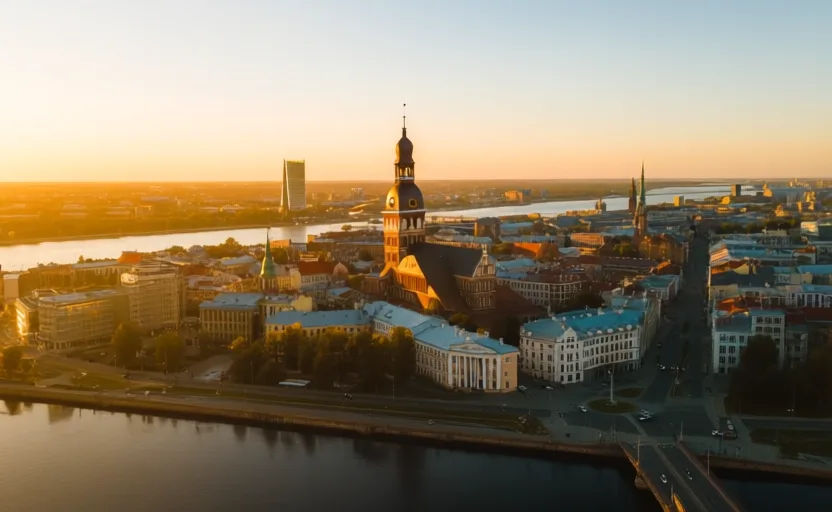 Riga · AI city illustration · Artistic impression
City · Europe
Riga
Saved in this browser — no account needed. Sign in later and it comes with you.
Where it is
Where the Daugava reaches the Gulf of Riga, the land is a flat sandy plain at almost sea level, and the city grew on the river's right bank, about 15 kilometres upstream from the mouth. That sheltered stretch of water was a natural harbour long before any town stood here, and the Daugava itself was a trade route reaching deep into the continent. The city covers about 307 square kilometres. Its climate is humid continental, softened by the sea: the sea brings frequent autumn rain and fog, January and February average about −2 °C, and snow can lie continuously for eighty days.
The land and water around it
The Daugavariver
Used for trade since ancient times, and a link in the Viking route down to Byzantium. The city's harbour lies upstream from the river mouth, which gave the early town shelter from the open sea and a direct line to the interior.
The Gulf of Riga plaingulf
The land beside the gulf is a flat, sandy plain barely above sea level. It has no natural hills, which is partly why the earliest fortifications went up on a modest promontory called Senais kalns, the “ancient hill”, which was levelled in the 18th century and became the Esplanade.
The City Canal and its boulevardsharbour
A canal with a green belt on both sides curves round the medieval core, marking where the 19th-century boulevards begin. The suburbs beyond it were laid out in the 19th century, first in wood and later in stone.
Its history, in short
The harbour on the Daugava, settled by the Finnic Livs and visited by Viking traders, was already a trading place when German merchants and a missionary monk arrived in the 12th century. Bishop Albert landed with crusaders in 1200 and moved the seat of the Livonian bishopric here in 1201, which is the date Riga celebrates as its founding. Papal decrees made it the gateway for German merchants trading in the Baltic, and in 1282 it joined the Hanseatic League. The city accepted the Reformation in 1522 and passed under Polish–Lithuanian, then Swedish, and from 1721 Russian rule, while a German-speaking upper class kept control of its administration until 1891. In the 19th century it became one of the Russian empire's most industrial cities, and the new Latvian middle class made it the centre of a national awakening. It has been the capital of Latvia since the declaration of 18 November 1918, apart from the years of Soviet and Nazi occupation. Soviet-era immigration reshaped its population, and by 1989 ethnic Latvians were only 36.5 per cent of residents.
Timeline
Dates are shown on a timeline rather than as changing shapes on the map. The globe draws modern boundaries only, and tinting a modern outline to stand for a historical one would state something we cannot source.
Classical world
2nd century
Duna Urbs
A sheltered natural harbour on the Daugava is recorded under the name Duna Urbs. The Livs, a Finnic people, settled it later, and Riga developed as a Viking-age trading centre.
Post-classical world
1201
Bishop Albert moves to Riga
Albert, who had landed with 23 ships and 500 crusaders the year before, moves the Livonian bishopric here from Ikšķile and gets the elders of Riga to agree under pressure. In 1202 he founds the Order of the Brothers of the Sword to defend the territory.
German and church chroniclers date the founding of Riga to Albert's arrival in 1201, and the day is still celebrated. Archaeology and the Chronicle of Henry show a trading settlement already existing, and the story that Germans brought civilisation to the pagans is regarded as a later myth.
1282
The Hanseatic League
Riga joins the league, which gives it a lasting economic and political stability that carried it through later conflicts. The city's prosperity grew across the 13th to 15th centuries.
Early modern & oceanic
1522
The Reformation
Riga accepts the Reformation and ends the power of the archbishops. After the Livonian Order collapsed in 1561 the city briefly held the status of a free imperial city, and by 1581 it came under the influence of Poland–Lithuania.
Well attestedWikipedia1710–1711
Plague in the Great Northern War
Half of Riga's residents are killed by plague. The Treaty of Nystad in 1721 brings the city under Russian rule.
Industrial & imperial
1873
The first national song festival
The Latvian middle class that grew with industrialisation founded the Riga Latvian Association in 1868 and organised the first song festival in 1873. The festival is still held every five years at the Mežaparks Great Bandstand.
18 November 1918
Capital of independent Latvia
Latvia declares its independence with Riga as its capital, after the German army had marched into the city in September 1917. In the interwar years the United Kingdom and Germany replaced Russia as the main trade partners.
Well attestedWikipedia1940–1944
Two occupations
The Soviet Union invades in June 1940 and holds rigged elections, and Nazi Germany occupies the country from 1941 to 1944. Riga's Jews were confined in a ghetto in the Maskavas quarter, and the Baltic Germans were sent to Germany after seven centuries in the city.
Places that carry meaning
The Historic Centre13th–19th centuries
UNESCO describes three layers: the medieval core, the 19th-century boulevards around the City Canal, and suburban quarters with wooden buildings of the 18th and 19th centuries. The medieval core stands on the right bank, and its church towers form the skyline seen from across the river.
The Art Nouveau districtEarly 20th century
Riga has at least 800 Art Nouveau buildings, one of the largest collections in the world. When stone building was permitted in the suburbs, the style filled them, and by the early 1900s the city had the highest concentration of Art Nouveau in Europe.
Riga Cathedral (the Dom)From 1211
Albert laid the cornerstone in 1211, ten years after the bishopric moved to Riga. It is the church that grew with the new bishop's town.
Mežaparks Great BandstandSong festivals
An open-air bandstand where the Latvian Song and Dance Festival is held every five years, one of the largest amateur choral and dance events in the world and part of UNESCO's list of intangible heritage.
Languages here
Places are usually multilingual. This lists what is actually spoken, not one language per border.
LatvianBaltic family
The sole official language, spoken by the country's titular nation.
Ethnic Latvians were 63 per cent of the city in 1935, fell to 36.5 per cent in 1989 under Soviet immigration, and had recovered to 47.4 per cent by 2022. Latvian-language national feeling was nurtured in the city from the mid-19th century.
RussianSlavic family
The most widely used minority language, spoken by about a third of residents.
Russians were 47.3 per cent of the city in 1989 and 35.7 per cent in 2022. Nationally, 37.7 per cent spoke Russian as a mother tongue in 2023. Many Soviet-era immigrants and their children born before 1991 did not receive Latvian citizenship automatically, and in 2022 15.3 per cent of the city's residents were non-citizens.
GermanGermanic family
The historic language of the city's merchants and administration.
German was the official language of the city's administration until Russian replaced it in 1891, and until that year even the registers of births, marriages and deaths were written in it. Germans were 42.9 per cent of the city in 1867, 25.5 per cent in 1897 and 13.9 per cent by 1913, before the Baltic Germans left in 1939–40.
LivonianUralic family
The nearly extinct Finnic language of the harbour's earliest settlers, protected by law.
The best documented origin of the city's name is the Livs' own word for the warehouses along the river, which German turned into Riga. Estonian, a close relative of Livonian, still calls the city Riia.
Learn the language here
- 1Understand which languages are spoken hereRiga is multilingual. Start with which languages are used, by whom, and for what — the phrase list only covers one of them.Written by Globe Quest
- 2Learn 11 phrasesCurated everyday phrases for Riga, with audio and a written form.Written by Globe Quest
- 3Say them out loudSpeaking practice with pronunciation feedback, one phrase at a time.Globe Quest material, your own additions
- 4Come back to themSpaced review, so what you learned this week is still there next month.Written by Globe Quest
Check yourself
When did Riga join the Hanseatic League?
1282
Riga joined the Hanseatic League in 1282. The Hansa gave the city lasting economic and political stability for centuries.
Why was the site of Riga a natural place for a harbour?
A sheltered stretch of the Daugava lies upriver from the mouth
The harbour sits some 15 kilometres up the Daugava, sheltered from the gulf, on a river that was a major trade route running into the interior.
Worth arguing about
- Riga's story is told in different ways by Baltic Germans, Latvians and Russians. Whose version should the city's museums and street names follow?
- Soviet-era immigrants and their children were not automatically given citizenship in 1991. How should a state weigh the legacy of occupation against the rights of long-term residents?
What we have not established
These are open questions, listed rather than filled in. We would rather show a gap than a plausible guess.
Where does the name Riga come from?
Several explanations circulate: a German name for the former river Rīdzene, a Latin word for “irrigated”, a Celtic root, and a Liv word for a loop. The best documented is a Latvian word for a warehouse, reported in 1610 and echoed by an English geographer in 1589, but no medieval source settles it.
Sources
- Wikipedia · RigaWikipedia · encyclopedia · checked 2026-11-24
- Wikipedia · History of RigaWikipedia · encyclopedia · checked 2026-11-24
- UNESCO · Historic Centre of RigaUNESCO World Heritage Centre · intergovernmental · checked 2026-11-24
- Wikipedia · LatviaWikipedia · encyclopedia · checked 2026-11-24
Reviewed by Globe Quest editorial on 2026-11-24. Drafted with AI assistance and checked against the sources above before publication.