 Globe Quest
 Human Quest · LearningSign in
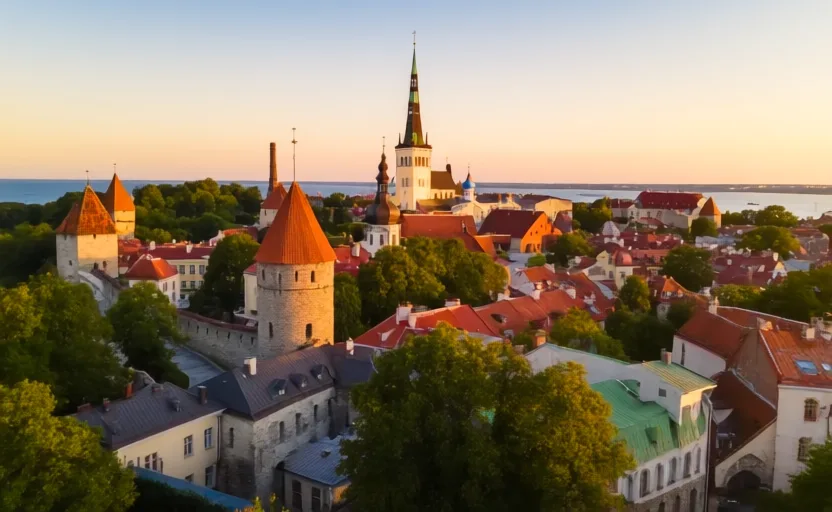 Tallinn · AI city illustration · Artistic impression
City · Europe
Tallinn
Saved in this browser — no account needed. Sign in later and it comes with you.
Where it is
Estonia’s capital faces north across a bay of the Gulf of Finland, only about 80 km from Helsinki, with Stockholm 380 km to the west. The ground is low: the highest point in the city is 64 m, and the dominant feature is a limestone cliff that runs through the urban area and breaks the skyline into a high edge and a flat shore. Winters are cold but softened by the sea, with temperatures hovering near freezing, and daylight at midwinter lasts barely six hours. In midsummer it stretches past 18 hours.
The land and water around it
The Gulf of Finland shorecoast
The city has 46 km of coastline, drawn out into three large peninsulas: Kopli, Paljassaare and Kakumäe. The bay gave the medieval merchants a sheltered port, and the short crossing to Helsinki is why the two capitals have long been tied together.
The limestone cliffplateau
A long limestone edge crosses the city and is visible at Lasnamäe and Astangu as well as at Toompea. The cathedral hill itself is not part of that formation, even though it looks like it belongs to it. The cliff top gave the upper town its defensive position; the lower town grew on the flat ground below.
Lake Ülemiste and the lost riverlake
Lake Ülemiste, about 9.4 square kilometres, is the main source of the city’s drinking water. A small river once ran from it through the old town to the sea, but in the 1930s it was sent into the sewers and vanished from sight. It survives only in street names such as Jõe (“river”) and Kivisilla (“stone bridge”).
Its history, in short
A fortress stood on the hill of Toompea by about 1050, beside a harbour that sat on the trade route between Novgorod and western Europe. That position drew outside powers: the Danish king took the town in 1219, and it later passed to the Teutonic Order. Under the name Reval it received Lübeck law in 1248 and joined the Hanseatic League in 1285 as its northernmost member. A walled town of roughly 8,000 people with 66 towers, it grew rich as a go-between for east and west. The Reformation brought Lutheranism, and in 1561 Reval came under Sweden. Russia took it in 1710, but the town’s own council and the local nobility kept their institutions until the council was abolished in 1889. Independence was declared in the city in February 1918. Soviet occupation in 1940 gave way to German rule from 1941, then to a second Soviet occupation in 1944, after which the city was reshaped by mass settlement from elsewhere in the USSR. Full independence was restored in August 1991, and the medieval centre was inscribed as a World Heritage Site in 1997.
Timeline
Dates are shown on a timeline rather than as changing shapes on the map. The globe draws modern boundaries only, and tinting a modern outline to stand for a historical one would state something we cannot source.
First cities & states
c. 3000 BCE
Hunter-fishers on the shore
Comb-ceramic pottery from about 3000 BCE, and corded-ware pottery from about 2500 BCE, marks the earliest traces of a small community of hunters and fishers where the city centre now stands.
Approximate dateWikipedia
Post-classical world
c. 1050
A fortress on Toompea
A stronghold is built on the hill that becomes the seat of government. The upper town on this hill has been the administrative centre ever since.
1219
Danish conquest
King Valdemar II of Denmark takes the town during the Northern Crusades, which imposed Catholic Christianity on northern Estonia. A popular reading of the name Tallinn is “Danish castle”, though its origin remains uncertain.
Well attestedWikipedia1285
Reval joins the Hanse
As the northernmost member of the Hanseatic League, Reval handles trade between Novgorod and Muscovy to the east and western Europe. Lübeck law had been granted in 1248, and in 1346 the Danish king sold the town to the Teutonic Order.
Well attestedWikipedia
Early modern & oceanic
1710
Capitulation to Russia
Plague-stricken Reval surrenders to Russia during the Great Northern War. The council and the Estonian Knighthood keep their cultural and economic autonomy inside the Russian Empire.
Industrial & imperial
24 February 1918
Independence proclaimed
The Declaration of Independence is issued in Tallinn, which becomes the capital of the new republic once German occupation ends in November.
Well attestedWikipedia9–10 March 1944
The Soviet air raid
More than a thousand incendiary bombs fall on the city, killing 757 people, 586 of them civilians, and leaving 20,000 without shelter. The Soviet army re-occupies Tallinn in September.
Well attestedWikipedia
Contemporary
20 August 1991
Independence restored
Tallinn again becomes the capital of a de facto independent state. The old town is inscribed on the World Heritage list in 1997.
Places that carry meaning
Toompea and the lower town11th–16th centuries
Two towns in one: the castle and cathedral on the limestone hill, where the rulers sat, and below it the merchants’ town with its guilds, churches and walls. The two were sheltered by the same fortifications, and the medieval plot pattern survives almost unchanged.
Town Hall and Old Thomas1530
In 1530 a weather vane in the form of an old soldier, Old Thomas, was set on the Town Hall spire. He became the city’s emblem. The city wall around it had 66 towers.
LasnamäeSoviet period
A district built to house workers moving in from Russia and other parts of the USSR, and now the most populous in the city. Its estates, with Mustamäe and Väike-Õismäe, explain why Russian is still a major language of the capital.
Languages here
Places are usually multilingual. This lists what is actually spoken, not one language per border.
EstonianUralic family
The official language and the first language of just over half of residents.
A Finnic language, and one of the few in Europe outside the Indo-European family. Roughly 53% of Tallinners spoke it as their first language in 2026. Around a quarter of its vocabulary is borrowed from German, mostly Low Saxon, a trace of the Hanseatic centuries.
RussianSlavic family
The first language of about two in five residents.
About 42% of residents had Russian as a first language in 2026. Most of this population descends from Soviet-era arrivals, and the large new districts built for them are still where it is most concentrated.
Ukrainian and Finnish
Smaller communities with a significant number of native speakers.
Alongside English, the most common foreign language, there are notable numbers of native Ukrainian and Finnish speakers.
Learn the language here
- 1Understand which languages are spoken hereTallinn is multilingual. Start with which languages are used, by whom, and for what — the phrase list only covers one of them.Written by Globe Quest
- 2Learn 12 phrasesCurated everyday phrases for Tallinn, with audio and a written form.Written by Globe Quest
- 3Say them out loudSpeaking practice with pronunciation feedback, one phrase at a time.Globe Quest material, your own additions
- 4Come back to themSpaced review, so what you learned this week is still there next month.Written by Globe Quest
Check yourself
What was Reval’s place in the Hanseatic League?
The northernmost member, from 1285
Reval joined in 1285 as the northernmost member of a trading alliance dominated by German cities, controlling the route between Novgorod and the west.
Why do Russian speakers form such a large share of Tallinn’s population?
Districts such as Lasnamäe were built in the Soviet era for incoming workers
Soviet planners built whole districts to house migrants from Russia and elsewhere in the USSR, and ethnic Estonians fell from over 80% before the Second World War to just over half by 2022.
Worth arguing about
- A medieval town kept its plot pattern almost intact from the 13th–14th centuries onward. Does that kind of survival depend more on luck than on deliberate care?
- Nearly half of Tallinn’s residents have a first language other than Estonian. What should a capital ask of its minority-language residents, and what should it offer?
What we have not established
These are open questions, listed rather than filled in. We would rather show a gap than a plausible guess.
Where does the name Tallinn come from?
The usual reading is Taani-linna, “Danish castle”, after the 1219 conquest, but the name of the neighbouring medieval county, Revala, has no agreed etymology and earlier Scandinavian saga references complicate the picture.
Sources
- Wikipedia · TallinnWikipedia · encyclopedia · checked 2026-11-24
- Wikipedia · History of TallinnWikipedia · encyclopedia · checked 2026-11-24
- UNESCO · Historic Centre (Old Town) of TallinnUNESCO World Heritage Centre · intergovernmental · checked 2026-11-24
- Wikipedia · EstoniaWikipedia · encyclopedia · checked 2026-11-24
Reviewed by Globe Quest editorial on 2026-11-24. Drafted with AI assistance and checked against the sources above before publication.