 Globe Quest
 Human Quest · LearningSign in
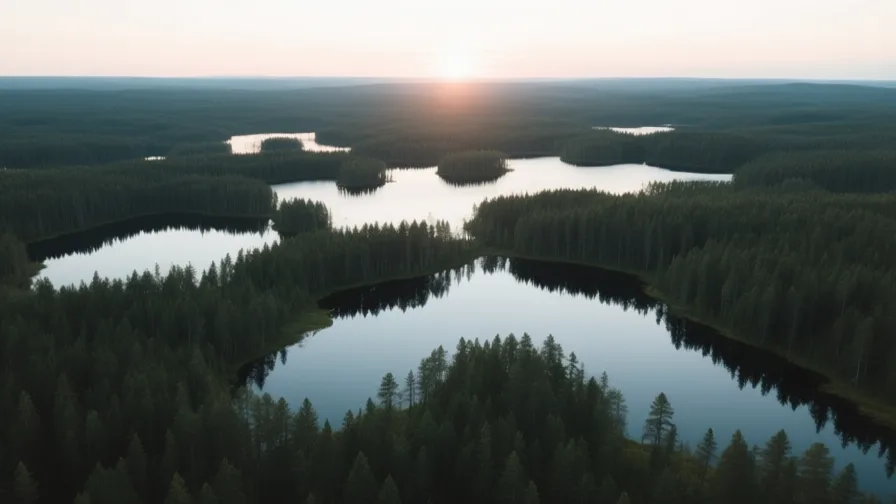 Finland · AI landscape illustration · Artistic impression
Country · Europe
Finland
Saved in this browser — no account needed. Sign in later and it comes with you.
Where it is
Finland stretches about 1,160 kilometres from Hanko on the southern coast to Nuorgam in Lapland, between roughly the 60th and 70th parallels. Ice shaped nearly all of it. The glaciers scoured a low, worn-down landscape of bedrock, left hollows that filled to become some 168,000 lakes, and the land is still rising as it recovers from the weight of the ice. Boreal forest covers most of the ground, and the south-west coast breaks up into the world’s largest archipelago, more than 50,000 islands. Winters are long, but the Gulf Stream, the Baltic and the lakes make the climate milder than at similar latitudes in Alaska or Siberia. About 5.7 million people live here.
The land and water around it
The Finnish Lakelandlake
The densest area of lakes in the country, in the interior, with Saimaa, the fourth largest lake in Europe. Many large inland cities, such as Tampere, Jyväskylä and Kuopio, stand near big lakes.
The Archipelago Seasea
Between the south-western mainland and the island of Åland lies the highest concentration of the more than 50,000 islands of Finland’s archipelago.
Rebounding landplain
As the ice sheet thinned, the land began to rise, and the uplift continues today. Much of the country was once under water, and the ancient shorelines stand 150 to 220 metres above the present sea level depending on the region.
Its history, in short
People arrived as the last ice sheet retreated, at the latest around 8500 BCE, and the first pottery appeared in 5200 BCE. For the next several thousand years the area lay in contact with other cultures around the Baltic. From the 12th century written sources appear, and in the middle of the 13th century most of the territory became part of the Kingdom of Sweden during the Northern Crusades. Mikael Agricola’s translation of the New Testament into Finnish in the 16th century laid the base for a written language. Sweden lost Finland to Russia in 1809, and it became an autonomous grand duchy. Under Russian rule a Finnish nationalist movement grew from the 1860s, drawing on folklore and the Kalevala epic. Independence came in 1917, followed by a civil war in 1918 won by the Whites. In 1939 the Soviet Union attacked in the Winter War; Finland lost territory but kept its independence. Rapid industrialisation after the war turned a farming country into a welfare state. Finland joined the European Union in 1995, the euro in 1999 and NATO in 2023.
Timeline
Dates are shown on a timeline rather than as changing shapes on the map. The globe draws modern boundaries only, and tinting a modern outline to stand for a historical one would state something we cannot source.
First cities & states
c. 8500 BCE
First settlers
Hunter-gatherers using stone tools arrive towards the end of the last glacial period, with artefacts shared with Estonia, Russia and Norway.
Approximate dateWikipedia
Post-classical world
1249 and 1293
Swedish crusades
Sweden mounts a crusade against the Tavastians in 1249 and another against the Karelians in 1293, and most of the country becomes part of the Swedish kingdom from the 13th century. Whether an earlier crusade around 1155 ever took place is doubted.
Early modern & oceanic
1551
New Testament in Finnish
Mikael Agricola, bishop of Turku, publishes his translation, the start of written Finnish.
Well attestedWikipedia
Industrial & imperial
29 March 1809
The Grand Duchy
After the Finnish War, Alexander I of Russia makes Finland an autonomous grand duchy, confirmed by the Diet of Porvoo.
Well attestedWikipedia1866–1868
The great famine
A catastrophic famine is followed by easing of economic rules and extensive emigration.
Well attestedWikipedia1906
Universal suffrage
Finland gives all adults the vote, a European first, and also lets every adult citizen stand for public office, a world first.
Well attestedWikipedia1917
Independence
Finland declares independence after the Russian Revolution. A civil war follows in 1918, which the anticommunist Whites win, and republic status is confirmed in 1919.
Well attestedWikipedia30 November 1939
The Winter War
The Soviet Union attacks Finland. The Red Army suffers heavy losses, but its advance reaches Vyborg in March. Finland loses territory yet keeps its independence.
Well attestedWikipedia
Places that carry meaning
HelsinkiFounded 1550
The capital and largest city, on the Gulf of Finland coast in the far south of the country.
ÅlandAutonomous region
An archipelago connected to the mainland by a shallow submarine plateau, and the only monolingual Swedish-speaking region of Finland.
HaltiHighest point
At 1,361 metres, the highest point in Finland, in the far north. Elsewhere the land is low, with a third of the country below 100 metres.
Languages here
Places are usually multilingual. This lists what is actually spoken, not one language per border.
FinnishUralic family
The first language of 83.5 per cent of the population.
A Finnic language, and one of only four official EU languages that are not Indo-European. Its nearest kin are Estonian and Karelian, with Hungarian and the Sámi languages further off, and it shares no ancestry with the other Nordic national languages.
SwedishGermanic family
The second official language, native to 5.0 per cent.
Spoken along parts of the western and southern coast and in Åland, where it is the only language. It is a compulsory school subject, and many non-native speakers know it well.
Sámi languagesUralic family
Recognised as Finland’s third official language.
Closely tied to the Sámi, whose name for themselves is linked in one theory to the name Suomi. Few people speak a Sámi language as their mother tongue today.
Learn the language here
Check yourself
How is Finnish related to the other Nordic national languages?
It is unrelated by descent, being part of the Uralic family
Finnish belongs to the Finnic branch of Uralic, close to Estonian and Karelian, while Swedish, Norwegian and Danish are Germanic.
Why are parts of Finland still rising?
The land is recovering from the weight of the Ice Age ice sheet
When the ice thinned and withdrew, the land began to rise, and the uplift continues. Much of the country had been under the sea.
Worth arguing about
- Finland spent centuries under Sweden, then a century under Russia, and kept its own language and institutions. What kept them alive?
- Finland’s two national names, Suomi and Finland, are unrelated. What does it mean for a country to be known by a name that its own language does not use?
What we have not established
These are open questions, listed rather than filled in. We would rather show a gap than a plausible guess.
How many lakes does Finland have?
One count gives 168,000 lakes larger than 500 square metres, while the same article’s introduction speaks of over 180,000 recorded lakes. The totals depend on the minimum size used.
Sources
- Wikipedia · FinlandWikipedia · encyclopedia · checked 2026-11-24
- Wikipedia · History of FinlandWikipedia · encyclopedia · checked 2026-11-24
- Wikipedia · Geography of FinlandWikipedia · encyclopedia · checked 2026-11-24
Reviewed by Globe Quest editorial on 2026-11-24. Drafted with AI assistance and checked against the sources above before publication.