 Globe Quest
 Human Quest · LearningSign in
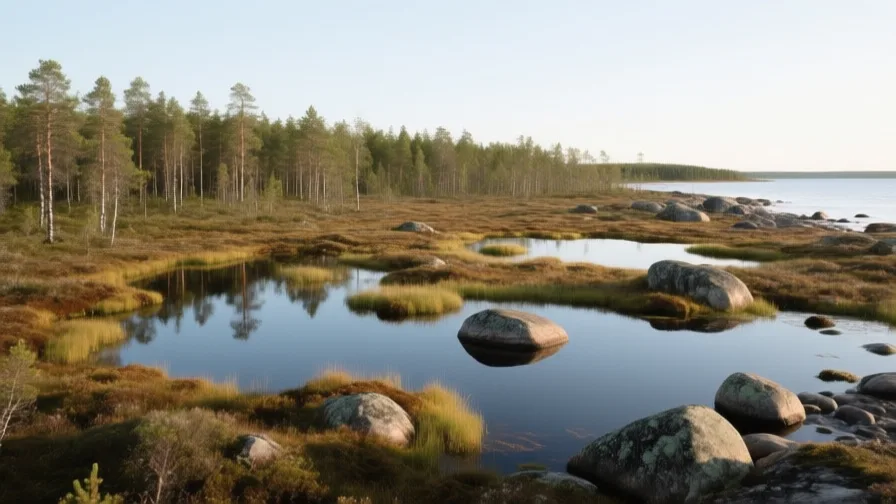 Estonia · AI landscape illustration · Artistic impression
Country · Europe
Estonia
Saved in this browser — no account needed. Sign in later and it comes with you.
Where it is
Estonia is a flat country on the eastern shore of the Baltic, facing Finland across the Gulf of Finland to the north and bordering Latvia in the south and Russia in the east. Average height is only about 50 metres, and the highest ground, Suur Munamägi in the south-east, reaches 318. Limestone cliffs line the northern coast. Offshore lie more than 2,300 islands, the largest being Saaremaa and Hiiumaa. Bogs and mires cover almost a quarter of the land and forests close to half, and Lake Peipus forms much of the eastern border. The sea and the North Atlantic Current keep the climate milder than the latitude would suggest.
The land and water around it
The islands of the Westisland
Saaremaa, at 2,673 square kilometres, and Hiiumaa, at 989, are the two largest of more than 2,300 islands and islets. A small cluster of meteorite craters, the largest called Kaali, lies on Saaremaa, and the impact may have been seen by Iron Age people.
Lake Peipus and the eastern waterslake
Lake Peipus, at 3,555 square kilometres, is the largest of more than 1,500 natural lakes and forms much of the border with Russia. Võrtsjärv is second, in central Estonia, and the Narva, the largest river by discharge, drains toward the Gulf of Finland.
Bogs, forests and oil shalemarsh
Bogs and mires cover 23.2 per cent of the land, forests about 47 per cent. The mineral wealth is limestone and oil shale, mined in the north-east, which has also left spoil heaps and heavy pollution.
Its history, in short
People have lived in Estonia since about 9000 BCE. The Estonians were among the last pagan peoples of Europe, and a crusade brought them under Danish and German rule in the thirteenth century. Denmark held the north until 1345, and the Teutonic Order and church states held the rest until the 1550s. Sweden took over from 1561, and Russia conquered the whole territory in the Great Northern War, confirmed in 1721. Throughout these centuries the German-speaking nobility kept its land and its language of administration, and Estonians were mostly serfs until the early nineteenth century. A national movement grew from the 1850s, around newspapers, song festivals and an epic poem, and independence was declared on 24 February 1918. The Molotov-Ribbentrop Pact assigned Estonia to the Soviet sphere, and Soviet occupation followed in 1940, then German in 1941 and Soviet again from 1944. Singing demonstrations in 1988 to 1990 led to restored independence on 20 August 1991. Estonia entered NATO and the European Union together in 2004.
Timeline
Dates are shown on a timeline rather than as changing shapes on the map. The globe draws modern boundaries only, and tinting a modern outline to stand for a historical one would state something we cannot source.
First cities & states
c. 9000 BCE
The first settlers
The Pulli settlement on the River Pärnu is dated to the early ninth millennium BCE, at least 11,000 years old. It belongs to the Kunda culture.
Post-classical world
1208–1227
The northern crusade
The Livonian Brothers of the Sword begin campaigning against the Estonians in 1208. The Estonian leader Lembitu is killed in the Battle of St Matthew's Day in 1217, and by 1227 the crusaders have conquered the area.
Early modern & oceanic
1561
Swedish rule
During the Livonian War the north submits to Sweden. In 1625 the whole mainland is Swedish, until Russia conquers it in 1710.
Well attestedWikipedia
Industrial & imperial
1816–1819
Serfdom abolished
Serfdom ends in southern Estonia in 1816 and in northern Estonia in 1819, allowing farmers to rent or buy land and many to move to the towns. This is the economic base of the later national awakening.
24 February 1918
Independence declared
A Salvation Committee, formed after the Bolsheviks disband the provincial assembly, declares independence in Tallinn and forms a provisional government between the Bolshevik retreat and the German arrival.
Well attestedWikipediaJune–August 1940
Soviet annexation
The Soviet Union invades on 16 June after an ultimatum, and Estonia is formally annexed on 6 August. In the first year, more than 8,000 people are arrested, and about 10,000 civilians are deported on 14 June 1941.
Well attestedWikipedia
Contemporary
March 1949
Mass deportation
About 20,000 Estonians are deported to Siberia as the Soviet authorities push through collectivisation. The armed resistance of the Forest Brothers fades away by the mid-1950s.
Well attestedWikipedia1988–1991
The Singing Revolution
Protests that began with the Phosphorite War over mining lead to full independence on 20 August 1991. The Estonian state's legal continuity had been kept alive through diplomats and a government in exile.
Well attestedWikipedia
Places that carry meaning
TallinnMedieval onward
The capital and largest city, on the northern coast along the Gulf of Finland. Its medieval old town is on the UNESCO World Heritage List.
Tartu11th century onward
A city in the south-east that the Rus' prince Yaroslav captured in about 1030 and the Sosols destroyed as a foothold in 1061. In the Russian Empire it was the seat of the Imperial University of Dorpat, whose faculty included German professors.
Kaali craterc. 7th century BCE
A group of meteorite craters on Saaremaa made when a large meteorite struck, perhaps within the memory of the Iron Age population.
Languages here
Places are usually multilingual. This lists what is actually spoken, not one language per border.
EstonianUralic family
The official language and first language of most people.
A Finnic language and one of the few in Europe that is not Indo-European. About a quarter of its vocabulary comes from Low Saxon and High German, a legacy of centuries under German-speaking landowners.
RussianSlavic family
The language of the largest minority.
Russians were the largest minority group in 1934. Altogether the population reports 243 different mother tongues.
GermanGermanic family
The old language of administration, law and higher education.
Baltic Germans owned most of the land and dominated the towns until the early twentieth century. German remained the language of the law and the Lutheran church until the late nineteenth century and in part until 1918.
Learn the language here
Check yourself
Why do many Estonian words resemble German ones?
Estonian borrowed a large share of its vocabulary from Low Saxon and High German
Estonian is Finnic, not Germanic, but centuries of German-speaking rule left roughly a quarter of its vocabulary borrowed from German dialects.
When was Estonian independence first declared and then restored?
1918, and again in 1991
Independence was declared on 24 February 1918 and was lost to Soviet annexation in 1940. It was restored on 20 August 1991 after the Singing Revolution.
Worth arguing about
- Estonia was ruled by Danes, Germans, Swedes and Russians but kept its language. What made that survival possible?
- The Estonian state held that its independence never legally ended, even during decades of occupation. Why did that principle matter in 1991?
What we have not established
These are open questions, listed rather than filled in. We would rather show a gap than a plausible guess.
When did the ancestors of the Estonians arrive on the Baltic shore?
It was once tied to the Comb Ceramic culture, but linking an archaeological culture to a language cannot be proven. Some researchers suggest a Uralic language was spoken here since the end of the last glaciation.
Sources
- Wikipedia · EstoniaWikipedia · encyclopedia · checked 2026-11-24
- Wikipedia · History of EstoniaWikipedia · encyclopedia · checked 2026-11-24
- Wikipedia · Geography of EstoniaWikipedia · encyclopedia · checked 2026-11-24
Reviewed by Globe Quest editorial on 2026-11-24. Drafted with AI assistance and checked against the sources above before publication.