 Globe Quest
 Human Quest · LearningSign in
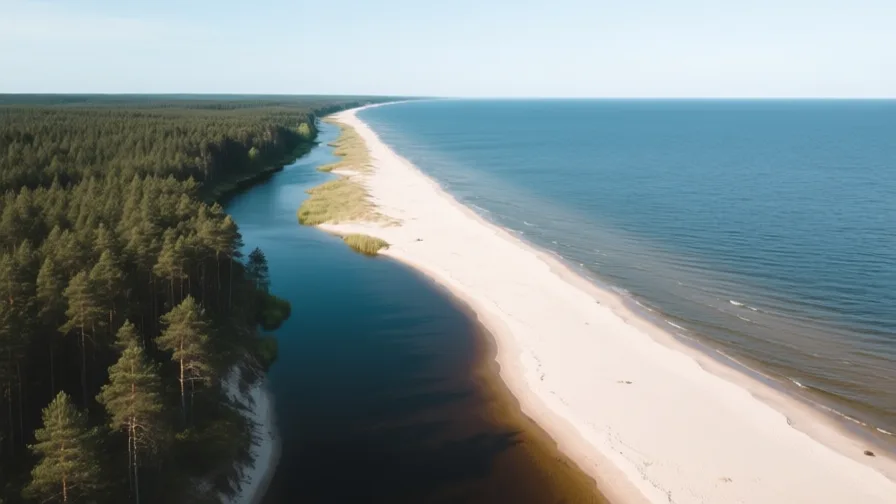 Latvia · AI landscape illustration · Artistic impression
Country · Europe
Latvia
Saved in this browser — no account needed. Sign in later and it comes with you.
Where it is
Latvia is the middle of the three Baltic states, a country of about 64,600 square kilometres with Estonia on its northern border and Lithuania on its southern one, Russia and Belarus to the east and a long coast on the Baltic Sea and the Gulf of Riga. It is flat: nothing rises above 350 metres, and the land is lowland plains, gentle hills and a patchwork of forest and field. Forest covers 56 per cent of the territory, which gives Latvia one of the highest shares in the European Union, and there are more than 12,500 rivers. The west coast, especially the Courland Peninsula, has a milder maritime climate, while the east is more continental, with colder winters and warmer summers.
The land and water around it
The Daugavariver
Latvia's principal river was the head of a trade route from the Baltic across what is now Russia to southern Europe and the Middle East, used by Vikings and later Nordic and German traders. The missionaries who began the conquest of Latvia sailed up it, and Riga stands at its mouth.
The Baltic and Gulf of Riga coastcoast
Hundreds of kilometres of seashore remain undeveloped, lined with pine forest, dunes and white sand. The coast was known across Europe for amber, and Latvia is still sometimes called Dzintarzeme, the land of amber.
Lowlands, forest and riversplain
Most of the country is fertile lowland and moderate hills, with large forests alternating with fields and farmsteads. Along with the Daugava, major rivers include the Lielupe, Gauja, Venta and Salaca, and the Salaca is the main breeding river for Baltic salmon in the east.
Its history, in short
Baltic peoples settled the eastern Baltic coast around 3000 BCE, and by about 900 CE four Baltic tribes, the Curonians, Latgalians, Selonians and Semigallians, lived beside the Finnic Livonians. The Daugava carried a trade route between Scandinavia and Byzantium, and amber took Latvian goods as far as Rome. In the late 12th century German missionaries and crusaders arrived, and over the 13th century the Livonian Order and the Church conquered the land and made Riga their base. The German-speaking elite of landowners and merchants, the Baltic Germans, held power for centuries under successive overlords: the Livonian Order, Poland–Lithuania, Sweden and, from 1721 in the north and by 1795 across the whole territory, the Russian Empire. In the 19th century a Latvian national movement formed around language and song. Independence was declared on 18 November 1918, lost to Soviet occupation in 1940, interrupted by German occupation from 1941 and followed by Soviet rule again from 1944. The Singing Revolution of 1987 led to the restoration of independence in 1991. Soviet-era immigration left Russians as the largest minority, almost a quarter of the population.
Timeline
Dates are shown on a timeline rather than as changing shapes on the map. The globe draws modern boundaries only, and tinting a modern outline to stand for a historical one would state something we cannot source.
First cities & states
c. 3000 BCE
Baltic settlers
The Proto-Baltic ancestors of the Latvians settle on the eastern coast of the Baltic Sea. Finnic peoples, forefathers of the Livonians, had lived there earlier.
Post-classical world
1207
Terra Mariana
A crusader state of Church and Order lands in what is now Latvia and Estonia is created, under the direct authority of the pope. The Livonian lands were subdued by 1207 and most Latgalian ones by 1214.
Well attestedWikipedia
Early modern & oceanic
1561
The Livonian Order dissolves
During the Livonian War the Order is dissolved by the Treaty of Vilnius. The territory is divided between vassal duchies of Poland–Lithuania, Courland and Semigallia in the west and Livonia in the north.
1721
Russia takes the north
The Treaty of Nystad ends the Great Northern War, and Swedish Livonia passes to Russia. The Baltic German nobility kept their privileges, including German for local administration and a Landtag of their own, and half the residents of Riga had died of plague in 1710–1711.
Industrial & imperial
1873
The first song festival
Latvian nationalists promote their culture in the 19th century, and the Latvian Song and Dance Festival begins. It is held normally every five years, with about 30,000 performers.
Well attestedWikipedia18 November 1918
Independence
The People's Council of Latvia proclaims independence, and Kārlis Ulmanis sets up a government. The country had been devastated by the First World War, and a war of independence followed. In 1934 Ulmanis established a dictatorship.
Well attestedWikipediaJune 1940
Soviet occupation
After the Molotov–Ribbentrop Pact assigns Latvia to the Soviet sphere, the country is forcibly incorporated into the Soviet Union. Most Baltic Germans left under agreements with Nazi Germany in 1939 and 1940, and Germany occupied Latvia from 1941 to 1944.
Well attestedWikipedia
Contemporary
1990–1991
Independence restored
The Supreme Council declared the restoration of independence on 4 May 1990. In January 1991 Soviet forces tried and failed to overthrow the authorities, and de facto and official independence were restored on 21 August 1991.
Well attestedWikipedia
Places that carry meaning
Riga1201 onward
The capital and largest city, home to about a third of the country's people. The Church-led conquest began from here, and in the 13th to 15th centuries it was a leading member of the Hanseatic League.
DaugavpilsRussian imperial period onward
A city in the eastern region of Latgale, where a large fortress was built after Russia gained the region in 1772. Ethnic Latvians are a minority of its population, as in Rēzekne, and Latgale's cultural separation from the rest of Latvia grew under its long Polish-Lithuanian then Russian rule.
Grobiņac. 650–850
A colony of a few hundred people, most likely from Gotland, settled near this town on the west coast. It shows the Scandinavian presence on the Baltic shore centuries before the crusades.
Languages here
Places are usually multilingual. This lists what is actually spoken, not one language per border.
LatvianBaltic family
The sole official language and the language of the titular nation.
Latvian is a Baltic language of the Balto-Slavic branch of Indo-European. Ethnic Latvians were 65.5 per cent of the population in 2025, down from 77 per cent in 1935 and 52 per cent at the Soviet-era low of 1989.
RussianSlavic family
By far the most widely used minority language.
In 2023 37.7 per cent of residents spoke Russian as a mother tongue and 34.6 per cent at home, including people who are not ethnic Russians. It spread through Soviet-era immigration and is dominant in several cities, so that in Daugavpils and Rēzekne ethnic Latvians are a minority.
LatgalianBaltic family
A historical variety of Latvian in the east, protected by law.
Latvian law treats Latgalian as a historical variation of Latvian rather than a separate language. The region it is spoken in was cut off from the rest of Latvia under Polish and later Russian rule.
LivonianUralic family
A nearly extinct Finnic language, protected by law.
The Livonians, a Finnic people on the coast and the lower Daugava, are counted among the ancient peoples from whom modern Latvians descend, beside four Baltic tribes.
Learn the language here
Check yourself
Why was the Daugava important in early Latvian history?
It was the main trade route into the interior and towards Byzantium
The Daugava was at the head of a trade route used by Vikings and later traders, which is why both missionaries and merchants came up the river and why Riga arose at its mouth.
What status does Latgalian have under Latvian law?
A protected historical variety of Latvian
Latvian is the sole official language, but Latgalian and the nearly extinct Livonian are both protected by law.
Worth arguing about
- For centuries Latvia's rulers spoke other languages than its farmers. How does that history shape the importance of Latvian today?
- A large Russian-speaking minority exists mainly because of Soviet-era immigration. How should a state treat residents whose presence is a legacy of occupation?
What we have not established
These are open questions, listed rather than filled in. We would rather show a gap than a plausible guess.
What is the exact area of Latvia?
Accounts give about 64,573 and 64,559 square kilometres, and the land area and inland water are counted differently, so only the approximate figure of 64,600 is used here.
Sources
- Wikipedia · LatviaWikipedia · encyclopedia · checked 2026-11-24
- Wikipedia · History of LatviaWikipedia · encyclopedia · checked 2026-11-24
Reviewed by Globe Quest editorial on 2026-11-24. Drafted with AI assistance and checked against the sources above before publication.