 Globe Quest
 Human Quest · LearningSign in
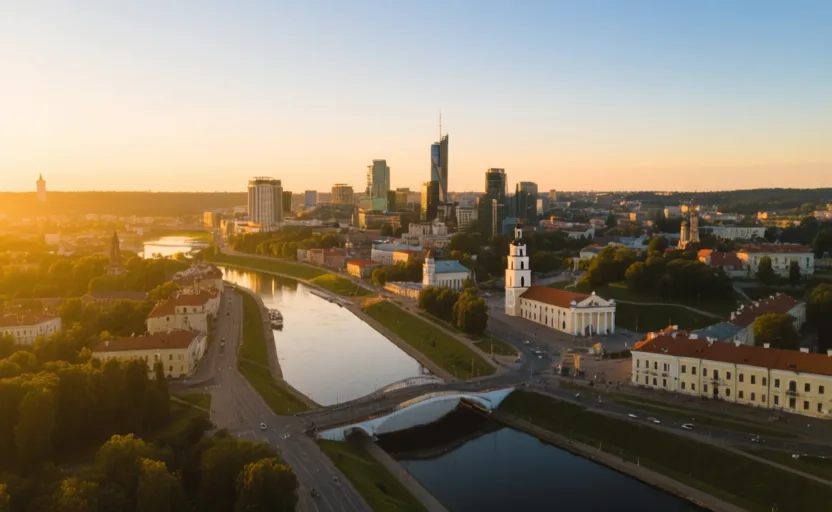 Vilnius · AI city illustration · Artistic impression
City · Europe
Vilnius
Saved in this browser — no account needed. Sign in later and it comes with you.
Where it is
Far from the sea, Vilnius stands in the south-east of Lithuania, some 312 kilometres from the Baltic coast, where the small river Vilnia runs into the broad Neris. The ground is a landscape of hills left by the glaciers, and the oldest fortifications went up on those heights above the confluence. The city covers about 402 square kilometres, and roughly 69 per cent of that is green space rather than buildings. The climate is humid continental: January averages around −4 °C, rivers can freeze in hard winters, and the surrounding lakes are almost always frozen from December to March.
The land and water around it
The Neris and Vilnia confluenceriver
The city sits where the Vilnia joins the Neris, and it takes its name from the smaller river: Vilnia is an old Lithuanian word for a ripple. The first fortified settlements gathered at this meeting of rivers, which is still the densest part of the old city.
Gediminas Hillplateau
A glacial hill above the confluence, where a wooden castle was built about 1000 CE. The medieval town grew in a rough circle radiating out from the castle site, with irregular blocks and small streets, and larger squares added later.
A cold inland climateclimate
Because Vilnius is far from the Baltic coast, winters are colder than on the shore: a hard frost of −25 °C or colder turns up in every second winter, and the surrounding lakes freeze for months. Summers are warm, with periodic heat waves above 30 °C.
Its history, in short
A wooden castle on the hill above the river mouth was the first fortification, and by 1323, when Grand Duke Gediminas mentioned it in letters inviting Germans and Jews to settle, Vilnius was already the seat of the Lithuanian grand dukes. City rights followed in 1387, after the country's conversion to Christianity. Under the Polish–Lithuanian Commonwealth the city flourished, with a university from 1579 and so many peoples living in it that Western writers nicknamed it the Babylon of Europe. Russia took it in 1795, closed the university in 1832, and later banned the printing of Lithuanian in the Latin alphabet. In the 19th century it was a centre of Jewish, Polish, Lithuanian and Belarusian national movements. In the 20th it changed hands repeatedly: German occupation in the First World War, Poland from 1920, the Soviet Union in 1940, and Nazi Germany in 1941, and the Holocaust ended its long role as one of Europe's great Jewish centres. After the war, the population exchange between Poland and Soviet Lithuania left a city with a Lithuanian majority for the first time in modern history. Soviet forces attacked the TV tower in January 1991, killing 14 civilians.
Timeline
Dates are shown on a timeline rather than as changing shapes on the map. The globe draws modern boundaries only, and tinting a modern outline to stand for a historical one would state something we cannot source.
Post-classical world
c. 1000
A wooden castle on the hill
A timber castle is built to fortify Gediminas Hill at the meeting of the two rivers. The settlement did not develop into a town until the 13th century, during the Baltic peoples' struggles against German invaders.
Approximate dateUNESCO World Heritage Centre1323
First named as capital
Grand Duke Gediminas writes to western cities from “Vilna”, in the earliest surviving mention of the city as the capital of Lithuania. The letters invite Jews and Germans to settle.
1387
City rights
Vilnius receives city rights after the Christianisation of Lithuania, and craftsmen and merchants of many nationalities settle in it.
Well attestedWikipedia
Early modern & oceanic
1579
Vilnius University
Stephen Báthory establishes the university, which makes the city a centre of learning for the Commonwealth. Tsarist authorities closed it in 1832 after the November Uprising.
1795
Absorbed into the Russian Empire
After the Third Partition of Poland, Vilnius becomes capital of a Russian governorate. Between 1799 and 1805 the city walls are pulled down to let it expand, leaving only the Gate of Dawn.
Well attestedWikipedia
Industrial & imperial
October 1920
Poland takes the city
A conflict over the city after the First World War ends with its occupation by Poland, and it remains part of Poland until 1939. Lithuania did not accept this, and never recognised the 1922 elections that supported union with Poland. The 1931 Polish census counted 65.9 per cent Poles and only 0.8 per cent Lithuanians in the city.
DisputedWikipediaLithuanian accounts treat the takeover as an occupation of its historic capital and describe a policy of repression of Lithuanians in the 1930s, while Polish accounts present the city as a majority-Polish one that voted for incorporation.
June 1940
Soviet takeover
After Lithuania had received the city in 1939, the Soviet Union takes control in June 1940 despite Lithuanian resistance, and Vilnius becomes the capital of the Lithuanian Soviet Socialist Republic. Nazi Germany seized the city in June 1941.
Places that carry meaning
Vilnius Historic CentreMedieval onward
An old town counted among the largest and best preserved in Europe, with Gothic, Renaissance, Baroque and Classical buildings. UNESCO lists it for the harmony between architecture and the natural landscape, and for how the Grand Duchy's many peoples shaped it. Vilnian Baroque is named after the city.
Gate of DawnMedieval
The only town gate left after the Russian authorities demolished the walls between 1799 and 1805. Its other names include Aušros vartai and Ostra Brama, a reminder of the several languages that name the city's landmarks.
Palace of the Grand Dukes of Lithuania13th–17th centuries
The Vilnius Castle Complex was the residence of the Lithuanian monarchs from the 13th century until the mid-17th, and the palace later hosted the Eastern Partnership summit of 2013.
Languages here
Places are usually multilingual. This lists what is actually spoken, not one language per border.
LithuanianBaltic family
The national language, spoken by about two thirds of residents.
Lithuanian was the predominant spoken language of medieval Lithuania, but in the city it lost ground over the centuries. Since independence in 1990, Lithuanians have been a clear majority for the first time in modern history: 67.4 per cent in 2021. The form “Vilnius” became widespread only during the Lithuanian national awakening of the late 1800s.
PolishSlavic family
The language of the largest minority, concentrated in the south-east.
Polish-speaking townspeople grew in number during the 16th and 17th centuries, and by the middle of the 17th century most city records were written in Polish. Poles are about 6.3 per cent of Lithuania's population and are concentrated in the Vilnius region. The Polish name for the city, Wilno, is still used in Polish.
RussianSlavic family
The second largest minority language, a legacy of imperial and Soviet rule.
Russian was the language of administration under the empire, and after the Second World War the city became a mix of Lithuanians, Russians and Poles. Russians are about 5.0 per cent of Lithuania's population, with other minorities such as Belarusians and Ukrainians smaller still.
Learn the language here
- 1Understand which languages are spoken hereVilnius is multilingual. Start with which languages are used, by whom, and for what — the phrase list only covers one of them.Written by Globe Quest
- 2Learn 11 phrasesCurated everyday phrases for Vilnius, with audio and a written form.Written by Globe Quest
- 3Say them out loudSpeaking practice with pronunciation feedback, one phrase at a time.Globe Quest material, your own additions
- 4Come back to themSpaced review, so what you learned this week is still there next month.Written by Globe Quest
Check yourself
Where does the name Vilnius come from?
A river, the Vilnia, whose old name means a ripple
The name was transferred from the small Vilnia to the city at its mouth, which is why Polish still calls it Wilno.
When did Vilnius receive city rights?
1387
City rights came in 1387, after Lithuania's Christianisation. Gediminas had already called it his capital in 1323.
Worth arguing about
- Vilnius had Polish, Jewish, Lithuanian, Russian and Belarusian names and histories at the same time. Whose version should be told on a public sign?
- The city changed hands several times in the 20th century, and each change brought a new language of administration. What does that do to a place's memory?
What we have not established
These are open questions, listed rather than filled in. We would rather show a gap than a plausible guess.
How large was each language community in Vilnius before 1945?
Censuses taken under different governments give very different pictures. The 1897 Russian census, the 1916 German census, the 1931 Polish census and the 1941 German estimate each use different methods and boundaries, so the shares of Poles, Jews and Lithuanians cannot be compared directly.
Sources
- Wikipedia · VilniusWikipedia · encyclopedia · checked 2026-11-24
- Wikipedia · History of VilniusWikipedia · encyclopedia · checked 2026-11-24
- UNESCO · Vilnius Historic CentreUNESCO World Heritage Centre · intergovernmental · checked 2026-11-24
- Wikipedia · LithuaniaWikipedia · encyclopedia · checked 2026-11-24
Reviewed by Globe Quest editorial on 2026-11-24. Drafted with AI assistance and checked against the sources above before publication.