 Globe Quest
 Human Quest · LearningSign in
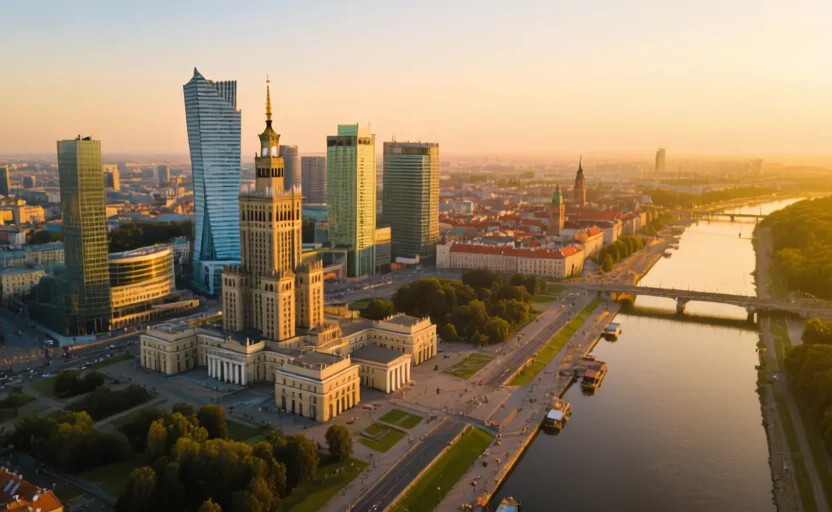 Warsaw · AI city illustration · Artistic impression
City · Europe
Warsaw
Also known as Warszawa
Saved in this browser — no account needed. Sign in later and it comes with you.
Where it is
Straddling the Vistula in the heart of the Masovian Plain, Warsaw is roughly equidistant from the Baltic and the Carpathians, about 260 and 300 kilometres away. Its elevation averages 100 metres and the highest points on either side are only about 116 and 122 metres. What shapes the city is the river valley: on the left bank a moraine plateau ends in the Warsaw Escarpment, a bluff of 10 to 20 metres that carries the Old Town and the centre, while on the right bank terraces of sand, dunes and pine forest step down towards the water. Winters are cold and summers warm. Rainfall is low, around 550 millimetres a year.
The land and water around it
The Vistulariver
The river is the axis of the city and splits it into a left and a right bank. Its asymmetrical terraces explain why the west side holds the plateau, the Old Town and the centre while the east side is lower, sandier and forested.
The Warsaw Escarpmentplateau
The edge of the moraine plateau, 20 metres or more high at the Old Town and centre and about 10 metres to the north and south. It runs through the city as a visible landmark.
The Masovian Plainplain
The city sits in the heartland of this plain, with no hills to speak of. The highest point in the city is an artificial mound, Szczęśliwice hill at 138 metres. Aeolian sand with dunes and peat swamps covers the highest terrace on the right bank, much of it forested.
Its history, in short
Warsaw began as a small fishing settlement. Fortified places such as Bródno and Jazdów came first, and around 1300 Prince Bolesław II of Masovia founded the town that grew into the Old Town. It became the capital of the Duchy of Masovia in 1413 and was folded into the Polish Crown in 1526. Its rise came in 1596, when Sigismund III moved the court there from Kraków, and by the eighteenth century it was bigger than Gdańsk. It was the capital until 1795, then served Napoleon's Duchy of Warsaw and, after 1815, a Russian-ruled kingdom. Industry and a population boom came in the nineteenth century. Before 1939 about 30 per cent of its people were Jewish. In the war the ghetto was destroyed in 1943, the Warsaw Uprising failed in 1944, and the Germans razed most of what remained. Rebuilding began in 1945, with the Old Town recreated to its late eighteenth-century appearance.
Timeline
Dates are shown on a timeline rather than as changing shapes on the map. The globe draws modern boundaries only, and tinting a modern outline to stand for a historical one would state something we cannot source.
Post-classical world
About 1300
A new town on the Vistula
Bolesław II of Masovia founds the town after Jazdów is raided, on the site of a small fishing village. The first document naming its castellany dates from 1313.
1413
Capital of Masovia
Warsaw is made the capital of the Masovian Duchy, a town of about 4,500 people. In the 15th century a New Town grows north of the walls, with its own charter and council, partly to house those barred from the Old Town, particularly Jews.
Early modern & oceanic
1596
The capital moves from Kraków
Sigismund III decides to shift the royal court to Warsaw. The city becomes the centre of the Commonwealth and, in the eighteenth century, its most populous city.
Well attestedWikipedia
Industrial & imperial
11 November 1918
Independence
Józef Piłsudski arrives on 10 November, and on 11 November the Regency Council gives him military authority. The date is celebrated as the start of Poland's independence, with Warsaw as its capital.
Well attestedWikipedia19 April 1943
The Ghetto Uprising
Jewish fighters in the Warsaw Ghetto rise against its destruction. They hold out almost a month, and nearly all survivors are then killed. The ghetto had held some 500,000 people on about 2.6 square kilometres.
1 August 1944, for 63 days
The Warsaw Uprising
The Home Army rises as the Red Army nears the city. Planned to last 48 hours, the fighting goes on for 63 days. Afterwards the occupiers raze what is left.
Well attestedWikipedia
Contemporary
1945–1951
Rebuilding the Old Town
Most of the city lay in ruins in 1945. The Warsaw Reconstruction Office recreates the Old Town using surviving structures and archives, aiming at its late eighteenth-century form. Around 85 per cent of the historic city had been destroyed.
1980
World Heritage listing
UNESCO lists the reconstructed Old Town, so a rebuilt city is treated as heritage in its own right.
Places that carry meaning
The Old Town and Royal CastleMedieval, rebuilt 1945–1951
The market square, townhouses, the circuit of the city walls and the castle were recreated in a project of the Warsaw Reconstruction Office, which also influenced thinking on conserving other European cities after the war.
Sigismund's Column1644
The oldest monument in the city, designed by two Italians and still a landmark of the Old Town.
Stare Powązki cemetery1790
The oldest necropolis in Warsaw, covering 43 hectares, one of Poland's national necropolises.
Śródmieście and Plac Defilad1950s and 1960s
The central district was reshaped after the war, with streets widened and some of the old ones gone. Plac Defilad, among Europe's biggest squares of its type, was laid out across what had been streets, some of them cut in half.
Languages here
Places are usually multilingual. This lists what is actually spoken, not one language per border.
PolishSlavic family
The language of nearly every resident and of national government.
In the 2021 census 98.78 per cent of residents identified as Polish. In 1933 it was the mother tongue of 833,500 of 1,178,914 people, in a far more varied city that also had a large Jewish population and a notable German community.
UkrainianSlavic family
The language of the largest group of foreign-born residents.
Ukrainians were already among the largest foreign groups in 2019, and after the 2022 invasion over a million refugees passed through the city. Over 104,000 who arrived in the first days still lived there in 2022.
Vietnamese
The language of an established migrant community.
Vietnamese residents, with Belarusians and Russians, were among the most prominent foreign-born groups before 2022.
Learn the language here
- 1Understand which languages are spoken hereWarsaw is multilingual. Start with which languages are used, by whom, and for what — the phrase list only covers one of them.Written by Globe Quest
- 2Learn 12 phrasesCurated everyday phrases for Warsaw, with audio and a written form.Written by Globe Quest
- 3Say them out loudSpeaking practice with pronunciation feedback, one phrase at a time.Globe Quest material, your own additions
- 4Come back to themSpaced review, so what you learned this week is still there next month.Written by Globe Quest
- 5Practise with people: Vietnamese practice · Ho Chi Minh CityAn in-person practice circle. It is a prepared plan and needs a host before it runs.Run by members
Check yourself
Why did Warsaw become the capital?
Sigismund III moved the royal court from Kraków in 1596
Warsaw was only a provincial ducal seat until 1526. Sigismund III's decision to relocate the court there made it the national centre, long before Napoleon or the partitions.
On what basis was the Old Town rebuilt after 1945?
Surviving fragments and archives, aimed at its late 18th-century appearance
The reconstruction office used extant structures, the medieval street network and detailed records from the late eighteenth century, which is why UNESCO treats the result as a case study in conservation.
Worth arguing about
- A city rebuilt from archives and memory: is a faithful reconstruction heritage, or a copy of it?
- Before 1939 about a third of the city was Jewish, and its population is now almost entirely Polish. How should a city remember what it has lost and what it later absorbed?
What we have not established
These are open questions, listed rather than filled in. We would rather show a gap than a plausible guess.
How many people live in Warsaw?
The figure depends on the boundary and the date. The city is officially estimated at 1.87 million, with 1.8 million cited elsewhere in the text, and the metropolitan area is given as about 3.5 million in one place and 2 to 3 million in another.
Sources
- Wikipedia · WarsawWikipedia · encyclopedia · checked 2026-11-24
- Wikipedia · History of WarsawWikipedia · encyclopedia · checked 2026-11-24
- UNESCO · Historic Centre of WarsawUNESCO World Heritage Centre · intergovernmental · checked 2026-11-24
Reviewed by Globe Quest editorial on 2026-11-24. Drafted with AI assistance and checked against the sources above before publication.