 Globe Quest
 Human Quest · LearningSign in
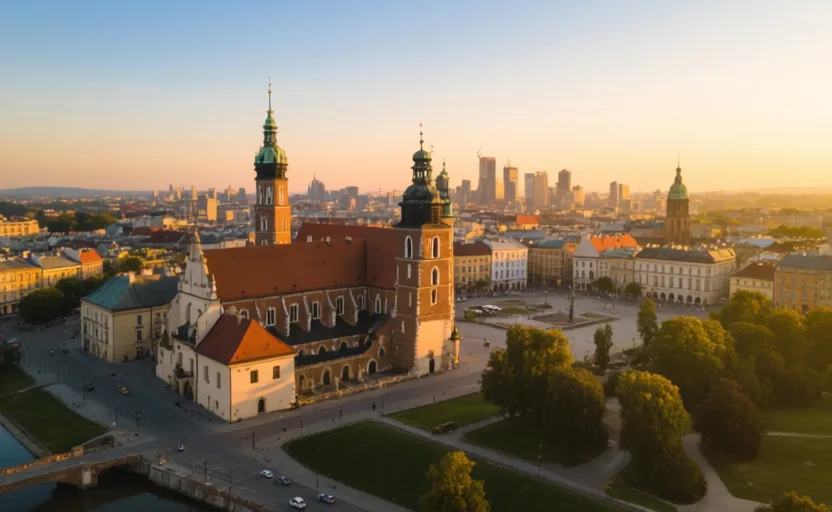 Krakow · AI city illustration · Artistic impression
City · Europe
Krakow
Saved in this browser — no account needed. Sign in later and it comes with you.
Where it is
Kraków stands on the upper Vistula at about 219 metres, where several landscapes meet. Limestone uplands, the Kraków–Częstochowa Upland to the north-west and the Małopolska Upland to the north-east, come close to the city, the Sandomierz Basin opens to the east, and the foothills of the Carpathians start to the south. The Tatra Mountains lie about 100 kilometres off, and warm foehn winds called halny blow down from them, raising temperatures quickly. The climate is semi-continental, with winters that are still cold on average, though summers are lengthening and getting hotter.
The land and water around it
Wawel Hillplateau
The rocky rise on the Vistula where the earliest known settlement stood and where the royal castle and cathedral now are. Legend places a dragon in a cave beneath it, and bones displayed at the cathedral entrance, most likely those of a mammoth, are linked to the tale.
The Vistula valleyriver
The river runs past Wawel and through an ecological corridor of international significance that reaches into the city. The historic centre includes Kazimierz, once a separate town, and its suburb of Stradom.
The Jurassic uplandsplateau
To the north-west the Kraków–Częstochowa Upland, part of the Polish Jura, borders the city, and the Bielany–Tyniec area is an internationally important refuge for wildlife and landscape. Landscape parks protect the valleys and reserves of this Polish Jura country.
Its history, in short
On Wawel Hill above the river, the Vistulans, a Lechitic tribe, had a fortified settlement by about the eighth century, and the city's name first appears in a record of the 960s describing a busy trading centre then under Bohemian rule. Mieszko I took it into Piast hands, and in 1038 it became the seat of Polish rulers. Mongol raids burned it in 1241, and it was rebuilt on a new plan and chartered in 1257, drawing German-speaking settlers. Under the Jagiellonian dynasty it became a centre of learning and the arts, and the university founded in 1364 is one of the oldest in the world. Sigismund III moved the court to Warsaw in 1596, though Wawel stayed a royal necropolis. After the final partition Kraków fell to Habsburg rule, and in 1939 became the seat of the German General Government, though the city itself was not destroyed. In 1978 its archbishop, Karol Wojtyła, became Pope John Paul II.
Timeline
Dates are shown on a timeline rather than as changing shapes on the map. The globe draws modern boundaries only, and tinting a modern outline to stand for a historical one would state something we cannot source.
Post-classical world
965 or 966
The first written record
A Sephardi Jewish traveller, Abraham ben Jacob, describes Kraków as a notable commercial centre under the Bohemian duke. Sources give 965 or 966, and Mieszko I later takes the city for the Piasts.
1038 or just after 1042
Seat of the Polish government
Kraków becomes the seat of the Piast rulers. The two accounts differ by a few years, and Casimir I the Restorer is the ruler named in the longer history.
1257
Rebuilt and chartered
After the Mongols burned the city in 1241 and returned in 1259, Kraków is rebuilt practically unaltered and given city rights on the Magdeburg model, attracting German-speaking burghers.
1364
The Cracow Academy
Casimir III founds the Academy, the second university in central Europe after Prague, later Jagiellonian University.
Well attestedWikipedia
Early modern & oceanic
1596
The court leaves for Warsaw
Sigismund III Vasa moves the administrative capital. The city had already lost importance after the last Jagiellon died childless in 1572.
Well attestedWikipedia1794
Kościuszko's insurrection
Kościuszko begins his uprising in the Main Square. Its failure leads to the final partition, and Kraków falls under Habsburg rule, with German made the town's official language in 1802.
Well attestedWikipedia
Industrial & imperial
1939
Capital of the General Government
Kraków becomes the seat of Governor-General Hans Frank. The Jewish population is confined in the Kraków Ghetto and sent to camps such as nearby Auschwitz and Płaszów, while the city's buildings survive.
Well attestedWikipedia
Contemporary
1978
A World Heritage site and a pope
The Old Town is among the first sites given World Heritage status, and Cardinal Karol Wojtyła becomes Pope John Paul II, the first pope from outside Italy in 455 years.
Places that carry meaning
Wawel Hill and CathedralFrom the 4th to 8th century onward
A former royal residence and necropolis, and the dominant feature of the historic centre, with a castle, a cathedral and the early Rotunda of Saints Felix and Adauctus.
Main Market SquareChartered 1257
The largest medieval market square in Europe, laid out when the city was rebuilt after the Mongols. St Mary's Basilica stands on it.
KazimierzMedieval onward
A separate royal town beside Kraków until 1791, shaped by the Catholic and Jewish faiths. Jews were pushed out of the old city to Kazimierz after 1495, and its synagogues include the Old Synagogue.
Wieliczka and Bochnia Royal Salt Mines13th to 20th century
Two mines on a single salt deposit, worked continuously from the 13th century and run as one royal enterprise, the Kraków Saltworks. They have chapels and sculptures cut into the salt.
Languages here
Places are usually multilingual. This lists what is actually spoken, not one language per border.
PolishSlavic family
The language of nearly all residents today.
In 2002 only 0.25 per cent of residents declared a non-Polish nationality, though by 2019 foreigners were estimated at about 10 per cent of the city's population.
YiddishGermanic family
The language of the large prewar Jewish community.
In 1931, 20.9 per cent of residents named Yiddish or Hebrew as their main language and 78.1 per cent named Polish. A Jewish community of 60,000 to 80,000 once supported at least 90 synagogues, and about 5,900 Jews remained at the end of the 1940s.
GermanGermanic family
The language of medieval burghers and, later, Habsburg administration.
German-speaking burghers dominated the merchants and magistrates by the end of the 13th century, and the city's law code was recorded in German. The 1311 rebellion of the wójt Albert led to a gradual repolonisation of the burgher class.
Learn the language here
- 1Understand which languages are spoken hereKrakow is multilingual. Start with which languages are used, by whom, and for what — the phrase list only covers one of them.Written by Globe Quest
- 2Learn 11 phrasesCurated everyday phrases for Krakow, with audio and a written form.Written by Globe Quest
- 3Say them out loudSpeaking practice with pronunciation feedback, one phrase at a time.Globe Quest material, your own additions
- 4Come back to themSpaced review, so what you learned this week is still there next month.Written by Globe Quest
Check yourself
When did Kraków stop being the capital, and why?
In 1596, when Sigismund III moved the court to Warsaw
The court moved to Warsaw in 1596. Kraków stayed a centre of learning and culture, and Wawel remained the place of royal burial.
Why does Kraków's historic centre survive in a way Warsaw's does not?
It was spared destruction in the Second World War
Although Kraków was the seat of the occupying German General Government, the city itself was not destroyed, so its Gothic, Renaissance and Baroque centre is largely original.
Worth arguing about
- A city that kept its buildings through the war but lost most of its Jewish community. What does a place owe to people who are no longer there?
- Kraków lost the court in 1596 and kept the university and the cathedral. Is a city more tied to its institutions or to its rulers?
What we have not established
These are open questions, listed rather than filled in. We would rather show a gap than a plausible guess.
When was Kraków first mentioned, and when did it become the seat of government?
The two accounts of the city's history give 965 and 966 for the first mention, and 1038 and a date just after 1042 for the move of the government. The earliest settlement is placed in the Stone Age in one account and in the 4th century on Wawel Hill in another, and the founding is also wrapped in legend.
Sources
- Wikipedia · KrakówWikipedia · encyclopedia · checked 2026-11-24
- Wikipedia · History of KrakówWikipedia · encyclopedia · checked 2026-11-24
- UNESCO · Historic Centre of KrakówUNESCO World Heritage Centre · intergovernmental · checked 2026-11-24
- UNESCO · Wieliczka and Bochnia Royal Salt MinesUNESCO World Heritage Centre · intergovernmental · checked 2026-11-24
Reviewed by Globe Quest editorial on 2026-11-24. Drafted with AI assistance and checked against the sources above before publication.