 Globe Quest
 Human Quest · LearningSign in
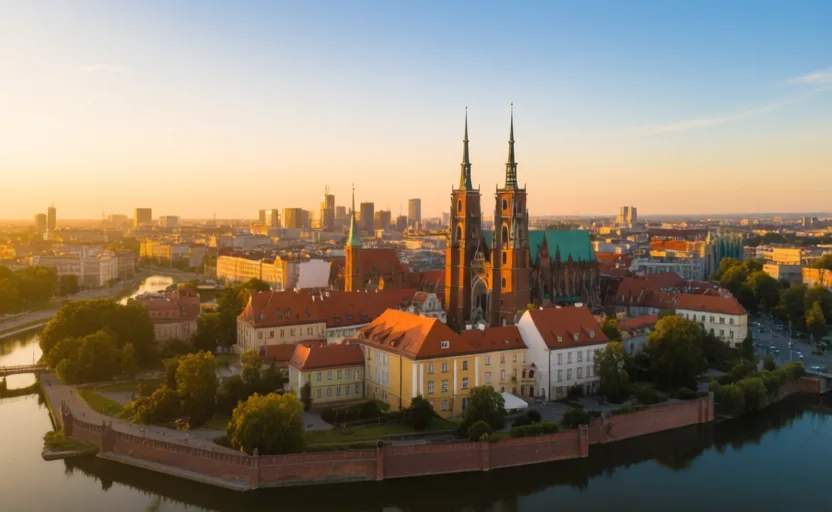 Wroclaw · AI city illustration · Artistic impression
City · Europe
Wroclaw
Saved in this browser — no account needed. Sign in later and it comes with you.
Where it is
The Oder runs through Wrocław on the Silesian Lowlands, between 105 and 156 metres above sea level, and four tributaries, the Bystrzyca, Oława, Ślęza and Widawa, join it within the city limits. The Sudetes rise to the south and the Trzebnickie Hills to the north-east, so the Oder valley between here and Opole collects heat. Among the cities the national weather service monitors, it records the highest average temperature in Poland, 9.7 degrees a year. Winters are mild and mostly overcast, and snow cover lasts a few weeks, among the shortest in the country.
The land and water around it
The Oderriver
The river and its four tributaries supply the city, and the first stronghold stood on its banks. In the 19th century the removal of fortifications let the city expand beyond its former limits, and the regulated Oder later made garden suburbs possible.
The Silesian Lowlandsplain
A low plain split into the Wrocław Plain, Wrocław Valley and Oleśnica Plain. It lies just north of the Sudetes and south-west of the Trzebnickie Hills, a setting that builds up heat, and the Amber Road and the Via Regia, two trade routes, met here.
Ostrów Tumskiisland
Cathedral Island, where the Ślężans raised a fortified gord and where Mieszko I later added new fortifications. At first the whole town was confined to this district.
Its history, in short
A stronghold on an island in the Oder grew where two long trade routes crossed: the Amber Road and the Via Regia. Archaeology points to a foundation around 940, and Mieszko I took it into the Polish state about 985. In the year 1000 it became a bishopric, as the Congress of Gniezno set up a church province. After 1241 German-speaking settlers arrived in large numbers, and German gradually became the main language of the city. In 1335 it passed to the Bohemian Crown, in 1526 to the Habsburgs, and after the War of the Austrian Succession to Prussia in 1742; in 1871 it joined the German Empire as Breslau. It industrialised, built a major university and was by 1910 a city of over half a million. In 1945 it became part of Poland, most Germans fled or were expelled, and Poles from the east, including Lwów, resettled the city.
Timeline
Dates are shown on a timeline rather than as changing shapes on the map. The globe draws modern boundaries only, and tinting a modern outline to stand for a historical one would state something we cannot source.
Post-classical world
About 940
A stronghold at the crossroads
Archaeological research dates the founding to around this year, on Ostrów Tumski. The city's namesake may be a duke called Wrocisław, though the origin of the name is debated.
1000
A bishopric
The Diocese of Wrocław is founded at the Congress of Gniezno, under the new archbishopric there, and the chronicler Thietmar names the town explicitly.
1335
The Bohemian Crown
Under the Treaty of Trentschin, the city becomes part of the Bohemian Crown’s territory inside the Holy Roman Empire.
Well attestedWikipedia
Early modern & oceanic
1526
Habsburg rule
Silesia passes to the Catholic Habsburgs. The city had accepted the Protestant Reformation in 1518 and later supported the Bohemian Revolt of 1618 out of fear of losing religious freedom.
1742
The Treaty of Breslau
Maria Theresa cedes most of Silesia to Prussia after the War of the Austrian Succession, and Austria's later attempt to retake it fails.
Industrial & imperial
1871
Part of the German Empire
Breslau grows from 208,000 to 512,000 people by 1910, turning into the leading commercial, cultural and administrative city of the empire's east, though it fell from third to seventh largest city in the empire.
Well attestedWikipedia1911–1913
The Centennial Hall
Max Berg builds a reinforced-concrete hall with the largest dome of its kind at the time, for up to 10,000 people, within exhibition grounds designed with Hans Poelzig.
Well attestedUNESCO World Heritage Centre
Contemporary
1945–1949
Wrocław becomes Polish
The city becomes part of Poland. Germans who did not flee are expelled between 1945 and 1949, and Polish settlers arrive, many deported from the former eastern lands, although by 1949 only about a fifth of the new population were themselves refugees.
Well attestedWikipedia
Places that carry meaning
Centennial Hall1911–1913
A milestone in reinforced-concrete architecture and a UNESCO World Heritage property. Its quatrefoil plan and ribbed dome served as assembly hall, theatre, exhibition space and sports venue at once.
The Market Square and Town HallMedieval
One of Europe's largest market squares, with Poland's oldest preserved town hall. Piwnica Świdnicka in its basement has served beer and food since 1273.
The Borough of Four TemplesModern
A corner of the Old Town where a synagogue and Lutheran, Catholic and Orthodox churches stand near one another. The White Stork Synagogue, completed in 1840, was rededicated in 2010.
Languages here
Places are usually multilingual. This lists what is actually spoken, not one language per border.
PolishSlavic family
The language of the city since 1945.
Polish was spoken by only about 3.6 per cent of residents in the 1910 census, though some Polish scholars put the Polish-origin share at up to 10 per cent. After 1945 it became the language of almost everyone.
GermanGermanic family
The main language of the city until 1945.
From the 13th century settlers from German-speaking regions made German the predominant language. The last German-language school in the city shut in 1963.
UkrainianSlavic family
The language of resettled communities from the east.
Postwar resettlement from the eastern lands, including Lwów and Volhynia, brought many Greek Catholics and Orthodox Christians of Ukrainian and Lemko descent, which is why the Old Town has an Orthodox church beside the others.
Learn the language here
- 1Understand which languages are spoken hereWroclaw is multilingual. Start with which languages are used, by whom, and for what — the phrase list only covers one of them.Written by Globe Quest
- 2Learn 11 phrasesCurated everyday phrases for Wroclaw, with audio and a written form.Written by Globe Quest
- 3Say them out loudSpeaking practice with pronunciation feedback, one phrase at a time.Globe Quest material, your own additions
- 4Come back to themSpaced review, so what you learned this week is still there next month.Written by Globe Quest
Check yourself
What two routes crossed where Wrocław grew?
The Via Regia and the Amber Road
A stronghold on an island of the Oder sat where these long-standing trading routes crossed, which explains both its early importance and its tendency to change hands.
What happened to the city's population after 1945?
Germans were expelled or left, and Polish settlers, many from the east, arrived
Most Germans fled or were expelled between 1945 and 1949, and the city was resettled by Poles, including people moved from former eastern Polish lands such as Lwów.
Worth arguing about
- The city changed hands repeatedly in a thousand years, and its main language changed too. What does it mean to say a city has a single history?
- Postwar Wrocław was resettled by people who had themselves been uprooted. How do newcomers come to feel a city belongs to them?
What we have not established
These are open questions, listed rather than filled in. We would rather show a gap than a plausible guess.
Who was Wrocław named for?
The city was long said to be named after Duke Vratislav I of Bohemia, but the Czechs only took control around 945, which contradicts this. The early form Wrocisław suggests a local duke of that name, though the founder is not securely identified, and the founding is dated only by archaeology to about 940.
Sources
- Wikipedia · WrocławWikipedia · encyclopedia · checked 2026-11-24
- Wikipedia · History of WrocławWikipedia · encyclopedia · checked 2026-11-24
- UNESCO · Centennial Hall in WrocławUNESCO World Heritage Centre · intergovernmental · checked 2026-11-24
Reviewed by Globe Quest editorial on 2026-11-24. Drafted with AI assistance and checked against the sources above before publication.