 Globe Quest
 Human Quest · LearningSign in
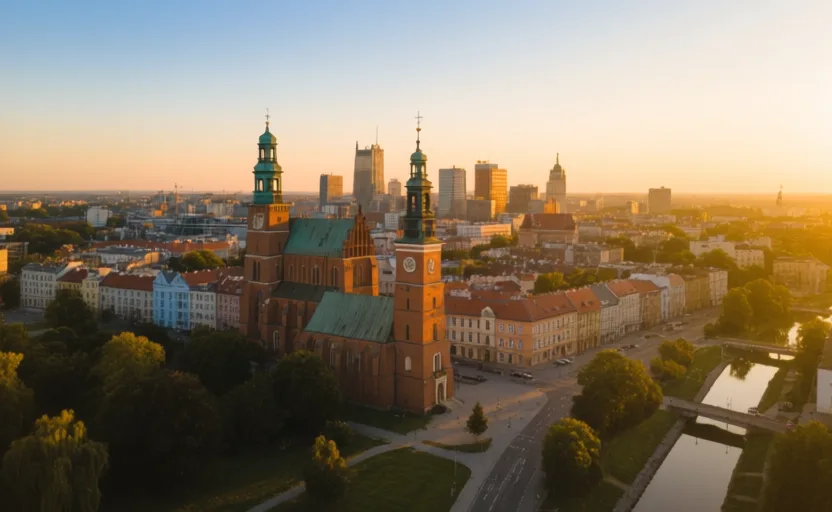 Poznań · AI city illustration · Artistic impression
City · Europe
Poznań
Saved in this browser — no account needed. Sign in later and it comes with you.
Where it is
The Warta flows north through Poznań and, near the centre, splits into two branches that wrap around the cathedral island of Ostrów Tumski. The smaller Cybina joins from the east. Between 60 metres in the river valley and 157 metres on Morasko hill, the ground is gently varied, with lakes on the western and northern edges, and the old centre stands on the left bank. Floods have been a constant problem: whole river channels were filled in during the late 19th and the 1960s partly to stop them. The climate sits between oceanic and humid continental, and Poznań is one of the sunniest and driest places in Poland.
The land and water around it
The Warta and Ostrów Tumskiriver
The Warta flows through from south to north, dividing into two arms that enclose the cathedral island, where the first stronghold and cathedral stood. The old centre lies west of the river, the district of Śródka east of it.
The lakeslake
Kiekrz, in the north-west, is the largest and is used for sailing. Malta, an artificial lake made in 1952 on the Cybina, is a rowing and canoeing venue, and Rusałka and Strzeszyn on the Bogdanka are for swimming.
Morasko hillmountains
The summit, 157 metres up, is the city's highest point and sits in a nature reserve for a meteorite impact, in the north. The lowest altitude, 60 metres, is down in the Warta valley.
Its history, in short
Poznań began as a stronghold between the Warta and the Cybina, in the land of the Western Polans, and Mieszko I built one of his main fortified centres here. His baptism in 966 may have taken place in the city, and its cathedral, the first in Poland, held the tombs of the early Piast rulers. Bohemia's army sacked it in 1038, and power moved to Kraków. In the mid-13th century the town was refounded on the left bank under Magdeburg law with German settlers. Wars, plague and floods cut the population of the conurbation from about 20,000 around 1600 to about 4,000 in 1732, and Bamberg and Dutch settlers were brought in to rebuild the suburbs. From 1793 until 1918 it was mostly under Prussian and then German rule, which fortified it and enlarged it. An uprising in 1918 and 1919 won it for the new Poland. The Germans made it the capital of Reichsgau Wartheland in the Second World War, and in 1956 workers' strikes here were an early sign of discontent under communism.
Timeline
Dates are shown on a timeline rather than as changing shapes on the map. The globe draws modern boundaries only, and tinting a modern outline to stand for a historical one would state something we cannot source.
Post-classical world
966
The baptism of Mieszko I
Mieszko's baptism, a defining moment for the Christianisation of his realm, may have happened in Poznań. The first cathedral in Poland and the seat of the first missionary bishop, Jordan, follow.
DisputedWikipediaHistorians who place the baptism in Poznań; the sources do not settle where it happened
1038
Sacked by Bohemia
After the pagan reaction that follows the death of Mieszko II, Duke Bretislaus I of Bohemia sacks both Poznań and Gniezno. The capital then moves to Kraków.
Well attestedWikipedia1253
A new town on the left bank
Przemysł I and his brother grant a charter under Magdeburg law to Thomas of Gubin, who brings many German settlers to help build the town around the Market Square, with a castle at its eastern end.
Early modern & oceanic
1736
A flood destroys the suburbs
One of the many floods in the city's history ruins most suburban buildings. Wars, plague and floods had already cut the conurbation from about 20,000 people around 1600 to about 6,000 by 1730, and settlers from Bamberg and the Netherlands came to rebuild.
Well attestedWikipedia
Industrial & imperial
1815
The Grand Duchy of Posen
After Napoleon's defeat and the Congress of Vienna, the region returns to Prussia, and Poznań is the capital of the Grand Duchy of Posen, which had a measure of self-rule. The old walls had been taken down early in the century and the main streets of today's centre laid out west of the old city.
Well attestedWikipedia1918–1919
The Greater Poland Uprising
A speech by Ignacy Paderewski in Poznań on 27 December 1918 ignites an uprising, and the Treaty of Versailles gives most of the region to Poland. German residents, 65,321 in 1910, number only 5,980 by 1926.
1939–1945
Capital of the Wartheland
Germany annexes the city on 8 October 1939. Many Poles are executed, expelled or used as forced labour. Fort VII becomes a concentration camp, and the city's roughly 2,000 Jews are largely murdered.
Contemporary
June 1956
The Poznań protests
A strike at the Cegielski locomotive factory becomes a wider protest, and a march on 28 June is fired on. Crowds attack party and secret police buildings, and 67 people are killed by official figures.
Well attestedWikipedia
Places that carry meaning
Poznań CathedralFrom the 10th century
The first cathedral in Poland, containing the tombs of the first Polish rulers, Mieszko I and Bolesław I the Brave, on the cathedral island between the two branches of the Warta.
The Old Town and Town Hall13th to 16th century
The Old Town was founded under Magdeburg law in the 1250s, and the Town Hall, rebuilt after a fire in 1536, is called an exemplary piece of Renaissance architecture in Poland.
Fort VII1939–1945
A 19th-century perimeter fort turned into a concentration camp. More than 3,400 prisoners were killed at sites nearby.
Poznań International FairFrom 1921
Trade fairs began in 1921 and became the International Fair in 1925. In 1929 the grounds held a national exhibition for ten years of independence, which drew about 4.5 million visitors.
Languages here
Places are usually multilingual. This lists what is actually spoken, not one language per border.
PolishSlavic family
The language of the city, with a local Greater Poland dialect.
After the expulsion and flight of the German population in 1945 the city became almost uniformly Polish. Poznań keeps its own local dialect and customs such as Saint Martin's croissants.
GermanGermanic family
The language of Prussian Posen and of a large part of the population before 1918.
The official German name was Haupt- und Residenzstadt Posen between 1910 and 1918. Under the Second Republic most German residents left, and under occupation about 95,000 Germans were settled in the city by 1944.
YiddishGermanic family
The historic language of the Jewish community, which goes back to the 13th century.
The Yiddish name of the city was Poyzn. The Jewish council was among the most important in Poland, and about 2,000 Jews remained in 1939.
UkrainianSlavic family
The language of the largest foreign community today.
Of 12,114 foreign nationals registered in May 2025, 5,780 were Ukrainian citizens and 3,041 were Belarusian, most of them migrant workers or students.
Learn the language here
- 1Understand which languages are spoken herePoznań is multilingual. Start with which languages are used, by whom, and for what — the phrase list only covers one of them.Written by Globe Quest
- 2Learn 12 phrasesCurated everyday phrases for Poznań, with audio and a written form.Written by Globe Quest
- 3Say them out loudSpeaking practice with pronunciation feedback, one phrase at a time.Globe Quest material, your own additions
- 4Come back to themSpaced review, so what you learned this week is still there next month.Written by Globe Quest
Check yourself
What makes Poznań Cathedral significant?
It is the first cathedral in Poland and holds the tombs of early Piast rulers
Built after the baptism of Mieszko I, the cathedral on Ostrów Tumski became the burial place of Piast monarchs including Mieszko I and Bolesław I the Brave.
What started the 1956 Poznań protests?
Workers at the Cegielski locomotive factory striking against government policy
The strike spread into a march and then riots, and 67 people died by official figures, making the events one of the first signs of open discontent under communism.
Worth arguing about
- A city moves from the river island to the left bank, and later cuts off river channels to control floods. How far should a city reshape its river?
- Poznań was Prussian for most of 125 years and Polish before and after. How does a city carry a mixed past into a nearly uniform present?
What we have not established
These are open questions, listed rather than filled in. We would rather show a gap than a plausible guess.
Where was Mieszko I baptised?
Poznań is a candidate, but the baptism of 966 is only said to have possibly taken place in the city, and the accounts do not fix the place. The city's population also depends on the boundary: 534,239 in the city at the end of 2025 against about a million in the metropolitan area.
Sources
- Wikipedia · PoznańWikipedia · encyclopedia · checked 2026-11-24
- Wikipedia · History of PoznańWikipedia · encyclopedia · checked 2026-11-24
Reviewed by Globe Quest editorial on 2026-11-24. Drafted with AI assistance and checked against the sources above before publication.