 Globe Quest
 Human Quest · LearningSign in
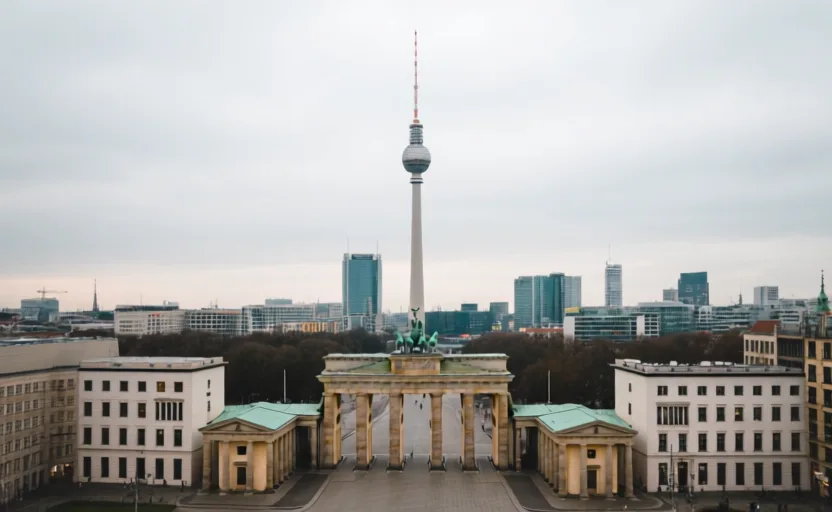 Berlin · AI city illustration · Artistic impression
City · Europe
Berlin
Saved in this browser — no account needed. Sign in later and it comes with you.
Where it is
Few capitals sit on ground as flat and wet as this. Berlin occupies a marshy, wooded stretch of the North European Plain, in a broad valley that meltwater from the last ice sheets carved between two low plateaus, the Barnim to the north and the Teltow to the south. The Spree follows that valley and joins the Havel at Spandau, and the Havel behaves like a chain of lakes. The highest point, at 122 metres, is a heap of building rubble. About a third of the city is forest, parks, water and gardens. The climate is oceanic, shading toward continental, with around 570 mm of rain a year and cold winters.
The land and water around it
The Spree and the Havelriver
The Spree meets the Havel in Spandau, in the west. The Havel is less a river than a string of lakes, among them the Tegeler See and the Großer Wannsee, while the upper Spree passes through the Müggelsee in the east. Berlin and Cölln began on the Spree, and Cölln’s island is now Museum Island.
The Berlin glacial valleyvalley
A broad ice-age valley, the Urstromtal, was formed by meltwater at the end of the last glaciation. It separates the Barnim Plateau from the Teltow Plateau and is why the centre is so low and flat and so prone to marsh.
Rubble hillshills
The city’s highest ground is man-made. Since 2015 the Arkenberge in Pankow, at 122 metres, have topped Teufelsberg, a 120-metre mound of rubble from wartime ruins. The highest natural point, the Müggelberge, reaches 114.7 metres.
Its history, in short
The name is probably Slavic, from a word for swamp, and Slavic tribes were living on this ground from the 7th century. German merchants then founded two towns facing each other across the Spree, Berlin on the bank and Cölln on an island, and they grew rich on the staple right where two trade routes met. They were joined under one administration in the early 18th century. The Thirty Years’ War cost the city half its people. The Great Elector rebuilt by inviting refugees, and by 1700 about a third of residents were French Huguenots. In 1701 Berlin became capital of the new Kingdom of Prussia, then of the empire in 1871. Factories, railways and the civil service pushed the population past 800,000 by 1870, from 172,000 at the start of the century. The Greater Berlin Act of 1920 swallowed dozens of neighbouring towns and doubled the population to around four million. Bombing and the Battle of Berlin in 1945 were followed by division into East and West, and from 1961 a wall. After 1990 Berlin took back its role as capital of a single Germany.
Timeline
Dates are shown on a timeline rather than as changing shapes on the map. The globe draws modern boundaries only, and tinting a modern outline to stand for a historical one would state something we cannot source.
Post-classical world
1237
Founding date
German merchants found two settlements: Berlin, where the Nikolaiviertel now stands, and Cölln, across the water on an island in the Spree. Their later alliance, in 1307, shared a foreign policy, though each kept its own administration.
Approximate dateWikipedia
Early modern & oceanic
1685
Edict of Potsdam
Frederick William offers asylum and ten years without tax to French Huguenots. By 1700 about 30 percent of Berliners are French.
Well attestedWikipedia1701
Prussian capital
Frederick III crowns himself king and Berlin replaces Königsberg as capital of the new kingdom. Between 1700 and 1750 the population nearly quadruples, from about 30,000 to 113,000.
Well attestedWikipedia
Industrial & imperial
1810
Berlin University founded
The institution now called Humboldt University opens, with the philosopher Johann Gottlieb Fichte as its first rector.
Well attestedWikipedia1920
Greater Berlin
The Greater Berlin Act incorporates dozens of suburbs, villages and estates, raising the population from 1.9 million to about 4 million. In that decade Berlin is the third-largest city in the world.
Well attestedWikipedia
Contemporary
June 1948 – May 1949
Blockade and airlift
The Soviet Union cuts the land routes into West Berlin after the western Allies extend the currency reform to their sectors. The three western powers supply the city by air for nearly a year.
Well attestedWikipedia1961
The Wall
East Germany builds a wall around West Berlin. East Berlin, which holds most of the old centre, becomes the eastern capital, a status the western powers do not recognise.
Well attestedWikipedia1989–1990
The Wall falls
The opening of the Wall leads to reunification in 1990, and Berlin becomes a city-state among Germany’s sixteen on 3 October 1990.
Places that carry meaning
Museum Island1824–1930
Five museums built over a century by leading Prussian architects, on the island where Cölln began. They are listed for showing how the modern museum of art and archaeology took shape, and how its buildings were designed around the collections.
Nikolaiviertel13th century, reconstructed
The rebuilt district at the site of Alt-Berlin, the oldest settlement area in the city, close to the Rotes Rathaus.
Berlin Modernism Housing Estates1910–1933
Seven estates built during the housing reform movement, especially under the Weimar Republic, with leading modernist architects. They set standards for light, air and flats that shaped social housing inside and outside Germany.
The Reichstag19th century to the present
The seat of parliament, where Philipp Scheidemann proclaimed the republic on 9 November 1918. Norman Foster remodelled it in the 1990s with a glass dome over the chamber.
Languages here
Places are usually multilingual. This lists what is actually spoken, not one language per border.
GermanGermanic family
The official and everyday language.
Standard German is used throughout the city, and educated residents increasingly speak it in daily life rather than the local dialect.
Berlinerisch
The traditional urban speech of Berlin and its surroundings.
Linguists do not treat it as a true dialect. It comes from a Brandenburg variety and is now seen more as a sociolect, weakened by immigration and by the habit of speaking standard German.
Immigrant languages
The most common foreign languages heard in the city.
Turkish and Polish lead, followed by English, Persian, Arabic, Italian, Bulgarian, Russian, Romanian, Kurdish and Serbo-Croatian, then French, Spanish and Vietnamese. Immigration has a long history here: Huguenots arrived in the 17th century, and Chinese migration dates to the 19th.
Slavic place namesSlavic family
A layer left by the first known inhabitants.
The area was once settled by Slavs, and five of the twelve boroughs, among them Pankow, Spandau and Köpenick, carry Slavic-derived names, as do 22 of its 96 neighbourhoods. The name Berlin itself may come from an Old Polabian word for swamp.
Learn the language here
- 1Understand which languages are spoken hereBerlin is multilingual. Start with which languages are used, by whom, and for what — the phrase list only covers one of them.Written by Globe Quest
- 2Learn 14 phrasesCurated everyday phrases for Berlin, with audio and a written form.Written by Globe Quest
- 3Say them out loudSpeaking practice with pronunciation feedback, one phrase at a time.Globe Quest material, your own additions
- 4Come back to themSpaced review, so what you learned this week is still there next month.Written by Globe Quest
Check yourself
Which 1685 measure brought French Huguenots to Berlin?
The Edict of Potsdam
The Elector’s Edict of Potsdam answered France’s revocation of the Edict of Nantes by offering religious freedom and tax exemption, and about 30 percent of Berliners were French by 1700.
How was the valley that the Spree follows formed?
By meltwater from ice sheets at the end of the last glaciation
The Urstromtal is an ice-age meltwater channel between two low plateaus. Its flat, damp floor is why the city centre began as marsh.
Worth arguing about
- Berlin has been capital of Brandenburg, Prussia, an empire, a republic, a dictatorship and a divided city. What does a place that keeps changing its role do to the way it treats its own buildings?
- In 1700 about a third of Berliners were French refugees. How much of a city’s character comes from the people a ruler chooses to invite?
What we have not established
These are open questions, listed rather than filled in. We would rather show a gap than a plausible guess.
How many people live in Berlin?
Figures run from 3.7 million to 3.9 million for the city proper, depending on the year and on whether registered residents or estimates are counted, and the urban area is counted separately at 4.5 to 4.6 million. The boundary used decides the answer, so no single figure is given.
Sources
- Wikipedia · BerlinWikipedia · encyclopedia · checked 2026-11-24
- Wikipedia · History of BerlinWikipedia · encyclopedia · checked 2026-11-24
- UNESCO · Museumsinsel (Museum Island), BerlinUNESCO World Heritage Centre · intergovernmental · checked 2026-11-24
- UNESCO · Berlin Modernism Housing EstatesUNESCO World Heritage Centre · intergovernmental · checked 2026-11-24
Reviewed by Globe Quest editorial on 2026-11-24. Drafted with AI assistance and checked against the sources above before publication.