 Globe Quest
 Human Quest · LearningSign in
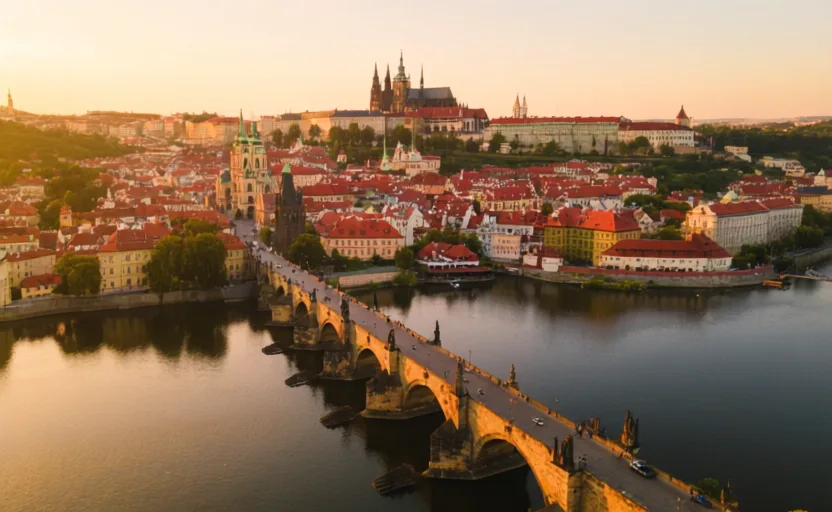 Prague · AI city illustration · Artistic impression
City · Europe
Prague
Also known as Praha
Saved in this browser — no account needed. Sign in later and it comes with you.
Where it is
Prague spreads along both banks of the Vltava, on a plateau cut by the river between a low point of 172 metres where the Vltava leaves the city and a western ridge of 399. Two hills rise close to the centre, Petřín at 327 metres and Vítkov at 270, and the castle sits on the left bank above the river. The city lies in the rain shadow of the Sudetes and other ranges, so it receives only about 500 millimetres of rain a year, relatively low for the country. Winters are cold with little sun, and from mid-October to mid-March temperature inversions can trap fog and some pollution until the prevailing westerly wind clears them.
The land and water around it
The Vltavariver
The river crosses the city from south to north, and its rapids and ford are one proposed origin of the name Praha. The Berounka joins it at the southern edge, and 99 smaller watercourses run through the city.
Prague Plateau and its hillsplateau
Most of the city lies on a plateau, with Petřín and Vítkov rising above the centre. The shale bedrock under the castle is one of the explanations offered for a name meaning a hot, dry place.
A rain-shadow climateclimate
An oceanic climate bordering on continental. Snow cover is common between mid-November and late March, and more days now pass 30 degrees Celsius than in the past.
Its history, in short
Prague grew from two fortified points on the river, a castle on the left bank and Vyšehrad to the south, at a place where trade routes between southern and northern Europe followed the Vltava. The Přemyslid prince Bořivoj moved his seat to the castle around 880, and by the next century merchants from across Europe traded below it. A bishopric followed in 973. In the 13th century three separate towns won privileges: the Old Town in 1230, the Lesser Side in 1257 and Hradčany in 1320. Under Charles IV, who ruled from 1346 to 1378, Prague became an imperial capital, with a planned New Town, a stone bridge and a university. The city shaped the Hussite movement, and in 1618 the defenestration at the castle set off the Thirty Years' War. Rudolf II, king from 1576, made it his home and a European centre of science and art. The four towns were merged in 1784. In the 20th century it was the capital of Czechoslovakia, was occupied in 1939, endured the Soviet invasion of 1968 and was a focus of the 1989 Velvet Revolution. It has been capital of the Czech Republic since 1993.
Timeline
Dates are shown on a timeline rather than as changing shapes on the map. The globe draws modern boundaries only, and tinting a modern outline to stand for a historical one would state something we cannot source.
Post-classical world
c. 880
Prague Castle established
Prince Bořivoj of the Přemyslids moves his seat here from Levý Hradec. The castle has housed Czech rulers ever since and today houses the president.
1170
The Judith Bridge
The first stone bridge over the Vltava is built. A flood destroys it just before the reign of Charles IV, and the Charles Bridge takes its place.
1347 or 1348
Charles University
Charles IV founds the oldest university in Central Europe. One source gives 1347 and the UNESCO record 1348. Its circle helped shape the ideas of the Hussite movement.
Early modern & oceanic
1618
Second defenestration of Prague
A violent confrontation at the castle starts the Thirty Years' War, which proves a harsh period for Prague and Bohemia.
Well attestedWikipedia1784
Four towns become one city
Under Joseph II, Hradčany, the Lesser Side, the Old Town and the New Town are merged. Josefov joins in 1850 and Vyšehrad in 1883, and in 1922 another 37 municipalities are incorporated.
Well attestedWikipedia
Industrial & imperial
15 March 1939
German occupation
German troops enter Prague and Hitler proclaims a protectorate over Bohemia and Moravia from the castle. Most Jewish residents are deported and killed, and in 1942 Czechoslovak agents assassinate Reinhard Heydrich.
Well attestedWikipedia
Contemporary
21 August 1968
Warsaw Pact invasion
Troops of the Soviet-led pact enter Prague and crush the reforms of the Prague Spring led by Alexander Dubček.
Well attestedWikipedia1992–1993
World Heritage listing and a new capital
The Historic Centre is inscribed in 1992 after the Velvet Revolution. In 1993, after the split of Czechoslovakia, Prague becomes the capital of the Czech Republic.
Places that carry meaning
Prague Castle and St Vitus CathedralFrom c. 880
One of the largest castles in the world, begun by Bořivoj, with the Gothic Cathedral of St Vitus built on the site of an older Romanesque rotunda, begun under John of Bohemia.
Charles Bridge14th century
The Gothic bridge that replaced the Judith Bridge and links the east bank to the Lesser Side and the castle district.
Old Town and Josefov13th century onward
The Old Town gained town privileges in 1230. Gothic arcaded houses with Romanesque cores surround its square, near the Týn church, and the early Gothic Old-New Synagogue stands in the Jewish Quarter.
Vyšehrad11th century onward
A second fortified settlement on the river, established across from the castle in the 11th century. It served as a temporary seat of Czech rulers under Vratislav II.
Languages here
Places are usually multilingual. This lists what is actually spoken, not one language per border.
CzechSlavic family
The language of the city and of the state.
At the 2011 census 64.8 per cent of residents named Czech as their ethnicity, and almost 29 per cent did not answer, so the real share is probably higher.
Slovak, Ukrainian and RussianSlavic family
The languages of the three largest minority groups.
Slovaks are the biggest ethnic minority in Prague, followed by Ukrainians and Russians. Foreign residents numbered 373,570 in late 2026, and about 14 per cent of residents in 2011 were born abroad.
GermanGermanic family
Historically one of the city's three main languages.
For most of its history Prague was multi-ethnic, with important Czech, German and mostly German-speaking Jewish populations, until the deportations and killings of the Second World War.
Learn the language here
- 1Understand which languages are spoken herePrague is multilingual. Start with which languages are used, by whom, and for what — the phrase list only covers one of them.Written by Globe Quest
- 2Learn 12 phrasesCurated everyday phrases for Prague, with audio and a written form.Written by Globe Quest
- 3Say them out loudSpeaking practice with pronunciation feedback, one phrase at a time.Globe Quest material, your own additions
- 4Come back to themSpaced review, so what you learned this week is still there next month.Written by Globe Quest
Check yourself
What happened to Prague's four original towns in 1784?
They were merged into one city under Joseph II
Hradčany, the Lesser Side, the Old Town and the New Town became a single entity in 1784, and later annexations such as Josefov and Vyšehrad completed the city.
Which explanation of the name Praha refers to the Vltava itself?
A threshold or ford and the rapids of the river
Theories link the name to the old Slavic word for ford or rapid, to a burned forest, or to a hot, dry place. The first points to the crossing on the Vltava.
Worth arguing about
- Prague had four separate towns until 1784. How does a city made of former rivals differ from one that grew from a single core?
- Prague was hit by occupation in 1939, invasion in 1968 and revolution in 1989. How should a city with so many turning points choose what to preserve?
What we have not established
These are open questions, listed rather than filled in. We would rather show a gap than a plausible guess.
How many people live in Prague?
Only about 65 per cent of residents were registered in the city at the 2011 census, which gave a figure near 1.3 million. Mobile-phone data suggest the real population is closer to 1.9 or 2.0 million, with 300,000 to 400,000 more commuting in on weekdays.
Sources
- Wikipedia · PragueWikipedia · encyclopedia · checked 2026-11-24
- Wikipedia · History of PragueWikipedia · encyclopedia · checked 2026-11-24
- UNESCO · Historic Centre of PragueUNESCO World Heritage Centre · intergovernmental · checked 2026-11-24
- Wikipedia · Czech RepublicWikipedia · encyclopedia · checked 2026-11-24
Reviewed by Globe Quest editorial on 2026-11-24. Drafted with AI assistance and checked against the sources above before publication.