 Globe Quest
 Human Quest · LearningSign in
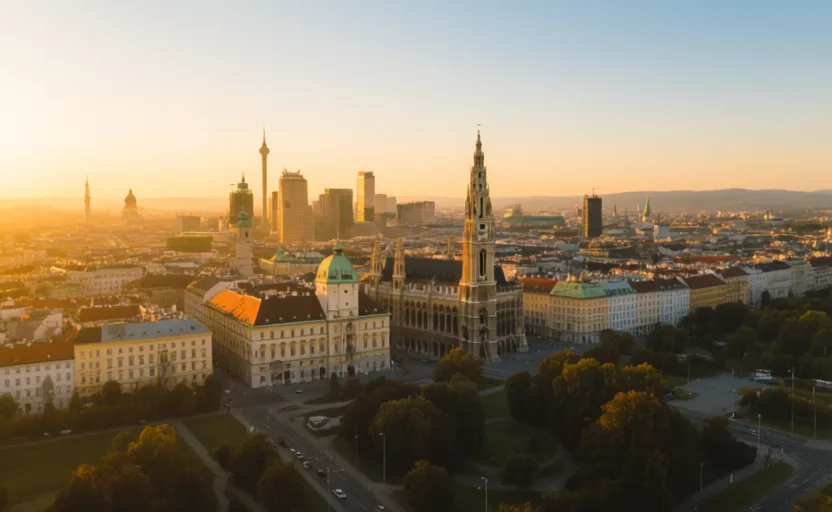 Vienna · AI city illustration · Artistic impression
City · Europe
Vienna
Also known as Wien, Vindobona
Saved in this browser — no account needed. Sign in later and it comes with you.
Where it is
Vienna stands where the last hills of the Alps, the Vienna Woods, drop away to the Vienna Basin and the edge of the Pannonian plain. The old inner city lies on the south bank of a meandering Danube, though the modern city spans both sides and is encircled by Lower Austria. The Slovak capital, Bratislava, is only about 50 kilometres away. Heights run from about 151 metres on the river flats up into the wooded west, which is also the wettest part of the city, at 700 mm or more a year, while the flat east is the driest. Winters are cold and fairly dry and summers are warm to hot.
The land and water around it
The Danube and the Donaukanalriver
The river once split into many channels. Regulation in the 1860s gave it a straight course away from the centre and left one narrowed branch, the Danube Canal, beside the old city. In 1972 work began on the Donauinsel and the New Danube.
The Vienna Woodsforest
The north-easternmost foothills of the Alps stand between Vienna and the rest of western Austria, and they hold the wettest districts of the city.
The Vienna Basinplain
The city lies where the Alps end and the Pannonian Basin begins, a position at the junction of the mountains and the plain, and its staple right later tied the city into trade along the Danube basin and to Venice.
Its history, in short
A Roman legionary camp, Vindobona, was begun around 97 CE on the south bank of the Danube, in the province of Pannonia, and the town around it reached about 15,000 people. It was abandoned for several centuries after the Huns invaded in the fifth century. The Babenberg rulers of Austria made Vienna their residence in 1155, gave it city rights in 1221, and grew rich from a rule that obliged passing merchants to offer their goods in the city. The Habsburgs, who took over in 1278, made it the seat of the Holy Roman emperors, and the city then withstood Ottoman sieges in 1529 and 1683. After 1683 it was rebuilt as a baroque capital, with palaces in its suburbs. In 1858 the old fortifications came down and the Ringstrasse was laid out in their place. By 1910 it had more than two million people, third among European cities behind London and Paris, swelled by migrants from across the empire, including many Czechs and Hungarians. After 1918 it was the capital of a much smaller republic and, as Red Vienna, built tens of thousands of public apartments. The Anschluss of 1938 brought the persecution and murder of its Jewish community, and from 1945 to 1955 the city was divided among four occupying powers.
Timeline
Dates are shown on a timeline rather than as changing shapes on the map. The globe draws modern boundaries only, and tinting a modern outline to stand for a historical one would state something we cannot source.
Classical world
c. 97 CE
Vindobona
Construction begins on the Roman legionary camp, with a civilian town beside it. Vindobona becomes a municipium with Roman city rights in 212.
Approximate dateWikipedia
Post-classical world
1155
Babenberg capital
Henry II of Austria moves the Babenberg residence to Vienna from Klosterneuburg, and the Schottenstift is founded. Austria becomes a duchy the next year.
1221
City rights and the staple
Vienna receives city rights and a staple right, which obliges all merchants passing through to offer their goods there.
Early modern & oceanic
1529 and 1683
Ottoman sieges
The first siege in 1529 fails when disease and an early winter force the Ottomans back. In 1683 the rebuilt fortifications hold for two months until the army under King John III Sobieski defeats them.
Well attestedWikipedia
Industrial & imperial
1858
The Ringstrasse
The fortifications are demolished and a broad boulevard is built in their place, lined with monumental buildings in the Ringstrasse style.
1919–1934
Red Vienna
Social Democrats win the council and carry out a municipal programme that includes public housing; more than 60,000 flats are built between 1925 and 1934.
Well attestedWikipedia1938
The Anschluss
German troops enter Austria, and Hitler addresses a crowd at the Heldenplatz on 15 March. Vienna had most of Austria’s Jews, and 65,000 were deported and murdered while about 130,000 fled.
Well attestedWikipedia
Contemporary
1945–1955
Four-power Vienna
The city is divided into sectors under the US, UK, France and the Soviet Union, with the inner city shared by all four in monthly rotation. The occupation ends after the Austrian State Treaty in 1955.
Well attestedWikipedia
Places that carry meaning
Historic Centre of ViennaRoman origins to the 19th century
A medieval core built over the Roman settlement, with baroque palaces and the Ringstrasse ensemble. St Stephen’s Cathedral dates from the 14th and 15th centuries, and the Schottenkloster is the oldest monastery in Austria. The site was listed as endangered from 2017 to 2026.
Schönbrunn Palace and Gardenslate 17th century onward
A Habsburg hunting lodge was rebuilt after destruction in the Ottoman attack of 1683 and became the imperial summer residence. Its Orangery, at 186 metres, is the longest in the world.
Gemeindebauten1925–1934
The public housing blocks of Red Vienna, owned by the city, are the lasting physical result of the socialist municipal experiment.
Languages here
Places are usually multilingual. This lists what is actually spoken, not one language per border.
GermanGermanic family
The official language, in its Austrian standard form.
Austrian German was standardised by the Österreichisches Wörterbuch in 1951. Everyday speech in Vienna belongs to the Austro-Bavarian dialect area, specifically Central Bavarian.
Turkish and the languages of former Yugoslavia
The languages of the largest migrant communities.
In 2012 about 38.8 per cent of Viennese had a full or partial migrant background, mostly from former Yugoslavia and Turkey, with others from Germany, Poland, Romania and Hungary.
Czech and Hungarian
Historic languages of the imperial capital.
Around 1900 Vienna had the second-largest Czech population in the world after Prague. Many Czechs and Hungarians went home after the First World War, but both languages remain part of the city’s story.
Learn the language here
- 1Understand which languages are spoken hereVienna is multilingual. Start with which languages are used, by whom, and for what — the phrase list only covers one of them.Written by Globe Quest
- 2Learn 11 phrasesCurated everyday phrases for Vienna, with audio and a written form.Written by Globe Quest
- 3Say them out loudSpeaking practice with pronunciation feedback, one phrase at a time.Globe Quest material, your own additions
- 4Come back to themSpaced review, so what you learned this week is still there next month.Written by Globe Quest
Check yourself
What was Vindobona?
The Roman military camp on the site of Vienna’s city centre
Vindobona, begun around 97 CE, anchored the Danube frontier of the province of Pannonia. The name vanished from records after the sixth century, and Wien comes from a different root, the river Wien.
What replaced Vienna’s old fortifications in 1858?
The Ringstrasse boulevard
Once the walls were demolished, the wide Ringstrasse was laid out on the cleared ground and lined with monumental buildings, and it defines the inner city today.
Worth arguing about
- Vienna was the capital of an empire of many languages and then of a small republic. How does a city adjust to being much bigger than the state around it?
- Red Vienna put public housing at the centre of city life. Which of its choices still shape how Viennese live, and which could another city copy?
What we have not established
These are open questions, listed rather than filled in. We would rather show a gap than a plausible guess.
How many people of Jewish background live in Vienna today?
One estimate puts the community at 8,000 members and another at 15,000. The two counts use different definitions of membership, so no single figure can be given.
Sources
- Wikipedia · ViennaWikipedia · encyclopedia · checked 2026-11-24
- Wikipedia · History of ViennaWikipedia · encyclopedia · checked 2026-11-24
- Wikipedia · AustriaWikipedia · encyclopedia · checked 2026-11-24
- UNESCO · Historic Centre of ViennaUNESCO World Heritage Centre · intergovernmental · checked 2026-11-24
- UNESCO · Palace and Gardens of SchönbrunnUNESCO World Heritage Centre · intergovernmental · checked 2026-11-24
Reviewed by Globe Quest editorial on 2026-11-24. Drafted with AI assistance and checked against the sources above before publication.