 Globe Quest
 Human Quest · LearningSign in
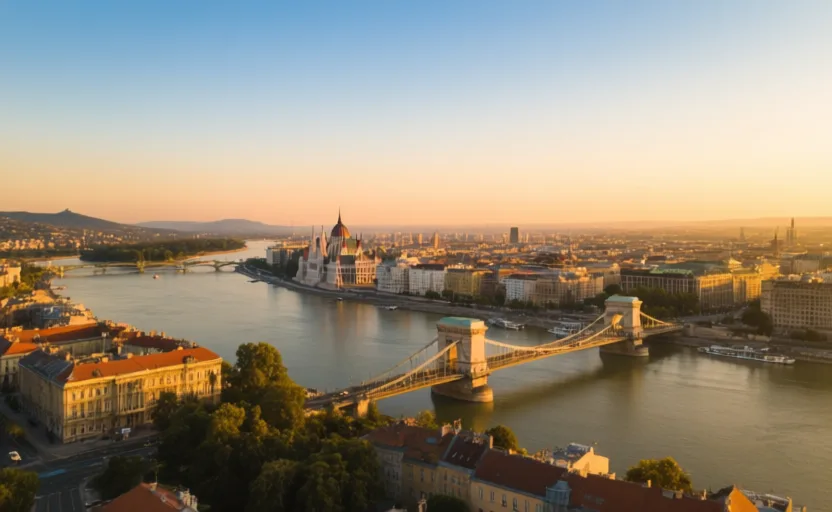 Budapest · AI city illustration · Artistic impression
City · Europe
Budapest
Saved in this browser — no account needed. Sign in later and it comes with you.
Where it is
The Danube runs through Budapest in a channel some 230 metres wide at its narrowest, and a scatter of islands once made the river fordable here. Two different landscapes face each other across it. Buda, on the west bank, climbs over river terraces and limestone and dolomite hills, rising to János Hill at 527 metres, the city’s high point. Pest, on the east, spreads across a flat sandy plain that tilts only gently upward. The city sits at the centre of the Pannonian Basin, on the old route between the hills of Transdanubia and the Great Plain, and its position also puts it on a belt of thermal springs.
The land and water around it
The Danube and its islandsriver
The river enters the city from the north and wraps round Óbuda Island and Margaret Island, with the long Csepel Island on the southern edge. Because shallows and islets made the crossing easy at this point, the site was a natural place for a settlement and a road.
The Buda Hillsmountains
Triassic limestone and dolomite, riddled with caves by dissolving water, among them the Pálvölgyi cave, which is 7,200 metres long. Gellért Hill and Castle Hill are the best-known heights, and the forests of the hills are protected.
The thermal springsclimate
More than a hundred medicinal geothermal springs feed the city’s spa culture, which dates from Roman times. The system includes the largest thermal water cave system.
Its history, in short
Celts built the first town on the slopes of Gellért Hill before the Christian era, and the Romans made Aquincum, in what is now Óbuda, a frontier city on the Danube. After the Magyar conquest, the Mongol invasion of 1241 showed how hard the plain was to defend, so Béla IV had stone walls built round the towns and put his palace on the hills of Buda. Buda became the capital in 1361 and, under Matthias Corvinus in the 15th century, a centre of Renaissance learning with a library second only to the Vatican’s. The Ottomans took Buda finally in 1541, built baths that are still used, and held it for over 150 years. After the Habsburg reconquest of 1686 the city grew, and Count Széchenyi’s Chain Bridge of 1849 was the first permanent crossing of the Danube. Buda, Pest and Óbuda were merged in 1873, and Budapest became one of the twin capitals of Austria-Hungary. Jews were nearly a quarter of the population by 1900. In 1944 and 1945 the city was besieged, more than 38,000 civilians died, and the Germans destroyed all its bridges. Greater Budapest absorbed smaller towns in 1950.
Timeline
Dates are shown on a timeline rather than as changing shapes on the map. The globe draws modern boundaries only, and tinting a modern outline to stand for a historical one would state something we cannot source.
Classical world
106 CE
Aquincum becomes a provincial capital
The Roman military settlement, first a camp, grows into the main city of Pannonia Inferior, with roads, amphitheatres and baths. It stood on the empire’s frontier along the Danube.
Post-classical world
1241–1242
The Mongol invasion
Pest, then the main medieval urban centre, is devastated. Béla IV responds by building stone walls round the towns and a castle on the rocky spur of Buda.
1361
A royal capital
The city becomes the capital of Hungary. From around 1300 to 1873, Buda was the capital over five separate periods, none lasting a century.
Early modern & oceanic
1476
Renaissance arrives with a queen
Matthias Corvinus marries Beatrice of Naples, and Italian artists, craftsmen and masons come to Buda, making Hungary one of the first countries in Europe touched by the Renaissance style.
Well attestedWikipedia1541
Buda falls to the Ottomans
After earlier captures in 1526 and 1529, the Ottomans take Buda for good and hold it for over 150 years. Bathing facilities from this period, such as the Rudas and Király baths, are still in use.
Well attestedWikipedia1686
The Habsburg reconquest
A campaign launched two years after an unsuccessful siege retakes Buda, opening a new period of growth after the end of the Ottoman occupation.
Industrial & imperial
17 November 1873
Three cities become one
Buda, Pest and Óbuda are officially united under the new name Budapest, in the era of Austria-Hungary. Pest becomes the administrative, political and commercial hub, and a Paris-style ring of boulevards is built.
24 December 1944 – 13 February 1945
The siege of Budapest
Soviet and Romanian forces besiege the city, which German and Hungarian troops defend. More than 38,000 civilians die and the retreating Germans blow up every bridge. Diplomats such as Carl Lutz and Raoul Wallenberg had been issuing protective papers to tens of thousands of Jews in the previous months.
Well attestedWikipedia
Places that carry meaning
Buda Castle Quarter13th century onward
The castle district on the spur of Castle Hill, where medieval and Baroque buildings sit together. It forms part of the World Heritage listing of the Danube banks, and the quarter holds Gothic houses on Országház Street and the Matthias Church.
Andrássy AvenueFrom 1872
A radial boulevard that reshaped Pest, running to Heroes’ Square and the City Park. The first underground railway on the European continent runs beneath it, opened in 1896 and still operating.
Aquincum1st century CE onward
The best-preserved Roman site in Hungary, in the Óbuda district. A museum with indoor and open-air parts now sits on the military settlement and the city that grew round it.
The Ottoman baths16th–17th century
The Rudas and Király baths were built by the Ottomans and are still in use five centuries later, part of a spa tradition that goes back to Roman times.
Languages here
Places are usually multilingual. This lists what is actually spoken, not one language per border.
HungarianUralic family
The language of nearly all residents and of government.
About 99 per cent of Budapest’s residents speak Hungarian, and almost 98 per cent speak it as a first language. Between 1851 and 1910 the Hungarian share of the population rose from about 36 to 86 per cent, as migrants from the countryside poured in.
GermanGermanic family
Once the main language of the city, now a minority and foreign language.
German settlers rebuilt Buda and Pest after the Mongol invasion, and German was dominant until Hungarians became the larger group in the later 1800s. Today about 2 per cent of residents declare German ethnicity and about 15 per cent say they speak it.
EnglishGermanic family
The most widely spoken foreign language in the city.
About 31 per cent of residents speak English, well ahead of German, French and Russian.
AromanianRomance family
The language of a 19th-century diaspora community.
In the 19th century Budapest, together with Vienna, was a leading base for the Aromanian diaspora, and the Aromanian communities of both cities were among the first to develop a distinct Aromanian identity.
Learn the language here
- 1Understand which languages are spoken hereBudapest is multilingual. Start with which languages are used, by whom, and for what — the phrase list only covers one of them.Written by Globe Quest
- 2Learn 11 phrasesCurated everyday phrases for Budapest, with audio and a written form.Written by Globe Quest
- 3Say them out loudSpeaking practice with pronunciation feedback, one phrase at a time.Globe Quest material, your own additions
- 4Come back to themSpaced review, so what you learned this week is still there next month.Written by Globe Quest
Check yourself
Which three towns were merged in 1873 to form Budapest?
Buda, Pest and Óbuda
The three cities were unified on 17 November 1873. Aquincum, the Roman city, lies inside Óbuda, and Csepel is a Danube island that was added later.
How do the two banks of the Danube differ in Budapest?
Buda is hilly and Pest is a flat sand plain
Buda stands on higher river terraces and limestone hills on the west bank, while the much larger Pest spreads over a flat plain on the east bank.
Worth arguing about
- Buda and Pest had very different roles for centuries: royal hill-fortress and merchant plain. Does the character of each side persist now that they are one city?
- Budapest’s bridges were all blown up in 1945 and rebuilt. What does a city lose, and what does it keep, when its crossings are destroyed?
What we have not established
These are open questions, listed rather than filled in. We would rather show a gap than a plausible guess.
Where do the names Buda and Pest come from?
The origins of both names are obscure. Buda has been traced to a first constable of the 11th-century fortress, to a Turkic personal name meaning a twig, or to a Slavic personal name, and none of these is settled.
Sources
- Wikipedia · BudapestWikipedia · encyclopedia · checked 2026-11-24
- Wikipedia · History of BudapestWikipedia · encyclopedia · checked 2026-11-24
- UNESCO · Budapest, including the Banks of the Danube, the Buda Castle Quarter and Andrássy AvenueUNESCO World Heritage Centre · intergovernmental · checked 2026-11-24
Reviewed by Globe Quest editorial on 2026-11-24. Drafted with AI assistance and checked against the sources above before publication.