 Globe Quest
 Human Quest · LearningSign in
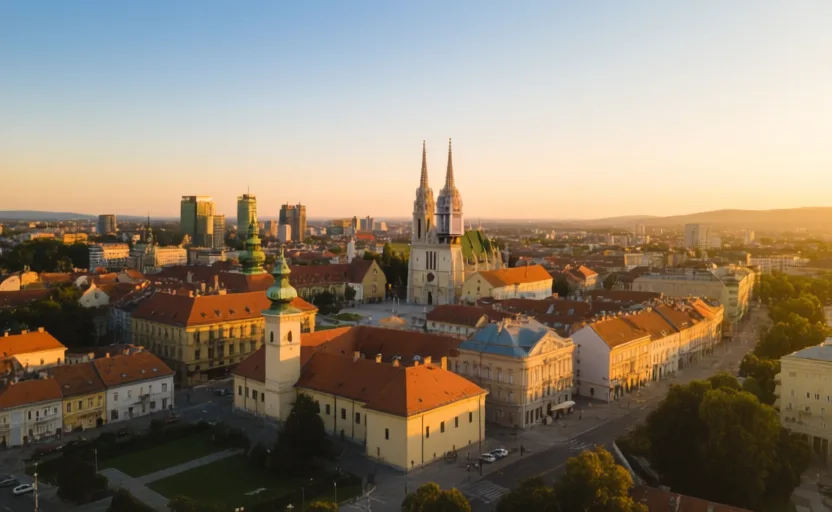 Zagreb · AI city illustration · Artistic impression
City · Europe
Zagreb
Saved in this browser — no account needed. Sign in later and it comes with you.
Where it is
Zagreb is a river-plain city leaning against a mountain. Most of it lies low along the Sava valley, at about 130 to 160 metres above sea level, while its northern and north-eastern districts climb into the foothills of Medvednica, whose highest peak, Sljeme, reaches 1,035 metres. The city spans some 30 kilometres east to west and 20 north to south, and sits close to the Slovenian frontier where Central Europe, the Mediterranean and Southeast Europe meet. Its climate is oceanic and borders on humid subtropical, with an annual rainfall of about 840 millimetres that makes it one of Europe’s wetter capitals.
The land and water around it
Medvednicamountains
The mountain north of the city, with the Sljeme peak and a TV tower on top. A medieval fortress, Medvedgrad, was built on its slopes in the 13th century, and former villages such as Šestine and Gračani keep their traditions there. The caves of its foothills, such as Veternica, hold evidence of Palaeolithic occupation.
The Sava valleyriver
Most of the city’s districts lie along the river valley at low elevation. For centuries the city stayed on the northern bank; after the Second World War the railway and river area filled with housing, and from the mid-1950s Novi Zagreb was built on the south bank.
The Medveščak streamriver
The small watercourse that ran between the hill of Gradec and the cathedral settlement of Kaptol. It was the dividing line between two rival communities that were merged only in the middle of the 19th century.
Its history, in short
Two settlements on neighbouring hills grew into one city. In 1094 Hungarian king Ladislaus founded a diocese here, and around the bishop’s see the clerical settlement of Kaptol developed, while the fortified settlement of Gradec rose on the next hill, with the Medveščak stream between them. After the Mongol attack of 1242, King Béla IV rewarded Gradec for sheltering him by granting its citizens autonomy through the Golden Bull. For centuries the two quarters quarrelled over rent and property, and the clashes, which lasted into the 17th century, included massacres and excommunications. By the later 16th century Zagreb was the political centre of Croatia, where the regional Sabor met, and the Jesuits opened a grammar school and then an academy that became the forerunner of the university. Gradec and Kaptol were joined in 1850. The 1862 railway, then the earthquake of 1880 and the rebuilding that followed shaped the grid of the lower town. Since the mid-1950s the city has pushed south of the Sava with Novi Zagreb, and in 1991 it became the capital of independent Croatia.
Timeline
Dates are shown on a timeline rather than as changing shapes on the map. The globe draws modern boundaries only, and tinting a modern outline to stand for a historical one would state something we cannot source.
Post-classical world
1094
A diocese at Kaptol
Hungarian king Ladislaus founds the diocese on his return from a campaign against the Kingdom of Croatia. The name Zagreb appears in the written record in connection with it; one account dates its first charter mention to 1134.
Approximate dateWikipedia1242
The Golden Bull of Gradec
After sheltering him from the Mongols, Gradec receives from Béla IV exemption from county rule, its own judicial system and the status of a free royal city.
Early modern & oceanic
1557 or 1577
Capital of Croatia-Slavonia
An assembly on 7 March 1577 is the first to call Zagreb the capital city of Croatia-Slavonia, though another account gives 1557 as the year it became the Croatian capital. In 1621 it also becomes the seat of the Ban.
1669
The Jesuit academy
The Jesuits, who came at the invitation of the Croatian Parliament and had already built the first grammar school, found an academy teaching philosophy, theology and law. It is the forerunner of the University of Zagreb.
Well attestedWikipedia
Industrial & imperial
1850–1851
One city
Gradec and Kaptol are united with surrounding settlements. Janko Kamauf becomes the first mayor in 1851, and Ban Josip Jelačić, whose name the main square carries, is credited with the union.
1862
The first railway
A line from Zagreb to Zidani Most and Sisak opens. A gasworks follows in 1863 and a waterworks in 1878.
Well attestedWikipedia1880
Earthquake and rebuilding
After the 1880 earthquake and up to the outbreak of the First World War, the city develops rapidly and gets the layout it has today, with old suburbs merging into the regular block pattern of the lower town.
Well attestedWikipedia
Contemporary
1991
Capital of independent Croatia
Parliament proclaims Zagreb the capital after independence. During the war the city saw sporadic fighting around army barracks and avoided major damage, though two rocket attacks in May 1995 killed seven civilians.
Well attestedWikipedia
Places that carry meaning
KaptolFrom 1094
The clerical quarter around Zagreb Cathedral, the smaller and eastern of the two original settlements, where the bishop’s see developed.
Gradec (the Upper Town)From the 13th century
The fortified hill settlement of craftsmen and merchants, now the Upper Town and one of the best-preserved urban nuclei in Croatia. The Grič cannon has been fired daily from the Lotrščak Tower to mark midday since 1877.
Donji Grad (the Lower Town)After 1880
The regular grid of blocks, museums, theatres and parks laid out on the plain below the old hills, which absorbed the old suburbs.
Novi ZagrebFrom the mid-1950s
New residential districts south of the Sava, first called Southern Zagreb. They show how the city broke its old limit at the river.
Languages here
Places are usually multilingual. This lists what is actually spoken, not one language per border.
CroatianSlavic family
The official language and the language of the capital.
Croats are 93.53 per cent of residents. The city also holds communities of Serbs, Bosniaks, Albanians, Romani, Slovenes, Macedonians and Montenegrins, and since the pandemic thousands of foreign workers from Nepal, the Philippines, India and Bangladesh, as well as parts of the Balkans, though many have temporary permits.
KajkavianSlavic family
The local dialect of Croatian around Zagreb.
One proposed origin of the city’s name rests on a sound shift attested in Kajkavian, a reminder that the speech of the region differs from the standard language.
GermanGermanic family
Historically the other name of the city: Agram.
The former German name Agram preserves an older form of the Croatian name, and the city belonged to the Habsburg monarchy after 1527.
Learn the language here
- 1Understand which languages are spoken hereZagreb is multilingual. Start with which languages are used, by whom, and for what — the phrase list only covers one of them.Written by Globe Quest
- 2Learn 11 phrasesCurated everyday phrases for Zagreb, with audio and a written form.Written by Globe Quest
- 3Say them out loudSpeaking practice with pronunciation feedback, one phrase at a time.Globe Quest material, your own additions
- 4Come back to themSpaced review, so what you learned this week is still there next month.Written by Globe Quest
Check yourself
Which two settlements merged to form modern Zagreb?
Kaptol, the cathedral settlement, and Gradec, the fortified hill town
Kaptol was inhabited mainly by clergy and Gradec by craftsmen and merchants, and the rivals quarrelled for centuries before the two were united in 1850.
What triggered the building boom that gave the lower town its present layout?
The 1880 earthquake and the rebuilding that followed
Between the 1880 earthquake and the First World War the city developed rapidly and acquired its characteristic regular layout, as old suburbs merged into the lower town.
Worth arguing about
- Zagreb grew from two hostile hill communities that fought for 400 years. Do cities that start as rivals become stronger or weaker for it?
- A long-standing height rule kept most towers out of Zagreb, so its high-rises date from the 1970s and 1980s. Does a skyline limit protect a city’s character or hold it back?
What we have not established
These are open questions, listed rather than filled in. We would rather show a gap than a plausible guess.
When did Zagreb first appear in the record, and when did it become the capital?
One account places the name’s first mention in 1094 with the foundation of the diocese, while the charter naming the diocese is dated 1134. Likewise, the year it became the Croatian capital is given as 1557, 1577 and 1845, depending on what counts as becoming the capital.
What is the city’s elevation?
Published elevations for the city run from about 127 to 158 metres above sea level, probably because they measure different points of a city that spans valley and foothills.
Sources
- Wikipedia · ZagrebWikipedia · encyclopedia · checked 2026-11-24
- Wikipedia · History of ZagrebWikipedia · encyclopedia · checked 2026-11-24
- Wikipedia · CroatiaWikipedia · encyclopedia · checked 2026-11-24
Reviewed by Globe Quest editorial on 2026-11-24. Drafted with AI assistance and checked against the sources above before publication.