 Globe Quest
 Human Quest · LearningSign in
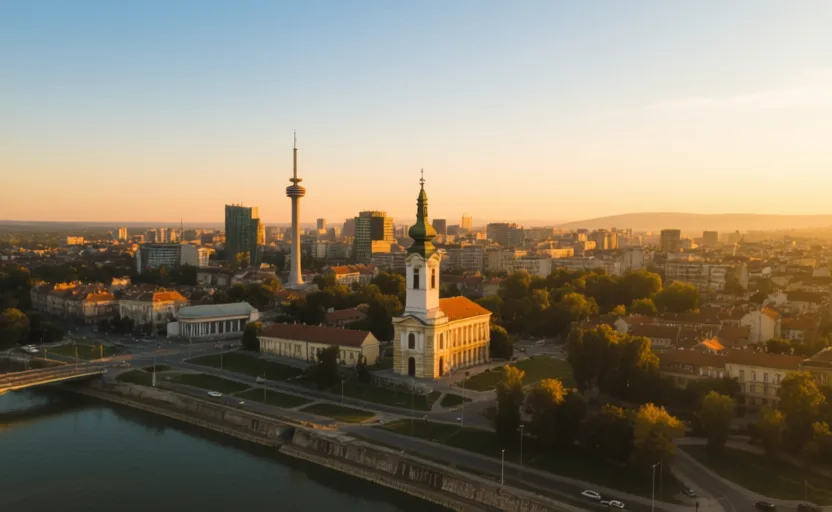 Belgrade · AI city illustration · Artistic impression
City · Europe
Belgrade
Saved in this browser — no account needed. Sign in later and it comes with you.
Where it is
The Sava joins the Danube at Belgrade, and the city occupies the ridge above the meeting of the two rivers, where the Pannonian Plain gives way to the Balkan Peninsula. The old core, the fortress of Kalemegdan, lies on the right bank of both rivers, about 117 metres above sea level. The right bank of the Sava is hilly, with Torlak hill at 303 metres the high point of the city proper and Avala and Kosmaj rising to the south, while across the water the land is flat alluvial plain and loess plateau. The climate is humid subtropical, with hot summers and cold winters, and about 700 millimetres of rain a year.
The land and water around it
The confluence of the Sava and the Danuberiver
A ridge overlooking the meeting of the two rivers figures in ancient myth as a stop on the voyage of Jason and the Argonauts. The Romans used the same position as a fortress on the Danubian frontier, and the historic core of the city sits on this spot.
The hills of the right bankmountains
The ground on the right bank of the Sava is hilly and unstable. About 1,155 points of land movement are recorded, covering nearly 30 per cent of the city’s territory. Some have been creeping downhill for centuries, and the Terazije slope above the Sava tilts monuments that stand on it. About 90 per cent of the land movement is triggered by building work and faulty water pipes.
The plains across the waterplain
Across the Sava and the Danube the land is mostly flat, made of river-laid plains and loess plateaus. After the Second World War the planners put New Belgrade on this low ground beside the Sava, so as to join the city with Zemun.
Its history, in short
The Vinča culture, one of the largest prehistoric cultures in Europe, flourished in the Belgrade area in the 6th millennium BC. Celts settled the place after 279 BC and called it Singidūn, the Romans made it Singidunum, a legionary base on the Danube frontier, and Slavs settled it in the 520s. Medieval Belgrade passed between Byzantine, Frankish, Bulgarian and Hungarian rulers before becoming the seat of the Serbian king Stefan Dragutin in 1284. The Ottomans captured it in 1521 and it became the second-largest Ottoman town in Europe, then changed hands with the Habsburgs several times, being largely destroyed each time. After the Serbian uprisings it became the capital of Serbia in 1841. Belgrade was the capital of Yugoslavia from 1918 until the state’s final dissolution in 2006, and was heavily bombed in April 1941. After the war the new government built New Belgrade on the far bank of the Sava. In the 1990s the city was where large protests against Slobodan Milošević took place and where tens of thousands of refugees from Croatia, Bosnia and Kosovo arrived.
Timeline
Dates are shown on a timeline rather than as changing shapes on the map. The globe draws modern boundaries only, and tinting a modern outline to stand for a historical one would state something we cannot source.
Classical world
After 279 BCE
Singidūn
The Celtic Scordisci take the settlement of a Thraco-Dacian tribe and name it Singidūn, meaning a fortress. The Romans later turn it into Singidunum.
Mid-2nd century
Roman city rights
Hadrian gives Singidunum the rights of a municipium, and by the end of the century it is a colonia. The legion stationed there, Legio IV Flavia Felix, builds its fort where the Upper Town of Kalemegdan now stands.
Approximate dateWikipedia
Post-classical world
1284
A Serbian royal seat
Belgrade becomes the capital of the Serbian king Stefan Dragutin after changing hands several times among Byzantine, Frankish, Bulgarian and Hungarian rulers. It later serves as capital of the Serbian Despotate under Stefan Lazarević.
Well attestedWikipedia
Early modern & oceanic
28 August 1521
Ottoman conquest
Suleiman the Magnificent takes the fortress. Most of the city is razed and its entire Orthodox Christian population is deported to Istanbul, but Belgrade soon becomes the seat of an Ottoman district and the second-largest Ottoman town in Europe.
Industrial & imperial
1841
Capital of Serbia
Prince Mihailo Obrenović moves the capital from Kragujevac to Belgrade. Serbian revolutionaries had held the city from 1807 to 1813, and Serbia’s semi-independence was recognised in 1830.
Well attestedWikipedia6 April 1941
The bombing
After mass protests against Yugoslavia’s accession to the Tripartite Pact and a military coup, the Luftwaffe bombs the city, killing up to 2,274 people. German, Italian, Hungarian and Bulgarian forces then invade the country.
Well attestedWikipedia
Contemporary
1948
New Belgrade
Construction begins on a modern district on the left bank of the Sava. The new regime rebuilds the city in a modernist style taken from Le Corbusier, to signal that Yugoslavia was a leader in modernity.
9 March 1991
Protests against Milošević
Large demonstrations led by Vuk Drašković, estimated at between 100,000 and 150,000 people, take place in the city. Two people are killed and tanks are sent into the streets, and later anti-war protests express solidarity with besieged Sarajevo.
Well attestedWikipedia
Places that carry meaning
KalemegdanRoman period onward
The fortress and park at the meeting of the rivers, on the site of the Roman legionary camp, with the city’s oldest architecture. Over its history the city is counted as the object of 115 wars and as destroyed 44 times.
The Roman street grid2nd century onward
The rectilinear plan of the Roman town is still traceable in the direction of Knez Mihailova Street and Studentski Trg, where the baths of the civil settlement have been found. Roman remains also survive under the City Library, in a space called the Roman Hall.
The Church of Saint Sava20th century
One of the largest Orthodox church buildings, built in the 20th century to commemorate the burning of the relics of Saint Sava on the Vračar plateau. Sinan Pasha ordered it in 1594, after a Serb rebellion was crushed.
New BelgradeFrom 1948
A planned district on the left bank of the Sava, joining Belgrade with Zemun. One of its numbered blocks, Block 70, has been known as the Chinese quarter since the mid-1990s.
Languages here
Places are usually multilingual. This lists what is actually spoken, not one language per border.
SerbianSlavic family
The language of the great majority.
Serbs make up over 86 per cent of the population of the wider city, and the standard language is written in both Cyrillic and Latin. The city’s name is a compound of words meaning “white” and “town”, and the same idea is found in Slavic city names such as Belgorod and Biograd.
RomaniIndo-Aryan family
The language of the largest named minority.
About 23,000 Roma live in the city, the largest minority recorded, ahead of people who identify as Yugoslavs, Gorani, Montenegrins, Russians, Croats and Macedonians.
RussianSlavic family
The language of recent arrivals and earlier émigrés.
Russian White émigrés settled in the city in the early 20th century, and after the invasion of Ukraine tens of thousands of Russians and Ukrainians registered their residence in Serbia, most of them in Belgrade.
ChineseSino-Tibetan family
The language of a community that arrived from the mid-1990s.
An estimated 10,000 to 20,000 Chinese people live in Belgrade, and Block 70 in New Belgrade has been known as the Chinese quarter since they first arrived.
Learn the language here
- 1Understand which languages are spoken hereBelgrade is multilingual. Start with which languages are used, by whom, and for what — the phrase list only covers one of them.Written by Globe Quest
- 2Learn 11 phrasesCurated everyday phrases for Belgrade, with audio and a written form.Written by Globe Quest
- 3Say them out loudSpeaking practice with pronunciation feedback, one phrase at a time.Globe Quest material, your own additions
- 4Come back to themSpaced review, so what you learned this week is still there next month.Written by Globe Quest
Check yourself
What does the name Beograd mean?
The white city
The name joins the Serbian words for “white” and “town”, and similar names such as Belgorod and Biograd are found across Slavic lands. The Celtic name Singidūn, meaning a fortress, was the older one.
What did the Romans build on the site of today’s Kalemegdan?
A legionary fort, at first of earth and timber and later of stone
Legio IV Flavia Felix built its camp there from the end of the 1st century, and the civilian town grew up around it, turning Singidunum into a main military base along the border.
Worth arguing about
- Belgrade has been razed dozens of times and rebuilt on the same ridge. What is it about a confluence that makes people return to the same spot after every destruction?
- The capital of a state that no longer exists, Yugoslavia, is now a city of mostly one nationality, with new communities arriving from Russia, Ukraine and China. How does a city adapt to being the centre of a different country?
What we have not established
These are open questions, listed rather than filled in. We would rather show a gap than a plausible guess.
How many people live in Belgrade?
The 2022 census gives about 1.2 million for the city proper, 1.3 million for the contiguous urban area and about 1.7 million for the wider administrative area, but accounts differ in the last digits. The metropolitan area is not formally defined and spreads into neighbouring municipalities, so no single total is reliable.
Sources
- Wikipedia · BelgradeWikipedia · encyclopedia · checked 2026-11-24
- Wikipedia · History of BelgradeWikipedia · encyclopedia · checked 2026-11-24
- Wikipedia · SerbiaWikipedia · encyclopedia · checked 2026-11-24
Reviewed by Globe Quest editorial on 2026-11-24. Drafted with AI assistance and checked against the sources above before publication.