 Globe Quest
 Human Quest · LearningSign in
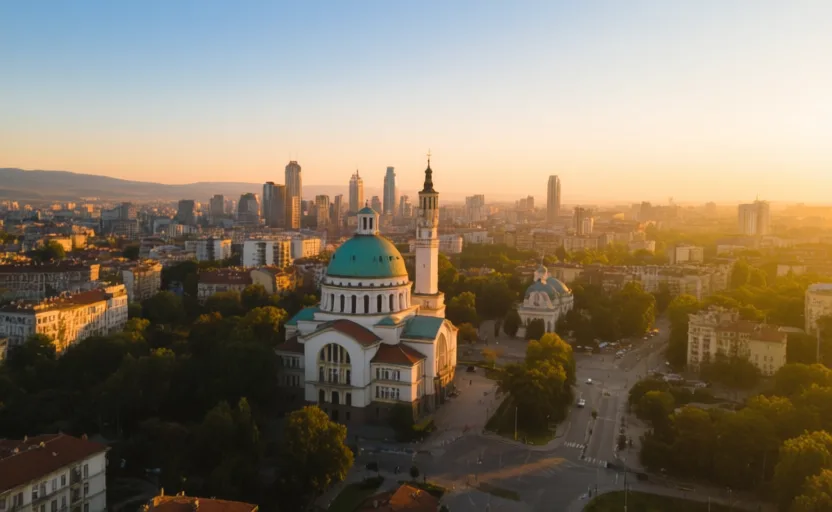 Sofia · AI city illustration · Artistic impression
City · Europe
Sofia
Saved in this browser — no account needed. Sign in later and it comes with you.
Where it is
Few capitals sit so far from a major river. Sofia lies in a basin about 550 metres up, under the northern slope of Vitosha, with the Balkan Mountains to the north and the Lyulin range to the west, and only small, shallow streams cross the city. Three passes lead into the valley and have carried roads since antiquity, and Vitosha is the watershed between the Black Sea and the Aegean. The mountains also trap air: winters are cold and snowy, and temperature inversions combined with solid-fuel heating make the city’s air one of the most polluted in Europe. Hot springs rise in the middle of town.
The land and water around it
Vitoshamountains
The mountain rising south of the city is the watershed between the Black Sea and the Aegean. Its Vitosha Nature Park is described as the oldest national park in the Balkans, and cable cars from the outskirts reach it all year.
The Sofia Valleyvalley
A high basin ringed by mountains, averaging 550 metres, with the Balkan Mountains to the north. It gives Sofia a central position in the Balkans and three natural passes, and it also limits airflow and traps pollution.
The hot springsclimate
Mineral springs still flow in the middle of the city and were the original draw of the site. The Roman city was famed for its springs, and the Central Mineral Baths now stand over them.
Its history, in short
Hot water drew people here for close to seven millennia, and Neolithic villages stood on the spot long before the Celtic Serdi gave their name to Serdica. Rome took it around 29 BCE, and it grew into the main city of the region, with walls, baths and an amphitheatre; Constantine is said to have called it his Rome, and in 311 the emperor Galerius issued an edict of toleration for Christians here. The First Bulgarian Empire took it in 809 under Khan Krum, and it became Sredets, briefly the Bulgarian capital in the 970s. Byzantium held it from 1018, the Second Empire from 1194, and the Ottomans conquered it in the 1380s. From 1530 to 1836 it was the seat of Rumelia, the empire’s largest province in Europe. Russian forces took it on 4 January 1878 when it had only 11,649 residents, many mosques were destroyed in the aftermath, and it was chosen as the capital of the new Bulgarian state in 1879. Migrants from other regions and from Ottoman Macedonia and Thrace then made it grow fast.
Timeline
Dates are shown on a timeline rather than as changing shapes on the map. The globe draws modern boundaries only, and tinting a modern outline to stand for a historical one would state something we cannot source.
Classical world
339 BCE
Sacked by Philip II of Macedon
The Thracian settlement, then in the Odrysian kingdom, is destroyed. The Celtic Serdi later give the place its name, first attested in a Greek inscription of the 1st century BCE.
29 BCE
Roman conquest
Rome subdues the Serdi, though sources differ on whether the region attacked, Segetike, was Serdica itself. Under Trajan it becomes a municipium named Ulpia Serdica, with fortifications, baths and an amphitheatre.
311
The Edict of Serdica
Emperor Galerius ends the persecution of Christians from Serdica and grants Christianity the status of a tolerated religion, two years before the Edict of Milan.
Well attestedWikipedia
Post-classical world
809
Taken by Khan Krum
After a long siege Serdica joins the First Bulgarian Empire. Byzantine emperor Nikephoros I invades in retaliation and is killed, and the city is permanently integrated as Sredets.
Well attestedWikipedia1382–1385
Ottoman conquest
The city falls to Ottoman forces in the 1380s. One source gives 1382 and another 1385.
Early modern & oceanic
1530–1836
Capital of Rumelia
Sofia is the seat of the Rumelia Eyalet, the province administering Ottoman lands in Europe, and the main hub of the caravan trade with Ragusa. Its population includes Muslims, Bulgarian and Greek-speaking Christians, Armenians, Georgians, Jews and Romani.
Well attestedWikipedia
Industrial & imperial
1878–1879
Liberation and capital
Russian troops under General Gurko enter on 4 January 1878, and Sofia is accepted as the capital of the new state on 3 April 1879. It then grew by migration from across Bulgaria and from areas still under Ottoman rule.
Well attestedWikipedia1913
First capital overflown by enemy aircraft
During the Second Balkan War the Romanian air corps flies over the city and drops pamphlets, a world first for a capital city.
Well attestedWikipedia
Places that carry meaning
Rotunda of St George and the Serdica ruins4th century
The 4th-century Rotunda stands among the remains of the Roman city, whose walls, gates, baths and amphitheatre are visible in the middle of the modern centre.
Boyana Church11th–19th centuries, best known for the 13th
A small church built under the Second Bulgarian Empire, inscribed by UNESCO in 1979. Its interior holds several layers of wall painting, and the 13th-century ones are the finest, interpreting the Byzantine canon with unusual vitality.
The triangle of religious toleranceOttoman and later
Sveta Nedelya Church, Banya Bashi Mosque and the Sofia Synagogue stand close together, with the Catholic Cathedral of St Joseph making the group a square. Banya Bashi is the only working mosque left from the Ottoman building boom of the 15th and 16th centuries.
Languages here
Places are usually multilingual. This lists what is actually spoken, not one language per border.
BulgarianSlavic family
The official language and the speech of most residents.
Bulgarians were recorded as about 88 per cent of residents in the 2011 census. The name Sredets, “middle”, is the Slavic form that replaced Serdica, and the later name Sofia comes from the church of St Sofia.
TurkishTurkic family
Spoken by a small minority, a trace of the Ottoman centuries.
Ottoman subjects from Anatolia joined the Bulgarian-speaking population after the conquest. Most Muslims left after 1878, and Turks were only 0.5 per cent of residents in the 2011 census.
GreekHellenic family
Spoken by Orthodox Christians in the Ottoman period.
Under the Ottomans the population included Bulgarian and Greek-speaking Orthodox Christians alongside Armenians, Georgians, Ragusans, Jews and Romani.
Learn the language here
- 1Understand which languages are spoken hereSofia is multilingual. Start with which languages are used, by whom, and for what — the phrase list only covers one of them.Written by Globe Quest
- 2Learn 11 phrasesCurated everyday phrases for Sofia, with audio and a written form.Written by Globe Quest
- 3Say them out loudSpeaking practice with pronunciation feedback, one phrase at a time.Globe Quest material, your own additions
- 4Come back to themSpaced review, so what you learned this week is still there next month.Written by Globe Quest
Check yourself
What was issued in Serdica in 311?
An edict of toleration for Christianity by Emperor Galerius
The Edict of Serdica ended the Diocletianic persecution two years before the Edict of Milan, though it granted only conditional tolerance.
Where does the name Sofia come from?
The church of Saint Sofia
Serdica came from the Serdi and Sredets from the Slavic for middle. Sofia is unusual among Bulgarian towns in taking its name from a church.
Worth arguing about
- A capital in a mountain basin with no big river, full of Roman, Ottoman and socialist layers. Which of its past is it hardest to see in the street?
- The city had about 11,600 people in 1878 and fewer than half the 70,000 of a century before. What does it take for a small town to become a national capital in a generation?
What we have not established
These are open questions, listed rather than filled in. We would rather show a gap than a plausible guess.
When did the Ottomans take Sofia?
One account gives 1382 and another 1385, under Murad I. The difference is not resolved in the sources found.
How many people live in Sofia?
Figures range from 1.2 million in the 2011 census to 1.4 million in 2018 and 1.28 million within the municipal territory, depending on the boundary and the year.
Sources
- Wikipedia · SofiaWikipedia · encyclopedia · checked 2026-11-24
- Wikipedia · History of SofiaWikipedia · encyclopedia · checked 2026-11-24
- Wikipedia · BulgariaWikipedia · encyclopedia · checked 2026-11-24
- UNESCO · Boyana ChurchUNESCO World Heritage Centre · intergovernmental · checked 2026-11-24
Reviewed by Globe Quest editorial on 2026-11-24. Drafted with AI assistance and checked against the sources above before publication.