 Globe Quest
 Human Quest · LearningSign in
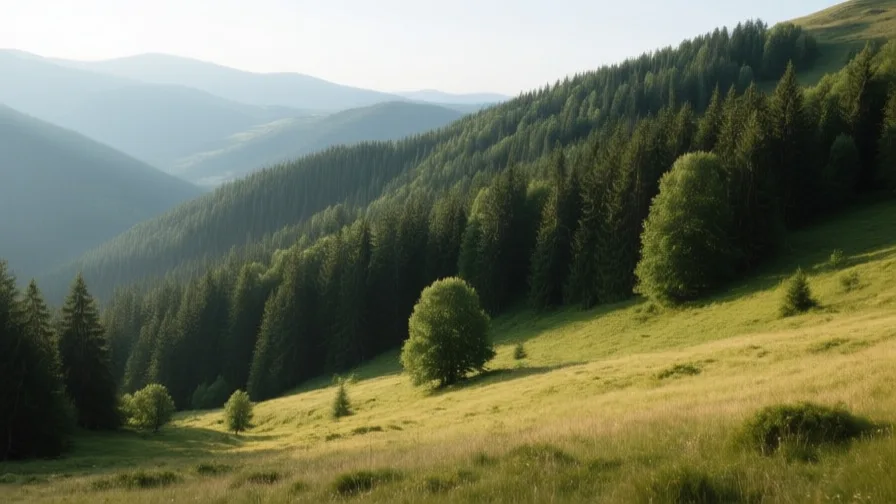 Romania · AI landscape illustration · Artistic impression
Country · Europe
Romania
Saved in this browser — no account needed. Sign in later and it comes with you.
Where it is
Romania is built around a great arc of mountains. The Carpathians run through the middle of the country, with fourteen ranges above 2,000 metres, and around them lie the Transylvanian and Moldavian plateaus, the Pannonian plain and the Wallachian plains. Roughly equal shares of the land are mountain, hill and plain. Everything drains toward the lower Danube, which forms much of the southern border with Serbia and Bulgaria before breaking into a delta on the Black Sea. The climate is continental, with four distinct seasons, hot summers and cold winters, softened in the west and by the sea in Dobruja.
The land and water around it
The Carpathiansmountains
The mountains dominate the centre of the country, and the highest peak, Moldoveanu, reaches 2,544 metres. Beyond the foothills the land falls away to plateaus and plains on every side.
The Danube Deltadelta
Where the Danube reaches the Black Sea it spreads over 5,800 square kilometres, making it the largest continuous marshland in Europe and, by one description, the best preserved delta on the continent. It is both a biosphere reserve and a World Heritage site.
The plateaus and plainsplain
The Transylvanian and Moldavian plateaus, the Pannonian plain and the Wallachian plains ring the mountains. Rain is moderate: around Bucharest about 570 millimetres fall in a year, and only the highest western mountains receive more than 750.
Its history, in short
Dacians held the land around the Carpathians until Rome conquered the core of their kingdom in 106 AD. The province was given up by 276, and over the following centuries migrating peoples crossed the territory, while Romance-speaking Vlachs are clearly recorded from the 10th century. By the mid-14th century two principalities, Wallachia and Moldavia, had formed, and later they lived under Ottoman suzerainty with considerable autonomy. Transylvania took another path: part of Hungary, then a principality under the Ottomans, and from the late 17th century a Habsburg possession in which Romanians were the majority but not the ruling class. The two principalities were united in 1859 under Alexandru Ioan Cuza, took the name Romania in 1866, won independence in 1877–78 and became a kingdom in 1881. After the First World War, Transylvania, Bukovina and Bessarabia joined, creating Greater Romania. The Second World War cost much of that territory again, and communist rule followed from 1947 until the revolution of 1989, which began in Timișoara. Romania has been a member of NATO and the European Union since the post-communist transition.
Timeline
Dates are shown on a timeline rather than as changing shapes on the map. The globe draws modern boundaries only, and tinting a modern outline to stand for a historical one would state something we cannot source.
Classical world
106 AD
Rome conquers Dacia
After several wars, the core of the Dacian kingdom becomes a Roman province and the process of Romanisation begins. The province is abandoned by 276, after invasions by other peoples.
Well attestedWikipedia
Early modern & oceanic
1568
The Edict of Turda
John II, the first Prince of Transylvania, guarantees freedom of conscience and religion, and lets each congregation pick its own clergy. In the decades that follow, Hungarian Calvinist princes rule Transylvania, and Protestantism flourishes there.
Well attestedWikipedia
Industrial & imperial
1859
Moldavia and Wallachia unite
Both principalities elect Alexandru Ioan Cuza as ruler, using an ambiguity in the agreement, which specified two thrones but did not forbid one man holding both. He abolishes serfdom and merges their institutions, and the country is renamed Romania in 1866.
1877–1881
Independence and the kingdom
Romania declares independence from the Ottoman Empire in the Russo-Turkish war of 1877–78 and is recognised at the Treaty of Berlin in 1878. In exchange for access to Black Sea ports it cedes the district of Bessarabia to Russia, and in 1881 Prince Carol becomes King Carol I.
Well attestedWikipedia1918–1920
The Great Union
Assemblies in Transylvania, Bukovina and Bessarabia proclaim union with the kingdom in 1918, and the Treaty of Trianon confirms the gain of Transylvania and nearby regions in 1920. Greater Romania reaches its largest extent.
1940
Territorial losses
Under Soviet and German pressure Romania gives up Bessarabia and Northern Bukovina to the USSR, the northern half of Transylvania to Hungary, by the Second Vienna Award, and the south of Dobruja to Bulgaria. Romania got Northern Transylvania back in 1945, a result the Paris Peace Treaties confirmed two years later.
Contemporary
1947
Communist rule begins
King Michael I is forced to abdicate under Soviet occupation, and a People’s Republic is proclaimed. The new regime consolidates power through a Stalinist policy that suppresses opposition and reorganises the economy.
December 1989
Revolution
A protest in Timișoara in support of the Reformed pastor László Tőkés spreads into a national uprising. Nicolae and Elena Ceaușescu are executed on 25 December.
Well attestedWikipedia
Places that carry meaning
Peștera cu Oase35,000 to 40,000 years ago
The cave where human remains were found in 2002. They are among the oldest known Homo sapiens in Europe, dated to between about 35,000 and 40,000 years ago.
Poiana SlatineiNeolithic
A site beside a salt spring near the village of Lunca, with the earliest known evidence for salt production in Europe. The works were later used by the Cucuteni–Trypillia culture.
Alba Iulia16th century and 1922
King John II moved his court here and became the first Prince of Transylvania. In 1922 Ferdinand I and Queen Maria were crowned sovereigns of all Romanians in the city, after the unions of 1918.
TimișoaraDecember 1989
The city where the protest that began the revolution broke out. The protest on behalf of a Reformed pastor, László Tőkés, grew within days into a national uprising.
Languages here
Places are usually multilingual. This lists what is actually spoken, not one language per border.
RomanianRomance family
The official language, spoken by over nine in ten people.
Spoken as a first language by 91.55 per cent of the population. It belongs to the Eastern branch of the Romance family and uses the Latin alphabet with five extra letters. The oldest surviving document in the language is a letter of 1521.
HungarianUralic family
The largest minority language, centred on Transylvania.
Spoken by 6.28 per cent of the population. Transylvania belonged to the Kingdom of Hungary until 1918, and most of the Hungarian minority still lives there. Laws allow minority languages in local administration and signage where a group makes up more than a fifth of a locality.
RomaniIndo-Aryan family
The language of the Roma, the second-largest minority.
Vlax Romani is spoken as a first language by 1.2 per cent of the population, and Balkan and Carpathian dialects are also used. Official figures are thought to undercount the Roma, many of whom lack ID cards or do not declare their ethnicity.
GermanGermanic family
The language of the Transylvanian Saxons and the Banat Swabians.
There were about 780,000 Germans in 1938, 111,301 in 1992 and only 45,129 in 2002. A democratic forum of the community still works in German. French also has a historical role, having spread among the elite from the 18th century, and around a quarter of Romanians today have studied it.
Learn the language here
Check yourself
Which two principalities did Alexandru Ioan Cuza unite in 1859?
Moldavia and Wallachia
Both principalities elected him ruler, and Cuza went on to merge their institutions, so the modern state formed without Transylvania, which stayed under Habsburg rule until 1918.
What distinction does the Danube Delta hold in Europe?
The largest continuous marshland in Europe
At about 5,800 square kilometres, it is the largest continuous marshland in Europe.
Worth arguing about
- Romania’s present borders were assembled in 1859, 1878, 1918 and 1947, and Transylvania, Bessarabia and Southern Dobruja have each been gained and lost more than once. How should a country tell a story that is that tied to its edges?
- Romanian is a Romance language in a region of Slavic and Hungarian speakers, and its name means “Roman”. What does it mean for a national identity to rest on a link to Rome?
What we have not established
These are open questions, listed rather than filled in. We would rather show a gap than a plausible guess.
Where do the Romanians come from?
Many Romanian historians trace the people to the Dacians and Romans mixing in the province of Dacia. The province was abandoned by 276, and the earliest clear mentions of Romance-speaking Vlachs date from the 10th century, so the intervening centuries are thinly documented and the question remains debated.
When did salt production at Poiana Slatinei begin?
Accounts give different dates for the first use of the salt spring there, from around 6050 BC in the early Neolithic to between the 5th and 4th millennium BC, so we describe it only as Neolithic.
Sources
- Wikipedia · RomaniaWikipedia · encyclopedia · checked 2026-11-24
- Wikipedia · History of RomaniaWikipedia · encyclopedia · checked 2026-11-24
- Wikipedia · Languages of RomaniaWikipedia · encyclopedia · checked 2026-11-24
Reviewed by Globe Quest editorial on 2026-11-24. Drafted with AI assistance and checked against the sources above before publication.