 Globe Quest
 Human Quest · LearningSign in
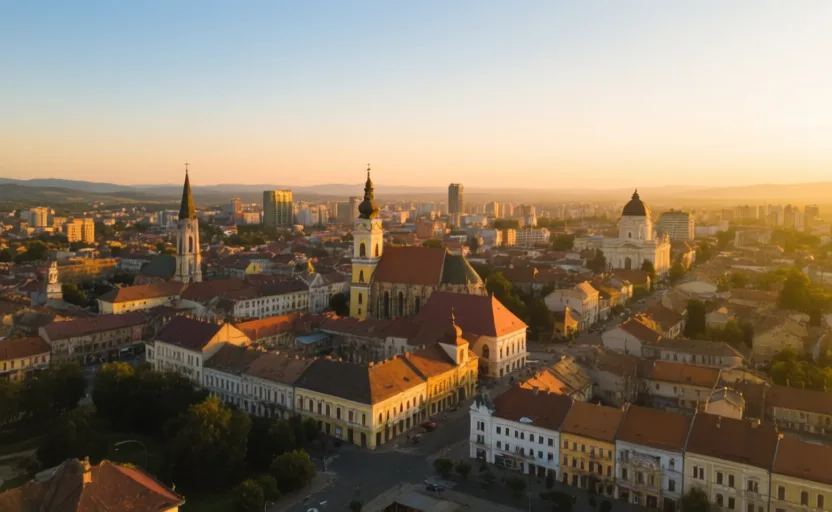 Cluj-Napoca · AI city illustration · Artistic impression
City · Europe
Cluj-Napoca
Saved in this browser — no account needed. Sign in later and it comes with you.
Where it is
Cluj-Napoca fills a valley of the Someșul Mic where three kinds of country meet: the Apuseni Mountains to the west, the Someș plateau to the east and the Transylvanian plain beyond. Hills of 500 to 700 metres close in on three sides, with Feleac Hill rising behind the southern districts, and smaller streams cut side valleys through the city. It lies in the middle of Transylvania, almost the same distance from Bucharest, Budapest and Belgrade, at 445, 461 and 483 kilometres. The climate is continental, with warm summers, cold winters and snow on the ground for about two months each year.
The land and water around it
The Someșul Mic valleyvalley
The river runs through the city, with a canal, the Canalul Morilor, crossing the centre and smaller streams joining from side valleys.
The hills around the citymountains
Hills between 500 and 700 metres enclose the city on three sides, and the nearer ones, Cetățuie and Calvaria, rise close to the centre.
The ford below Cetățuieriver
Before the Romans came, two routes for the salt trade, one north–south and the other east–west, met at a ford under a hill promontory now called Cetățuie. The growth of cattle-raising in the Pannonian plain made the salt trade with the Transylvanian plain ever more important.
Its history, in short
A pre-Roman settlement called Napoca stood here, and after the Roman conquest of 106 it became a municipium and then a colonia, and the capital of the province of Dacia Porolissensis, until the Romans left in 274. After a gap of centuries the medieval town grew up under the Kingdom of Hungary, settled partly by Transylvanian Saxons, and is first reliably recorded in 1275. It prospered as a trading town, earned the nickname of the treasure city in the late 16th century and became a centre of the Protestant Reformation, where Unitarianism was adopted by the Transylvanian diet in 1571. The city passed to the Habsburgs in 1699 and in the 19th century was the seat of government of the Grand Principality of Transylvania and the heart of Hungarian national politics. After the First World War it became Romanian and was handed back to Hungary from 1940 to 1944. Its Jews were deported in 1944. Romanians became the majority of the population in the 1960s, and the name Napoca was added in 1974. Since 2004 it has become one of Romania’s main academic, cultural, industrial and business centres.
Timeline
Dates are shown on a timeline rather than as changing shapes on the map. The globe draws modern boundaries only, and tinting a modern outline to stand for a historical one would state something we cannot source.
Classical world
106
Roman Napoca
After Trajan’s conquest of Dacia, a Roman town named Napoca is established, recorded on a milestone found in 1758. Hadrian makes it a municipium and later in the 2nd century it becomes a colonia, until the Romans evacuate it in 274.
Post-classical world
1213
A royal borough called Clus
The name Cluj is first written down, in Latin as Castrum Clus. The first reliable record of the settlement itself is in 1275, when it is granted to the bishop of Transylvania, after Transylvanian Saxons had been settled there.
Well attestedWikipedia
Early modern & oceanic
1571
Unitarianism
The Transylvanian diet at Turda adopts the radical doctrine of Ferenc Dávid, which freely interprets the Bible and rejects the dogma of the Trinity. Lutheranism and Calvinism had arrived in the city in the preceding decades.
Well attestedWikipedia1699
Habsburg rule
Under the Treaty of Carlowitz Cluj becomes part of the Habsburg monarchy. The city had lost much of its wealth and population in a century of plague and fires, and it recovers as the seat of the provincial government and diets.
Well attestedWikipedia
Industrial & imperial
1872
A Hungarian university
After the Compromise of 1867 puts Transylvania back inside the Kingdom of Hungary, a modern university is founded in the city with teaching entirely in Hungarian. It aims to bind Transylvania to Hungary and angers the Romanian population.
1918–1920
Union with Romania
Delegates from Cluj attend the assembly at Alba Iulia that proclaims union on 1 December 1918, and the Treaty of Trianon in June 1920 confirms the handover of sovereignty. The university becomes a Romanian institution.
1940–1944
Back under Hungary
The Second Vienna Award gives Northern Transylvania to Hungary, and the city is Hungarian again until Soviet and Romanian armies take it in October 1944. After Germany occupies Hungary in March 1944, the city’s Jews, who numbered 16,763 in 1941, are forced into ghettos and deported to Auschwitz in six transports between May and June.
Contemporary
1974
Cluj becomes Cluj-Napoca
The communist government adds the Roman name Napoca to the official name to recognise the ancient colony. The change was made under Ceaușescu’s national-communist regime, as part of its myth-making. The Hungarian name of the city is Kolozsvár and the German one Klausenburg.
Places that carry meaning
St Michael’s ChurchLate 14th century
The Gothic parish church on Unirii Square, dedicated to the Archangel Michael, the city’s patron saint. The city is described as spreading out from it.
Cluj-MănășturEarly Middle Ages
The site of a wooden fortress and later of an abbey founded by King Ladislaus I, which was destroyed in the Tatar invasions of 1241 and 1285. It was one of two groups of buildings that stood on the site at the start of the Middle Ages.
Babeș-Bolyai University1872 onward
Romania’s largest university, formed in 1959 when a Romanian university named for Victor Babeș and a Hungarian one named for János Bolyai merged. It teaches in Romanian and Hungarian, with 55 Hungarian-language specialisations as of 2007.
Bonțida Bánffy CastleMedieval and later
One of many castles around the city built by its wealthy families, in a village 32 kilometres from the centre. It was once called the Versailles of Transylvania.
Languages here
Places are usually multilingual. This lists what is actually spoken, not one language per border.
RomanianRomance family
The language of most residents.
Romanians first outnumbered Hungarians in the 1960s, and in the 1966 census 56 per cent of the city’s 185,663 people were Romanian. Before 1918 the city had only two church-run Romanian elementary schools, and the first Romanian periodical was printed in 1903.
HungarianUralic family
The language of a large minority and, for centuries, of the city’s administration.
Almost 50,000 Hungarians live in Cluj, the second-largest urban Hungarian community in Romania. There is a Hungarian state theatre and opera, Hungarian newspapers and research bodies, and the Reformed and Unitarian bishoprics have their seats in the city. Hungarian was the language of the majority until the 1960s.
GermanGermanic family
A historic language of settlers and of Habsburg-era institutions.
Transylvanian Saxons were settled here in the Middle Ages, and the city is Klausenburg in German. Maria Theresa founded a German university here in 1776, but it did not last long.
Learn the language here
- 1Understand which languages are spoken hereCluj-Napoca is multilingual. Start with which languages are used, by whom, and for what — the phrase list only covers one of them.Written by Globe Quest
- 2Learn 11 phrasesCurated everyday phrases for Cluj-Napoca, with audio and a written form.Written by Globe Quest
- 3Say them out loudSpeaking practice with pronunciation feedback, one phrase at a time.Globe Quest material, your own additions
- 4Come back to themSpaced review, so what you learned this week is still there next month.Written by Globe Quest
Check yourself
What was the Roman settlement on the site of Cluj called?
Napoca
Napoca was the Roman town, and its name existed before the conquest. The name was added to Cluj officially in 1974, when the communist government wished to emphasise the Roman past.
When did Romanians first outnumber Hungarians in Cluj?
In the 1960s
Even after the city joined Romania in 1920, Hungarians remained the majority for decades. The change came only in the 1960s.
Worth arguing about
- The same city is Cluj, Kolozsvár and Klausenburg, and each name belongs to a period and a community. Who should decide what a city is called, and does adding a Roman name settle anything?
- Cluj spent decades as a place where the state tried to change the city’s identity, first by Hungarianising and then by Romanianising it. What remains of a city’s character after such efforts?
What we have not established
These are open questions, listed rather than filled in. We would rather show a gap than a plausible guess.
Was the site continuously inhabited after the Romans left in 274?
One account finds no sign of urban settlement here for most of a millennium, while another points to two cemeteries and nearby villages that continued Roman customs. The evidence for the centuries between is thin, so the question stays open.
How many people live in Cluj-Napoca?
The 2021 census counted 286,598 inhabitants, down from 324,576 in 2011, but the county register gave 392,276 in 2007 and the metropolitan area is put at about 411,000. Counting methods differ and many residents and students are not registered as living there.
Sources
- Wikipedia · Cluj-NapocaWikipedia · encyclopedia · checked 2026-11-24
- Wikipedia · History of Cluj-NapocaWikipedia · encyclopedia · checked 2026-11-24
Reviewed by Globe Quest editorial on 2026-11-24. Drafted with AI assistance and checked against the sources above before publication.