 Globe Quest
 Human Quest · LearningSign in
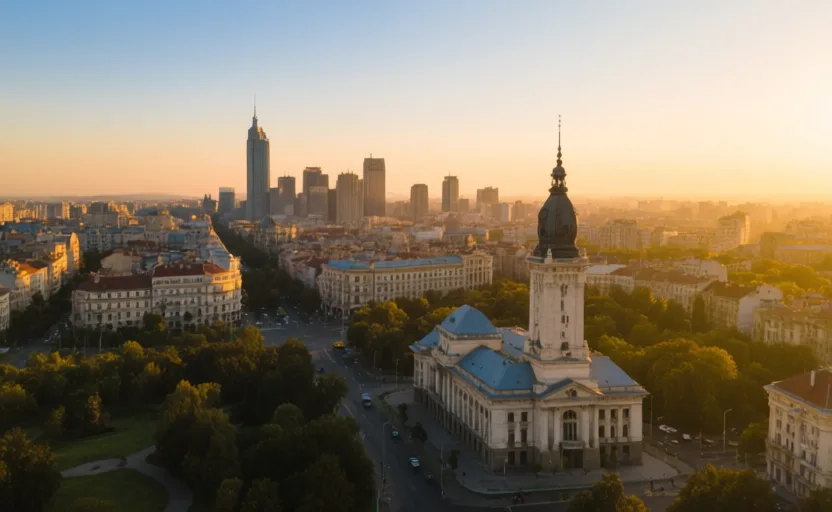 Bucharest · AI city illustration · Artistic impression
City · Europe
Bucharest
Saved in this browser — no account needed. Sign in later and it comes with you.
Where it is
Bucharest stands on open flat ground in the middle of the Romanian Plain, on land that was once covered by the Vlăsiei Forest and was cleared into fertile flatland, beside the modest Dâmbovița, which runs on to the Argeș and then to the Danube. The city proper covers about 239 square kilometres and has some 1.7 million residents, within a metropolitan area several times larger. Summers are hot and humid, with midsummer temperatures of 35 degrees in the centre, and winters are cold, windy and snowy because nothing on the plain stops the wind.
The land and water around it
The Dâmbovițariver
The river runs through the middle of the city and flows into the Argeș, a tributary of the Danube. Floods, such as that of 1865, were frequent until the river was channelled in 1883, and it was channelled a second time under the communist regime.
The Romanian Plainplain
The city sits in the centre of the plain, on ground that was once forest and then became fertile farmland. Its population has fallen since 2011 as people move to satellite towns such as Voluntari and Popești-Leordeni.
The Colentina lakes and Văcăreștilake
A string of lakes along the Colentina river, a tributary of the Dâmbovița, stretches across the north of the city. In the south, a concrete basin begun as a lake under Ceaușescu was abandoned in 1989, filled with wildlife and was declared a nature park in 2016.
Its history, in short
The city is first mentioned in 1459, as a citadel and residence of Vlad the Impaler, the ruler of Wallachia. It grew as the Ottoman demand for grain and trade with the Balkans pulled Wallachia’s centre of gravity south, and it competed with Târgoviște for the role of capital until the court settled here permanently after 1698. Fires, plagues, earthquakes and foreign occupations kept breaking the city, and it was rebuilt each time. Greek administrators appointed by the Ottomans, the Phanariotes, ran it from the 18th century until the 1821 uprising. In 1862 it became capital of the united principalities and in 1881 of the kingdom, and it grew fast, its boulevards and cosmopolitan culture earning it the name “Paris of the East”. It was occupied by German forces from 1916 to 1918, heavily bombed in the Second World War and then reshaped by communism. Under Nicolae Ceaușescu a whole historic quarter was demolished to build the Palace of the Parliament. The 1989 revolution spread from Timișoara to the capital and overthrew the regime.
Timeline
Dates are shown on a timeline rather than as changing shapes on the map. The globe draws modern boundaries only, and tinting a modern outline to stand for a historical one would state something we cannot source.
Early modern & oceanic
1459
First mention
A document names the Citadel of București, and the city becomes a residence of Vlad the Impaler, ruler of Wallachia. The Old Princely Court was built in the mid-16th century.
Well attestedWikipediaafter 1698
The permanent seat of the court
Under Constantin Brâncoveanu, Bucharest finally becomes the permanent location of the Wallachian court, settling its long rivalry with Târgoviște. His reign gave the city a distinctive local style of building and its first educational facilities.
Industrial & imperial
23 March 1847
The great fire
A fire consumes about 2,000 buildings and destroys a third of the city. The same year the Cișmigiu Gardens open in the centre.
Well attestedWikipedia1862
Capital of a united country
After Wallachia and Moldavia are united, Bucharest becomes the capital of the new principality. In 1881 it is the capital of the kingdom, and its population rises sharply.
Well attestedWikipedia1883
The river is channelled
The Dâmbovița is heavily channelled, ending the floods that had hit the city. The period brings gas lighting, horse-drawn trams and limited electricity, and the Calea Victoriei becomes the “Champs-Élysées” of the Paris of the East.
Well attestedWikipedia1916–1918
German occupation
After the Battle of Bucharest in December 1916, German forces hold the city until November 1918, and the official capital moves temporarily to Iași. Afterwards Bucharest becomes the capital of Greater Romania.
Well attestedWikipedia
Contemporary
4 March 1977
The Vrancea earthquake
An earthquake centred about 135 kilometres away kills about 1,500 people and damages the historic centre further.
December 1989
The revolution reaches the capital
Protests that began in Timișoara continue in Bucharest and bring down the communist regime. Student groups and opposition parties hold anti-communist rallies again in early 1990.
Well attestedWikipedia
Places that carry meaning
Curtea Veche, the Old Princely CourtMid-16th century
Built by Mircea Ciobanul as the Wallachian rulers’ seat in the town, it was extended under Brâncoveanu and later damaged by wars. It marks where princely authority first settled in the city.
Calea VictorieiLate 17th century onward
The main street was cut through the Vlăsiei forest under Brâncoveanu. In the 19th century it became the avenue that gave Bucharest its Paris comparison.
The Palace of the Parliament and the Civic Centre1980s
Built under Ceaușescu’s programme of systematization, they replaced about 1.8 square kilometres of old buildings, including old churches. It is the most prominent landmark in the city and the most contested.
Văcărești Nature ParkDeclared 2016
A village was demolished to make way for a lake that was never finished. The abandoned concrete basin has become a protected habitat of 190 hectares with 97 species of bird, known as the Delta of Bucharest.
Languages here
Places are usually multilingual. This lists what is actually spoken, not one language per border.
RomanianRomance family
The language of nearly the whole population.
About 97 per cent of those residents who declared an ethnicity are Romanians, and Romanian is the official language nationally.
RomaniIndo-Aryan family
The language of the Roma minority.
Roma are the largest minority named in the city’s census, alongside Hungarians, Turks, Jews, Germans, Chinese, Russians, Ukrainians and Italians. Nearly 227,000 residents did not declare an ethnicity.
GreekHellenic family
The language of the Phanariote administration in the 18th century.
The Ottomans appointed Greek Christian administrators to run the town from the 18th century. Their rule ended with the 1821 uprising, though Greeks remain a small community in the city.
FrenchRomance family
The historic language of the elite.
French spread among the Romanian elite from the 18th century, and by the 1930s many of them spoke it as a mother tongue. There is no native French-speaking population, and about a quarter of Romanians today have studied it.
Learn the language here
- 1Understand which languages are spoken hereBucharest is multilingual. Start with which languages are used, by whom, and for what — the phrase list only covers one of them.Written by Globe Quest
- 2Learn 11 phrasesCurated everyday phrases for Bucharest, with audio and a written form.Written by Globe Quest
- 3Say them out loudSpeaking practice with pronunciation feedback, one phrase at a time.Globe Quest material, your own additions
- 4Come back to themSpaced review, so what you learned this week is still there next month.Written by Globe Quest
Check yourself
Why was the Dâmbovița channelled in 1883?
To end the floods that had repeatedly hit the city
The channelling put a stop to the floods that were endemic in the city, such as that of 1865. The unfinished Danube–Bucharest canal belongs to the communist era.
What was cleared to build the Palace of the Parliament?
A whole historic quarter of about 1.8 square kilometres
Ceaușescu’s systematization razed old buildings and churches to build the Civic Centre and the palace, a loss that is still debated in the city.
Worth arguing about
- Bucharest has been burned, shaken by earthquakes, occupied and reshaped from above, and has kept rebuilding itself. Is a capital like that a city with a past or a city that keeps starting again?
- A concrete basin left over from a failed project became a nature park. Should the unfinished works of an authoritarian regime be demolished, finished or left to be taken over by nature?
What we have not established
These are open questions, listed rather than filled in. We would rather show a gap than a plausible guess.
Where does the name București come from?
Its origin is unverified. Tradition links it to a founder named Bucur, who in different legends is a prince, an outlaw, a fisherman, a shepherd or a hunter, and scholars have offered other derivations, from a word for joy to an Ottoman traveller’s claim that it came from a tribal name, with none established.
Sources
- Wikipedia · BucharestWikipedia · encyclopedia · checked 2026-11-24
- Wikipedia · History of BucharestWikipedia · encyclopedia · checked 2026-11-24
- Wikipedia · RomaniaWikipedia · encyclopedia · checked 2026-11-24
Reviewed by Globe Quest editorial on 2026-11-24. Drafted with AI assistance and checked against the sources above before publication.