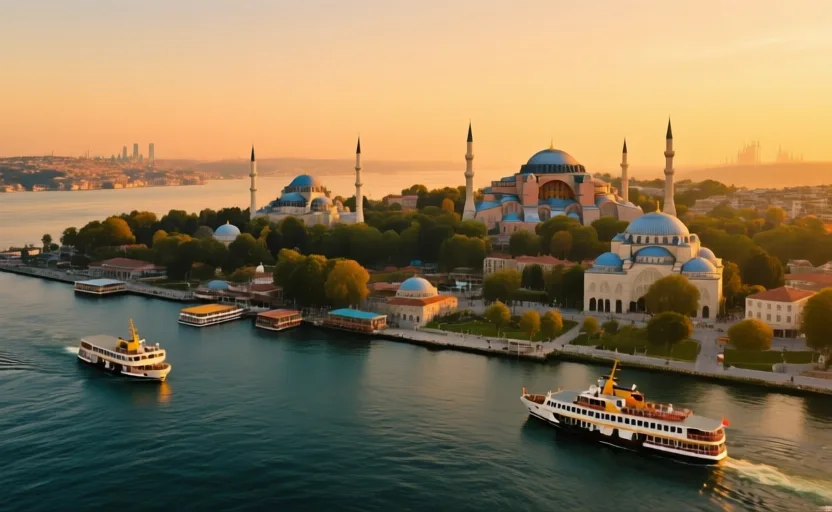
 Istanbul · AI city illustration · Artistic impression
City · Europe
Istanbul
Also known as Constantinople, Byzantium, Konstantiniyye, İstanbul
Saved in this browser — no account needed. Sign in later and it comes with you.
Read its story
Where it is
Istanbul sits on both sides of the Bosphorus, the only sea passage between the Black Sea and the Mediterranean. The historic peninsula is bounded by the strait to the east, the Golden Horn — a deep, sheltered inlet — to the north, and the Sea of Marmara to the south, leaving one narrow land approach. That combination of a controllable strait, an excellent natural harbour, and a site that is hard to attack by land is rare enough that no state in reach of it has ever been indifferent to who holds it. It is also the only large city on two continents, and its metropolitan population is well over fifteen million.
The land and water around it
The Bosphorusstrait
Thirty-one kilometres joining the Black Sea to the Sea of Marmara, under a kilometre wide at its narrowest. A major international shipping lane that is also a commuter ferry route.
The Golden Hornharbour
The inlet that gave the peninsula a sheltered deep-water harbour, historically closable with a chain across its mouth.
The North Anatolian Faultmountains
An active fault running through the Sea of Marmara just south of the city. Istanbul's earthquake risk is not incidental to its site; it is part of the same tectonic setting that shaped the region.
Its history, in short
A Greek colony, then a Roman provincial town, then an imperial capital from 330, then the capital of the Eastern Roman empire for over a thousand years, then the Ottoman capital from 1453 until the empire ended. Ankara became the Turkish Republic's capital in 1923, and Istanbul stopped being a seat of government for the first time in sixteen centuries — and kept growing anyway, on commerce, industry and migration from Anatolia. Its twentieth-century history also includes the departure of most of its historic Greek, Armenian and Jewish communities, through population exchange, discriminatory taxation, and the 1955 pogrom.
Timeline
Dates are shown on a timeline rather than as changing shapes on the map. The globe draws modern boundaries only, and tinting a modern outline to stand for a historical one would state something we cannot source.
Classical world
c. 660 BCE
Byzantium founded
Greek settlers, traditionally from Megara, establish a colony on the peninsula. The date comes from later Greek sources and is conventional.
Approximate dateUNESCO World Heritage Centre330
An imperial capital
Constantine dedicates the rebuilt city as a new capital, fixing the strait at the centre of Roman administration.
Well attestedUNESCO World Heritage Centre5th century
The land walls
A double line of walls with a moat is built across the peninsula's narrow land approach under Theodosius II. With sea walls and the Golden Horn chain, the city becomes extremely hard to take.
Well attestedUNESCO World Heritage Centre
Post-classical world
537
Hagia Sophia completed
The present domed building is completed as the great church of the empire, and remains the largest cathedral in the world for roughly a millennium.
Well attestedUNESCO World Heritage Centre1204
Sacked by the Fourth Crusade
A crusade directed at Egypt instead takes and sacks the city, which never fully recovers its earlier scale before 1453. Venice, which financed and steered the diversion, was a principal beneficiary.
Early modern & oceanic
1453
Ottoman conquest
Mehmed II takes the city with an army using large gunpowder artillery against fortifications that had held for a thousand years. The defence had not weakened; the attack had changed.
Well attestedUNESCO World Heritage Centre16th–17th centuries
The imperial skyline
Sinan builds the Süleymaniye complex in the 1550s; the Sultan Ahmed Mosque follows in the early 1600s. The result is a skyline in which a millennium of construction is visible from the water at once.
Well attestedUNESCO World Heritage Centre
Industrial & imperial
1923
The capital moves to Ankara
The Turkish Republic makes Ankara its capital. Istanbul loses the function it had held since 330 and continues to grow regardless, which is a useful counter-example to the idea that political centrality sustains a city.
Well attestedUNESCO World Heritage Centre1935–2020
Hagia Sophia: museum, then mosque again
The building is made a museum in 1935 and returned to use as a mosque in 2020. Each change of use was a decision, contested at the time and since. What the sequence means is argued between religious and national communities; the sequence itself is not in dispute.
DisputedUNESCO World Heritage CentreThe significance of Hagia Sophia's changes of use is actively contested between religious and national communities in Türkiye and internationally. This entry states the dated sequence and names the disagreement rather than adjudicating it.
Places that carry meaning
Hagia Sophia537 onward
A sixth-century domed building that has served as cathedral, mosque and museum. Its engineering — a very large dome on pendentives over a square plan — was without precedent at that scale.
The Theodosian walls5th century
Substantial stretches still stand across the peninsula. They are the physical record of why this site could be held for so long, and of the technology that eventually made holding it impossible.
The Süleymaniye complex1550s
A mosque with hospital, kitchens, schools and baths, by the architect Sinan. A külliye is a social institution as much as a building, which is why it occupies a hilltop rather than a plot.
Languages here
Places are usually multilingual. This lists what is actually spoken, not one language per border.
TurkishTurkic family
The official and everyday language of the city.
Written in Arabic script until the 1928 alphabet reform and in a Latin alphabet since — a deliberate break, and one that put earlier Ottoman writing out of ordinary reach within a generation.
Kurmanji KurdishIranian family
Widely spoken in the city through internal migration from the south-east.
Istanbul is among the largest Kurdish-speaking cities anywhere, a fact that a country-level 'the language is Turkish' summary erases entirely.
GreekHellenic family
Historic community language, now spoken by a very small remaining population.
A major language of the city for most of its history. The Ecumenical Patriarchate remains in Fener; the community does not, following the 1923 population exchange, the 1942 wealth tax, the 1955 pogrom and later departures.
LadinoRomance family
Historic community language of Sephardic Jews.
Judaeo-Spanish, brought by Jews expelled from Iberia in 1492 and settled in Ottoman cities. Still spoken by a small and mostly elderly population.
ArmenianArmenian family
Historic community language, with a continuing small community and schools.
Western Armenian, distinct from the Eastern Armenian of the Republic of Armenia, and classified as endangered.
Learn the language here
- 1Understand which languages are spoken hereIstanbul is multilingual. Start with which languages are used, by whom, and for what — the phrase list only covers one of them.Written by Globe Quest
- 2Learn 12 phrasesCurated everyday phrases for Istanbul, with audio and a written form.Written by Globe Quest
- 3Say them out loudSpeaking practice with pronunciation feedback, one phrase at a time.Globe Quest material, your own additions
- 4Come back to themSpaced review, so what you learned this week is still there next month.Written by Globe Quest
- 5Read why the language is what it isThe quest for this place covers how its languages got here and who speaks them.Written by Globe Quest
Check yourself
What combination made this site worth holding?
A controllable strait, a sheltered harbour, and one narrow land approach
Control of the Bosphorus, the Golden Horn as a harbour, and a peninsula defensible by a single wall.
Why did walls that held for a thousand years fail in 1453?
Large gunpowder artillery changed what a wall could withstand
The fortification was unchanged; the besieging technology was not.
Worth arguing about
- How does a city's location shape who holds power? Compare Istanbul with a place you know.
- Istanbul lost its capital status in 1923 and kept growing. What actually sustains a city?
What we have not established
These are open questions, listed rather than filled in. We would rather show a gap than a plausible guess.
How many Kurdish speakers live in Istanbul?
Türkiye's census does not collect language data, so every figure in circulation is an estimate derived from survey work or migration statistics, with a wide spread. We state that the number is large without quoting one.
How much of the strait's current traffic is Black Sea grain and oil?
Turkish authorities publish transit statistics, but we have not identified a stable, citable English-language series we could commit to and re-check on a schedule.
Sources
- UNESCO · Historic Areas of IstanbulUNESCO World Heritage Centre · intergovernmental · checked 2026-09-08
- UNESCO · Venice and its LagoonUNESCO World Heritage Centre · intergovernmental · checked 2026-09-08
Reviewed by Globe Quest editorial on 2026-09-08.